Nylon CNC Machining Services

High-Precision Machining for Strong, Wear-Resistant & Lightweight Nylon Parts
Custom Prototypes and Production with Advanced CNC Expertise

What is Nylon CNC Machining?

Nylon (PA) includes PA6/6, PA6, PA12 and reinforced grades. It’s tough, low-friction, and wear-resistant—great for bushings, gears, pulleys, guides, and structural fixtures.

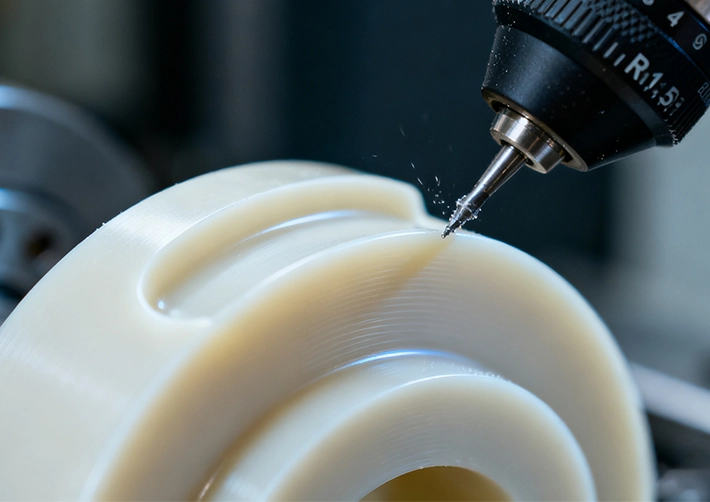
  • Tooling: Sharp O-flute/polished carbide; positive rake to shear cleanly.
  • Heat control: Air blast or light mist to avoid melting and chip-weld.
  • Feeds/Speeds: Higher feed, modest step-over; steady chip load prevents fuzz.
  • Moisture: Nylon absorbs water—size and flatness can drift; condition stock when critical.
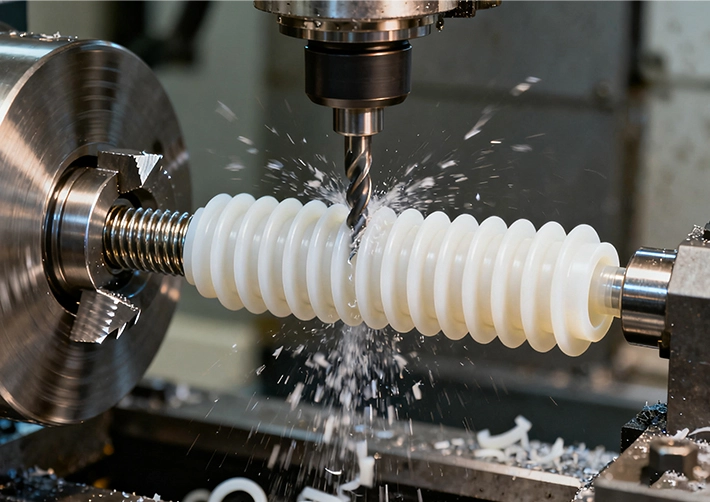
Nylon CNC machining overview with O-flute tool and air blast
Nylon machinability, wear parts and burr control

Key Considerations

Use short stick-out and firm workholding for thin walls. Climb milling gives cleaner edges. Plan a light finish pass for cosmetic faces; deburr gently to avoid whitening.

For tight-tolerance assemblies, rough → rest/condition (or dry at low temp per spec) → finish passes to stabilize dimensions.

Precision Nylon CNC Machining

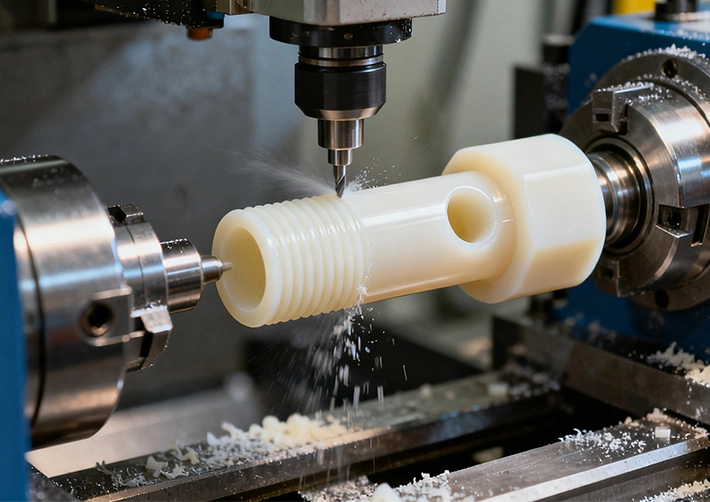
Nylon 3/4/5-axis CNC milling with O-flute cutters and vacuum fixturing

3, 4, 5-Axis CNC Milling

Fast pocketing and contouring for guides, cams, and housings. Balanced holders, sharp tools, and air blast produce uniform textures ready for assembly.

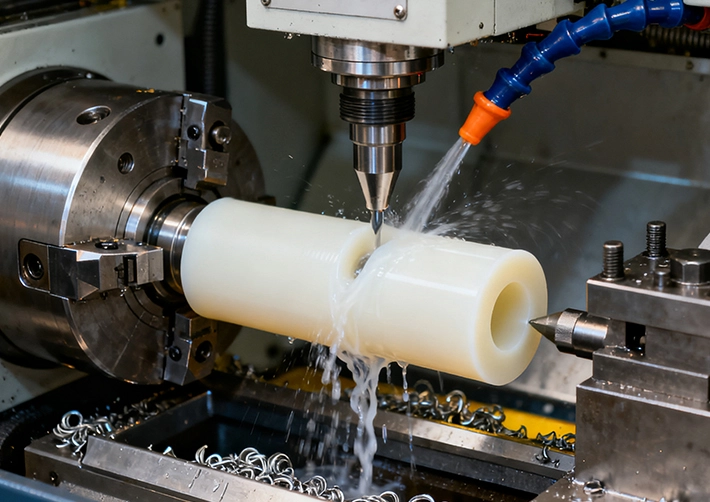
Nylon CNC turning and mill-turn for bushings, pulleys, rollers

CNC Turning & Mill-Turn

Smooth OD/ID finishes for bushings and rollers. Sharp inserts with generous chip-breaker geometry reduce fuzz and hold consistent diameters.

Nylon CNC Machining Capabilities

StandardsDetail
Max Part Size (X/Y/Z)2300 × 1500 × 600mm
Minimum Feature Size⊘1mm
Wall Thickness0.25mm
Tolerance+/-0.01
Surface Finish (as milled)Ra0.5–Ra3.2
Standard Lead Time3 working-days for rapid prototyping
Pricing LevelTo be confirmed after design review
Type of MachineGantry CNC / 3-4-5-Axis CNC / Mill-Turn Compound CNC / Swiss-Type CNC / Turning Machine...etc...
Common Grades Nylon 6/6 (PA66), Nylon 6 (PA6), Nylon 12 (PA12), Glass-Filled Nylon

Nylon (PA) Grades

Pick the right balance of strength, moisture resistance, and wear performance.

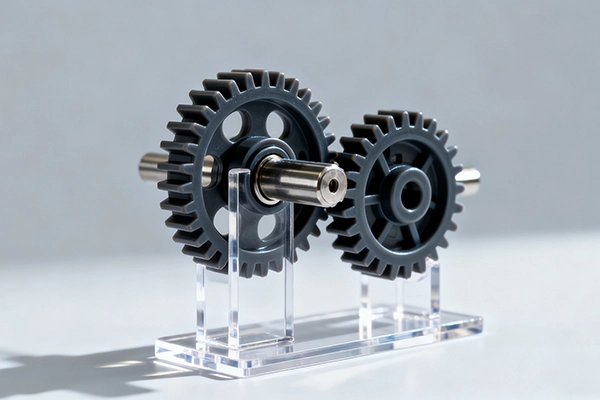
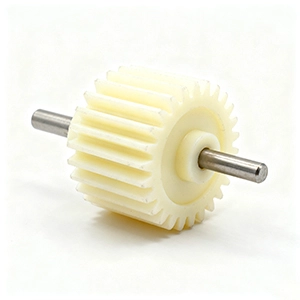
Nylon 6/6 precision gear with clean tooth profile (3:2)

Nylon 6/6 (PA66)

  • Higher strength & heat resistance vs PA6
  • Good wear & fatigue for gears and cams
  • Machines cleanly with sharp tools
  • Moderate moisture uptake

Rough then condition/dry if needed → finish passes for tight assemblies.

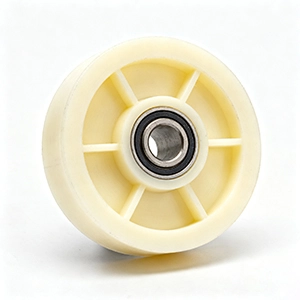
Nylon 6 machined roller with smooth OD finish (3:2)

Nylon 6 (PA6)

  • Tough, impact-resistant, easy to machine
  • Great for rollers, bushings, guides
  • More moisture absorption than PA66
  • Stable with proper conditioning

Use sharp tools, steady feed; plan a skim pass on show faces.

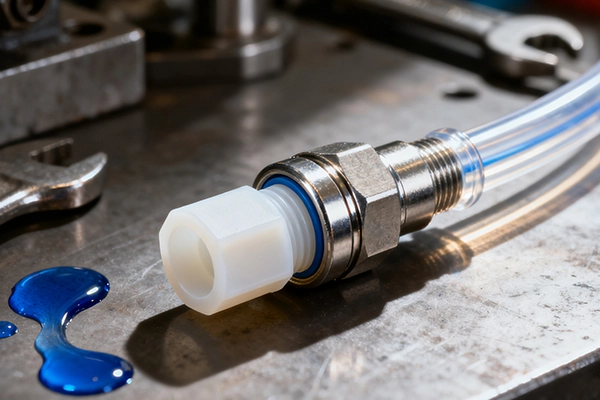
Nylon 12 machined manifold/cover with fine finish (3:2)

Nylon 12 (PA12)

  • Lowest moisture uptake among common nylons
  • Good dimensional stability
  • Lower modulus; good impact resistance
  • Seals, covers, fluid-handling parts

Great choice for tight flatness and stable fit in humid environments.

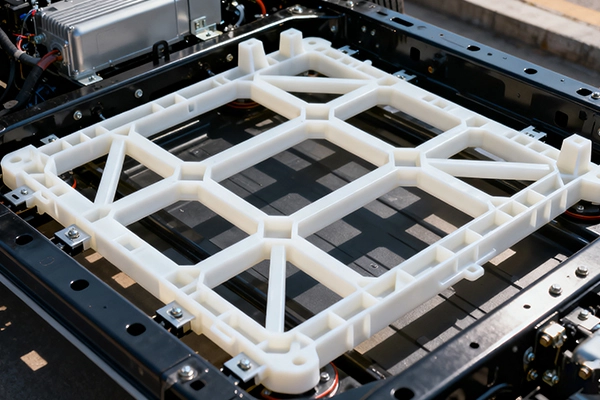
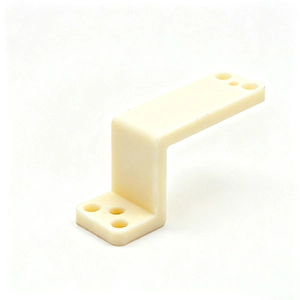
Glass-filled nylon structural bracket (3:2)

Glass-Filled Nylon

  • Higher stiffness & heat deflection
  • Abrasive—use coated carbide
  • Great for structural brackets, housings
  • Dimensional stability under load

Reduce SFM and maintain air/mist to control heat; expect higher tool wear.

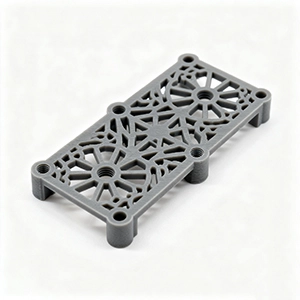
Display of Our Nylon CNC Machining Parts

Material Machining Guide

Nylon CNC Machining: Selection, Process, and Quality Notes

Nylon is commonly considered for wear pads, rollers, bushings, gears, and durable mechanical plastic parts. It is selected because of wear resistance, toughness, and fatigue performance. For CNC machining, the final result depends on material grade, toolpath strategy, tolerance allocation, surface finish, and inspection planning.

Good Fit

Use Nylon when the application benefits from wear resistance, toughness, and fatigue performance and the design can be machined with stable workholding.

Watch Points

Confirm wall thickness, hole depth, thread callouts, burr control, cosmetic surfaces, and finish buildup before production.

Quality Planning

Define critical dimensions, inspection method, tolerance class, and documentation requirements before the first article.

TopicPractical Guidance for Nylon
Design reviewSend 3D CAD, 2D drawings, material grade, finish notes, quantity, and critical-to-function dimensions.
Machining processMTSPi can review whether milling, turning, drilling, tapping, boring, or a combined route is best for the geometry.
Surface finishPlan cosmetic and functional finishing early, especially where coating thickness, polishing, or deburring affects fit.
InspectionUse calipers, micrometers, gauges, CMM, or visual inspection based on tolerance risk and assembly function.

FAQ

Is Nylon suitable for CNC machining?

Yes, Nylon can be CNC machined when the grade, geometry, tooling, workholding, and tolerance requirements are planned correctly.

What should I send for a Nylon machining quote?

Send CAD files, 2D drawings, quantity, material grade, finish requirements, tolerance notes, and any inspection or packaging needs.

Can Nylon parts be finished after machining?

Often yes. The right finish depends on the material family and part function. Confirm finish thickness and cosmetic expectations before machining.

How do I reduce cost on Nylon CNC parts?

Use practical tolerances, avoid unnecessary deep pockets or tiny holes, simplify setups, and reserve tight control for functional features.

Request A Quote

We'll Send You Back with Price Immediately!

DEC 1-31

XMAS SPECEIL

Up to

40% off

Nylon CNC Machining

We'll Send You Back with Price Immediately!