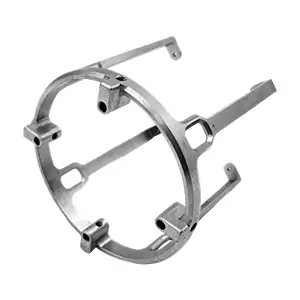
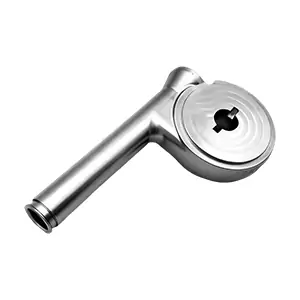
Low-Volume CNC Machining Services

Precision Low-Volume CNC Machining tailored for prototypes and small batches.
Fast turnaround, tight tolerances, and cost-effective production solutions.

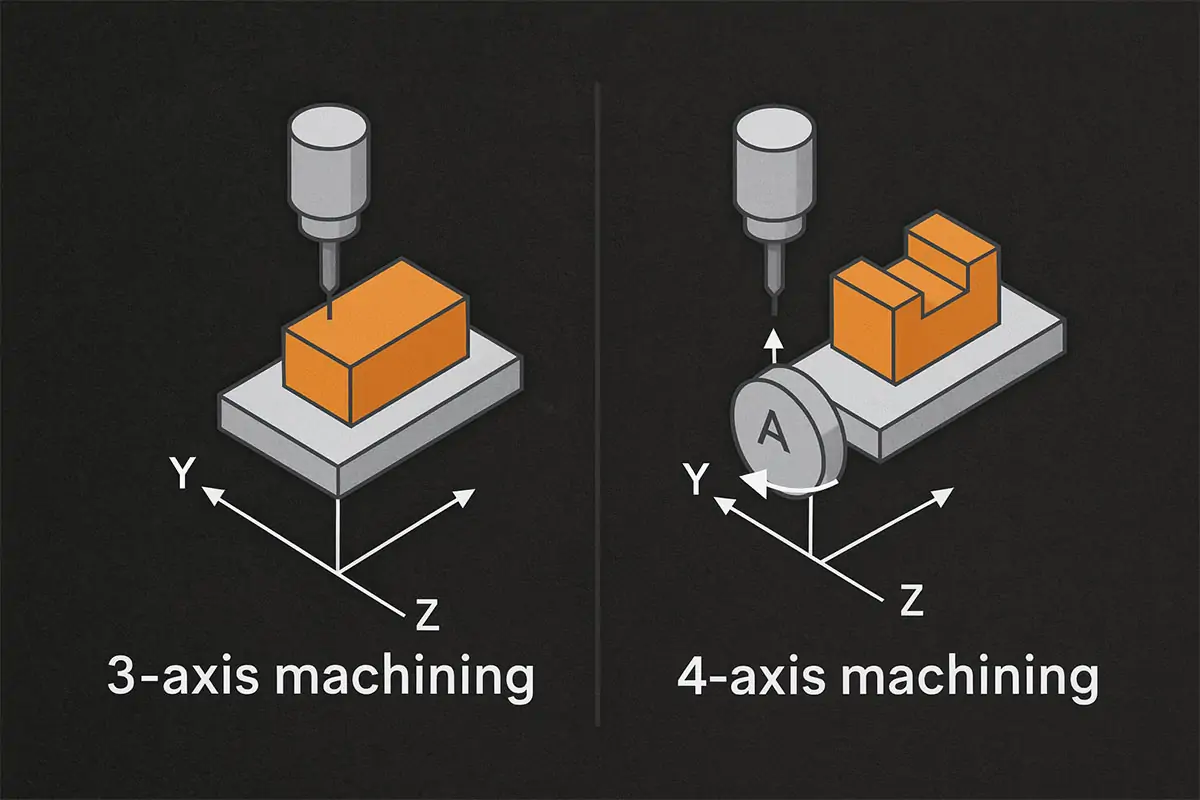
3-axis vs 4-axis CNC machining: XYZ milling compared with A-axis rotary positioning

What is the difference between 3 and 4 axis CNC?

3-axis CNC mills move the tool in X, Y and Z to machine one face at a time. 4-axis adds an A-axis rotary (on DATRON machines, the workpiece rotates around the X-axis). In indexed 4-axis, the A-axis rotates while not cutting; the brake engages and machining resumes at the new angle. In continuous 4-axis, cutting occurs as the A-axis rotates, enabling wrapped and helical features in a single operation.

  • Setup reduction: 4-axis lets you machine up to four sides in one fixture, minimizing re-clamps.
  • Capability: 3-axis excels at flats, pockets and profiles; 4-axis adds radial holes, slots, keyways and engraved text around the circumference.
  • Throughput & accuracy: Fewer setups shorten cycle time and reduce cumulative error compared to multiple 3-axis re-positions.
Typical use: Choose 3-axis for prismatic faces and simple contours; choose 4-axis for parts needing features around a cylinder, multi-face access, or continuous wrapped toolpaths.

Our Advantages

Cost Efficiency

Prototype-first fixturing and one-setup machining reduce NRE and total iteration cost.

Short Lead Times

Quick-turn scheduling and in-house finishing deliver parts in 1–3 days.

Stable Accuracy

CNC with in-process checks holds tight features—typical ±0.01–0.02 mm.

Material Flexibility

Aluminum, stainless, alloy steels, brass, titanium, and engineering plastics (ABS, PC, POM, PEEK).

Scalable Production

Re-usable CAM and fixtures scale easily from single pieces to pilot runs.

Consistent Finish

Multi-face machining avoids blend lines; Ra 1.6–3.2 µm typical. Anodize, plating, passivation available.

Materials for MEITESI CNC Machining

Surface Finishes for MEITESI CNC Machining

YUANYI provides surface finishes for 3-axis parts, enhancing appearance, smoothness, durability, and hiding tool marks for high-quality results.

Black Oxide Coating
Black Oxide Coating creates a smooth black surface that enhances appearance and provides mild corrosion resistance, widely used on steel parts for improved durability and a professional finish.
Color Anodized
Color Anodized treatment forms a durable oxide layer with vibrant colors, enhancing both corrosion resistance and decorative appeal for aluminum parts.
E-Coating
E-Coating provides a uniform, durable, and corrosion-resistant finish through an electro-deposition process, ideal for complex metal parts and automotive components.
Gold Plating
Gold Plating offers excellent conductivity, corrosion resistance, and a luxurious appearance, making it ideal for electronic components and decorative finishes.
Nitriding
Nitriding hardens the surface by diffusing nitrogen into the metal, enhancing wear resistance, fatigue strength, and corrosion protection without altering core properties.
Powder Coating
Powder Coating creates a tough, uniform, and decorative finish that resists scratches, corrosion, and fading, commonly used for metal parts and outdoor applications.
Sand Blasting
Sand Blasting cleans and textures the surface using high-speed abrasive particles, improving coating adhesion and giving parts a smooth, matte appearance.
Silver Plating
Silver Plating enhances electrical conductivity, corrosion resistance, and appearance, making it ideal for electrical connectors, contacts, and decorative metal parts.

Low-Volume CNC Production for Custom Metal and Plastic Parts

Low-volume CNC production is the bridge between prototype approval and full-scale manufacturing. It is useful when buyers need small batches of accurate metal or plastic parts without hard tooling, or when demand is uncertain and flexibility matters more than mass-production tooling.

MTSPi CNC supports low-volume machining with controlled setup, material guidance, surface finishing, inspection, and packaging. We help buyers define which dimensions are critical, which finish standards must be repeated, and how the batch should be inspected before shipment.

Best-fit projects

  • Pilot runs, bridge production, spare parts, custom hardware, equipment components, and short product launches
  • Machined aluminum, stainless steel, brass, copper, titanium, and engineering plastic components
  • Orders where flexibility, revision control, and quality evidence matter

Production planning

  • Fixture strategy for repeatable small batches
  • Material purchasing, finish coordination, and inspection planning
  • Revision tracking before repeat orders

Quality and delivery

  • First article checks, sampling inspection, or buyer-defined reports
  • Consistent packaging for finished and cosmetic parts
  • Support for repeat batches after approval

Low-Volume CNC Production Planning

Buyer needMTSPi CNC supportTypical use case
Pilot runProduce a small batch after prototype approvalValidate design, assembly, supplier capability, and customer demand
Bridge productionSupply parts while tooling or mass production is not readyKeep projects moving without committing to molds or dies
Custom equipment partsMachine accurate parts for industrial systems or automationFixtures, brackets, housings, plates, shafts, and connectors
Repeat small batchesUse controlled setup and inspection notes for recurring ordersStable purchasing for low-demand or specialized parts

Engineering and Sourcing Notes

Send CAD files, 2D drawings, material grade, quantity, tolerance notes, finish requirements, and inspection requirements. MTSPi CNC can review manufacturability, cost drivers, and quality risks before machining.

Related CNC Service Pages

Use these related pages to compare manufacturing routes, material choices, cost control, and inspection requirements.

FAQ

What is low-volume CNC production? It is small-batch machining for custom parts when buyers need production-quality parts without mass-production tooling.

When should I choose low-volume production? Choose it for pilot runs, bridge production, custom equipment parts, market tests, spare parts, and specialized components with limited demand.

How do you keep repeat batches consistent? Use approved drawings, revision control, fixture notes, material and finish requirements, inspection plans, and packaging instructions for repeat orders.


MEITESI CNC Parts Gallery

Request A Quote

We'll Send You Back with Price Immediately!

DEC 1-31

XMAS SPECEIL

Up to

40% off

Low-Volume Production

We'll Send You Back with Price Immediately!