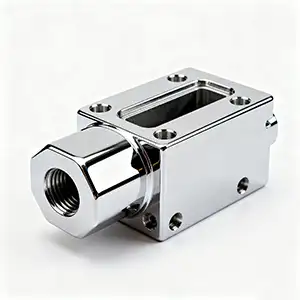
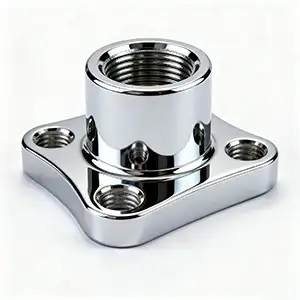
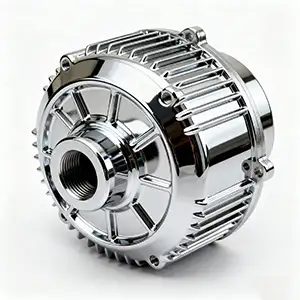
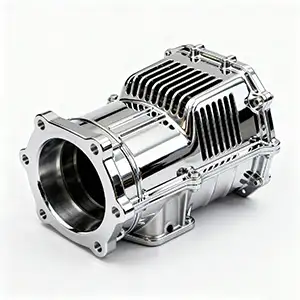
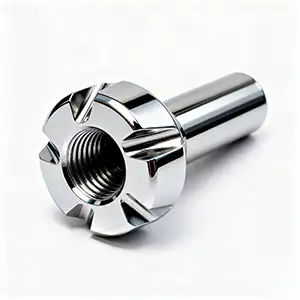
Chrome plating provides superior hardness, corrosion protection, and a brilliant reflective finish,
making it ideal for both functional and decorative CNC applications.
CNC chrome plating services enhance wear resistance, provide long-lasting corrosion protection, and deliver a mirror-like finish. Commonly used in automotive, aerospace, hydraulics, and precision industrial machinery.

Chrome plating deposits a thin layer of chromium onto a metal surface—typically over a nickel undercoat to improve adhesion and corrosion defense. The chromium layer raises surface hardness, lowers friction, and provides a durable, mirror-like finish. Thickness can be tuned to the job so parts gain both performance and a premium appearance.
There are two common types: decorative chrome, a thin deposit aimed at appearance and basic protection for trim and consumer hardware; and hard chrome, a thicker build optimized for wear resistance and dimensional restoration on rods, cylinders, molds, and dies. Hard‑chromed parts are often ground or honed to final size for precision fit.
Provides exceptional surface hardness, reducing wear in high-friction applications.
Protects against rust, oxidation, and chemical exposure in demanding environments.
Delivers a bright, reflective, and attractive appearance for both functional and decorative parts.
| Feature | Info |
|---|---|
| Coating Thickness | Decorative: 0.25–0.8 μm, Hard Chrome: 10–500 μm. |
| Surface Finish | Bright, reflective, or matte depending on application. |
| Hardness | Typically 850–1000 HV, providing superior wear resistance. |
| Industries | Automotive, aerospace, hydraulics, industrial tooling. |
Chrome Plating for CNC Machined Parts helps CNC part buyers add bright appearance, hardness, wear resistance, and corrosion protection where suitable. MTSPi CNC reviews the machined geometry, material grade, tolerance-sensitive areas, cosmetic expectations, and inspection needs before recommending a finishing route.
This page is written for sourcing and engineering teams that need practical finishing decisions, not just a process name. Share drawings, material, quantity, finish standard, color or texture target, masking requirements, and critical dimensions with the RFQ.
| Buyer question | Why it matters | Practical action |
|---|---|---|
| Material compatibility | Confirm that the material and alloy can accept the finish reliably | Avoid adhesion, color, hardness, or corrosion problems |
| Dimensional impact | Review coating thickness, edge build-up, holes, threads, masking, and critical fits | Protect assembly dimensions after finishing |
| Appearance standard | Define visible faces, gloss, matte texture, color range, and acceptable marks | Keep cosmetic expectations realistic |
| Inspection needs | Select visual checks, thickness checks, hardness checks, adhesion tests, or sample approval as needed | Match evidence to part function and buyer risk |
Surface treatment should be planned before final machining whenever possible. Threads, bores, bearing fits, sealing faces, electrical contact areas, and cosmetic surfaces may need different handling. For repeat work, keep a finish sample, color reference, thickness target, and packaging instruction with the drawing revision.
What should I confirm before choosing this finish? Confirm material grade, part function, cosmetic standard, masking needs, tolerance-sensitive surfaces, expected environment, and inspection requirements.
Can MTSPi CNC machine and finish the same parts? Yes. MTSPi CNC can support machining, finishing coordination, inspection, and packaging so the finish plan matches the machined part requirements.
Will surface treatment affect dimensions? Some finishes add thickness, change edges, or affect holes and threads. Critical fits should be marked on the drawing and masking or post-finish checks should be discussed early.