

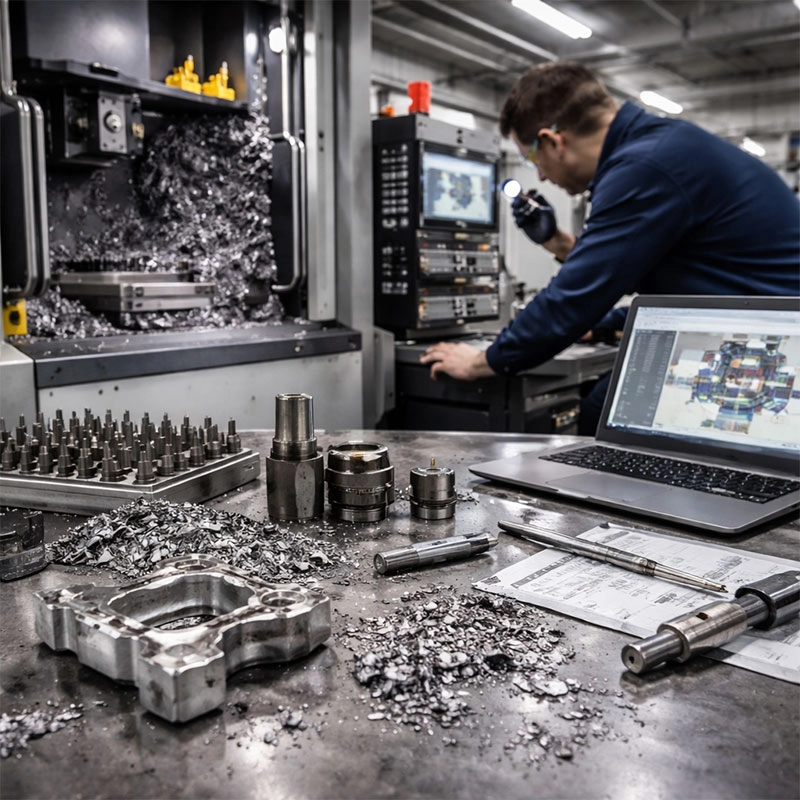
While CNC machining is a cornerstone of modern manufacturing, it’s not a perfect solution for every project. This article explores the less-discussed drawbacks of CNC technology, from high initial costs to design limitations, to help you make a fully informed decision for your production needs.
Exploring the Limitations and Drawbacks of CNC Machining
Hey there! If you’re considering CNC machining for a project, you’ve probably heard all about its amazing precision and repeatability. And it’s true—computer numerical control has revolutionized how we make things. But today, I want to have a friendly chat about the other side of the coin. Every technology has its trade-offs, and understanding the disadvantages of CNC milling and turning is just as important as knowing its strengths. Let’s pull back the curtain on some of the hidden costs and constraints you should be aware of before you dive in.
1. The High Initial Investment
Let’s start with the big one: cost. When we talk about the drawbacks of CNC machining, the upfront financial commitment is often the most significant barrier. It’s not just about buying a machine; it’s about building an entire ecosystem around it.
Machine and Tooling Costs
The price tag on a high-quality industrial CNC mill or lathe can be staggering. We’re talking tens to hundreds of thousands of dollars. Beyond the machine itself, you need a library of cutting tools, workholding fixtures like vises and chucks, and a steady supply of coolants and lubricants. A friend who runs a small job shop once told me, “Buying the machine felt like buying a house. Outfitting it felt like furnishing one!” This is a key part of the CNC machining pros and cons analysis—the “con” of capital expenditure is very real.
Software and Skilled Labor
Your shiny new machine is useless without the brains to run it. You’ll need Computer-Aided Manufacturing (CAM) software to translate your designs into machine instructions (G-code). Licenses for professional-grade software are a major ongoing cost. More importantly, you need skilled programmers and operators. Finding someone who truly understands feeds, speeds, toolpaths, and machine kinematics is challenging and expensive. This human element is a critical, and often overlooked, limitation of CNC technology.
2. Design and Geometry Limitations
CNC machining is a subtractive process, meaning it carves your part out of a solid block. This fundamental approach creates some inherent CNC manufacturing disadvantages related to what shapes you can actually create.
The Challenge of Internal Geometry
Imagine trying to carve the inside of a hollow ball with a straight tool—it’s nearly impossible. That’s the core issue. CNC tools are rigid and typically access the workpiece from the top or sides. This makes features like internal channels, undercuts, or complex internal lattices extremely difficult or sometimes impossible to produce without designing multiple parts for assembly. If your design has lots of hidden or enclosed cavities, you might hit a wall. This is a classic example of a CNC machining design constraint.
Inherent Material Waste
Since you start with a solid block and remove everything that isn’t your part, you generate chips—a lot of them. For parts with a high buy-to-fly ratio (like an aerospace bracket made from a large billet of titanium), the material waste can be significant and costly. This isn’t just about money; it’s an environmental consideration too. While recycling chips is possible, the energy and material loss from subtractive manufacturing drawbacks is a valid point against CNC for certain applications, especially when compared to additive processes like 3D printing.
3. Operational and Practical Drawbacks
Beyond cost and design, the day-to-day reality of running CNC equipment comes with its own set of challenges. These are the practical problems with CNC machines that shop managers deal with regularly.
Setup and Programming Time
CNC is fantastic for repeat production, but for one-off prototypes or very small batches, the setup time can kill your efficiency. You have to design the part, program the toolpaths, simulate the run, select and set up tools, and fixture the workpiece perfectly. For a single part, this preparatory work can take longer than the actual machining time. This is why for quick prototypes, many makers still turn to manual machining or other processes. The question “what are the negatives of CNC milling?” often has “lead time for first articles” as a top answer.
Maintenance and Potential Downtime
CNC machines are complex mechanical systems with spindles, ball screws, linear guides, and a sophisticated control system. They require regular, preventative maintenance—lubrication, calibration, and component inspection—to maintain their famed accuracy. When a critical component fails, the machine is down, and production stops. Diagnosing and repairing these systems often requires specialized technicians, leading to costly downtime. It’s a reminder that the precision of computer numerical control machining comes with a need for meticulous care. For reliable information on machine maintenance standards, you can refer to resources from institutions like the National Institute of Standards and Technology (NIST).
4. Making an Informed Choice
So, after all this, is CNC machining a bad choice? Absolutely not! It’s an incredible technology. The goal here isn’t to scare you away but to empower you with a balanced view. Knowing these CNC machining challenges allows you to ask the right questions: Is my design suitable for subtractive manufacturing? Does my production volume justify the setup and programming time? Can my budget handle the machine investment and skilled labor?
For high-precision, high-strength metal parts in medium to high volumes, CNC is often unbeatable. But for highly complex organic shapes in low volume, 3D printing might be better. For very simple parts in huge quantities, injection molding could win on cost per part. My advice? View CNC as one powerful tool in a vast manufacturing toolbox. By understanding its limitations and drawbacks, you can use it more effectively and know when to choose a different tool for the job. Always start with your part’s requirements and work backward to the process—not the other way around.