

Categories
Blog CNC Milling & Turning

CNC Swiss Machining Guide: How It Makes Small Precision Parts

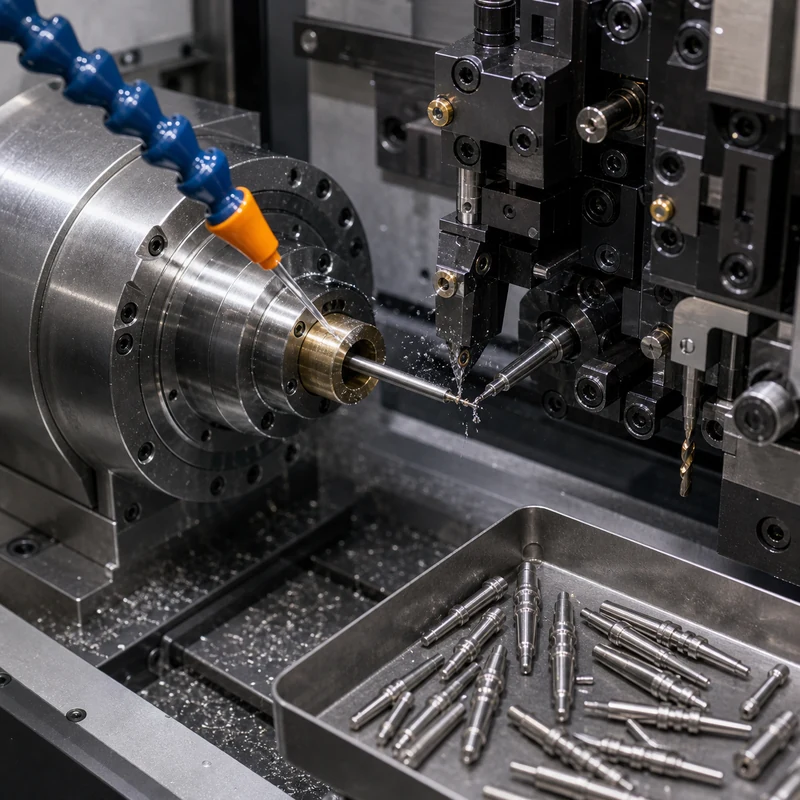
CNC Swiss machining is built for small parts that need tight concentricity, fine details, and repeatable production. Instead of holding a long bar far away from the tool, a Swiss-type lathe supports the material close to the cutting zone with a guide bushing. That simple difference helps reduce deflection and makes the process valuable for pins, shafts, connectors, medical components, and other slender parts.

For buyers comparing precision turning options, Swiss machining is usually worth considering when the part is small, long compared with its diameter, or filled with cross holes, grooves, flats, threads, and micro features. MTSPi can review drawings early and suggest whether a Swiss-type machining route or a conventional turning setup is more efficient.

How CNC Swiss Machining Works

A Swiss machine feeds bar stock through a sliding headstock. The guide bushing supports the workpiece near the cutting tools, while turning tools, drills, and live milling stations remove material in a programmed sequence. Many Swiss machines also use a sub-spindle, so the back side of the part can be completed before cutoff.

  • The bar is supported very close to the cutting point, which limits vibration on thin sections.
  • Turning, drilling, slotting, milling, threading, and cutoff can often happen in one cycle.
  • Automatic bar feeding makes the process strong for repeat parts and longer production runs.
  • Because several tools are available at once, fewer secondary setups are usually required.

Where Swiss Turning Performs Best

Part Requirement Why Swiss Machining Helps
Small diameter shafts and pins The guide bushing keeps slender stock stable during cutting.
Medical screws, sleeves, and miniature fittings Fine features can be produced with strong repeatability.
Electrical contacts and connectors High-volume bar-fed production reduces handling and variation.
Parts with radial holes or flats Live tooling can add features without moving the workpiece to another machine.

Design Notes for Better Results

Swiss machining rewards clean drawings. Identify critical diameters, true position requirements, thread callouts, material grade, surface finish, and any features that must align with each other. Avoid putting extremely tight tolerances on every dimension; reserve them for functional areas, because unnecessary precision can raise cost without improving performance.

  • Use generous corner radii where the design allows.
  • Keep deep micro holes realistic for tool length and chip evacuation.
  • Confirm whether burr-free edges are required after cutoff, cross drilling, or slotting.
  • For long thin parts, discuss straightness expectations before production.

Swiss Machining vs Conventional CNC Turning

Factor Swiss-Type Turning Conventional Turning
Best part size Small, slender, high-detail components Shorter or larger turned parts
Material support Guide bushing near cutting tools Chuck or collet support farther from the tool
Typical setup Multiple tools and possible sub-spindle Simpler tool arrangement
Main advantage Precision on tiny complex parts Flexible and economical for many general turned parts

Inspection and Finishing

For critical components, inspection should match the risk of the part. Diameter checks, thread gauges, optical measurement, and CMM inspection may all be used depending on geometry. If the part needs anodizing, passivation, or plating, coordinate machining allowances with the surface treatment plan before cutting begins.

Related MTSPi Resources

FAQ

Is Swiss machining only for tiny parts?

It is strongest on small and slender parts, but the right choice depends on diameter, length, features, tolerance, and quantity.

Can Swiss machines cut stainless steel?

Yes. Stainless steel, aluminum, brass, titanium, and many plastics can be machined, with tooling and speeds adjusted to the material.

When should I avoid Swiss machining?

For large, simple, short parts, a conventional CNC lathe may be faster and less expensive.
Categories
CNC Milling & Turning

What Is Swiss Type Machining? Your Friendly Guide to Precision

Ever wondered how tiny, complex parts for watches or medical devices are made with such incredible precision? That’s often the work of Swiss type machining. This friendly guide will walk you through what Swiss screw machining is, why it’s so valuable for precision manufacturing, and how it works in a way that’s easy to understand.

Understanding Swiss Type Machining: A Detailed Overview

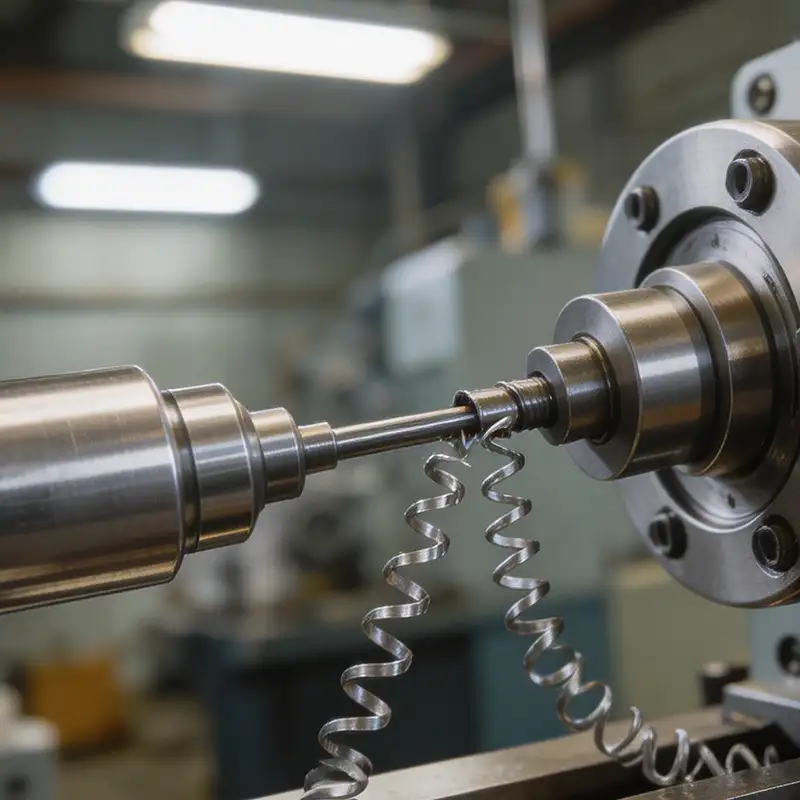
Let’s start with the basics. Swiss type machining, often called Swiss screw machining or using a Swiss lathe, is a specialized form of CNC turning. Its origins are exactly where the name suggests: the Swiss watchmaking industry, where crafting tiny, flawless components was a necessity. Unlike a conventional lathe where the workpiece is fixed and the tool moves, a Swiss screw machine uses a moving guide bushing. The bar stock slides through this bushing, getting support right next to the cutting tool. This simple-sounding difference is the secret to its superpower: exceptional stability and accuracy, especially on long, slender parts.

The Core Principle: How a Swiss Lathe Works

Imagine you’re trying to sharpen a very long, thin pencil. If you hold it at the very end, it will wobble and flex. But if you support it with your fingers close to the tip, you get a clean, precise point. That’s the essence of Swiss-type CNC machining. The guide bushing acts like your supporting fingers, drastically reducing vibration and deflection. This allows for intricate machining operations—like drilling, milling, and threading—on parts that would be too flimsy for a standard CNC lathe. You might hear experts refer to this as sliding headstock turning, which is just another way to describe the same brilliant process.

The Value of Swiss Machining for Precision Work

So, why go through this extra setup? The benefits are a game-changer for specific projects. First and foremost is extreme precision and tight tolerances. We’re talking about holding tolerances within a few microns consistently. This is non-negotiable for industries like medical device manufacturing (think bone screws or surgical tool components) and aerospace, where a tiny flaw can have big consequences. Second, it enables complete machining in one setup. A Swiss-style lathe often has multiple tool stations and live tooling, meaning it can perform turning, milling, and cross-drilling all without an operator moving the part to another machine. This boosts efficiency and, crucially, maintains perfect alignment. If you’re searching for high-volume precision turned parts, this process is often the most cost-effective solution.

Practical Advice: When to Choose Swiss CNC Machining

You don’t need a Swiss machine for every job. Think of it as a specialist tool in your workshop. We recommend you consider Swiss screw machining when your part design has these characteristics: it’s long and slender (with a length-to-diameter ratio that’s high), it requires extremely tight tolerances and a superb surface finish, or it needs multiple, complex secondary operations. A classic example is a small shaft with cross-holes, grooves, and threads. Using a conventional lathe for this could mean multiple setups and more room for error. With a Swiss lathe, it’s often one smooth, automated process from bar stock to finished part. For a deeper dive into the capabilities of modern CNC lathes, you can check out this resource from Modern Machine Shop.

Clearing Up Common Misconceptions

Let’s tackle a few myths head-on. A common one is that Swiss-type CNC machining is only for making screws. While it excels at that, its use has expanded far beyond. Today, it produces connectors, pins, nozzles, and countless other components. Another misconception is that it’s always slower than standard turning. For simple parts, yes, a conventional lathe might be faster. But for complex components, the ability to complete everything in one cycle often makes Swiss machining the faster overall choice. Finally, some believe it’s prohibitively expensive. For prototyping a single simple part, that might be true. But for production runs of complex, precision components, the reduced labor, scrap, and secondary processing make it incredibly economical.

Wrapping Up: Is Swiss Machining Right for Your Project?

In summary, Swiss type machining is a precision powerhouse perfect for long, slender, and complex parts that demand the highest accuracy. It’s the go-to method in industries where failure is not an option. When evaluating your next project, ask yourself: Does my part have challenging geometry? Are the tolerances extremely tight? Is the material delicate or the part prone to deflection? If you answered yes, then exploring Swiss screw machine services could be your best next step. It’s a fascinating corner of the CNC world that turns manufacturing challenges into reliable, high-quality solutions.

Request A Quote

We'll Send You Back with Price Immediately!

DEC 1-31

XMAS SPECEIL

Up to

40% off

What Is Swiss Type Machining? Your Friendly Guide to Precision

We'll Send You Back with Price Immediately!