

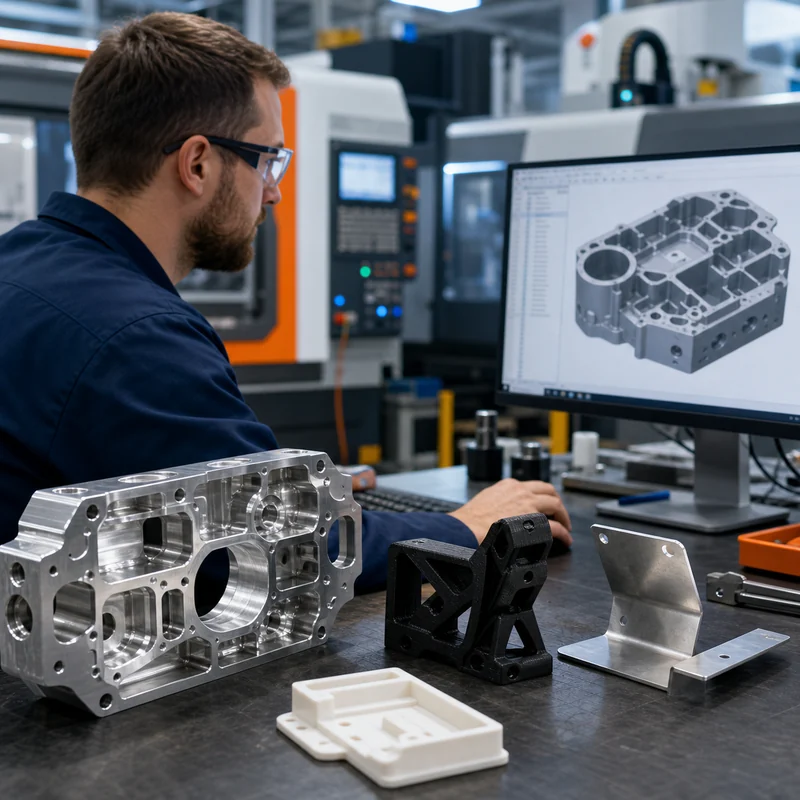
Rapid prototyping is not one single manufacturing method. It is a decision process: choose the fastest, most reliable way to turn a design into a physical part that can be tested, assembled, measured, shown to customers, or prepared for production. The right choice depends on what the prototype must prove, not only on which process is fastest.
For custom parts, the main options include rapid prototyping services, CNC machining, 3D printing, sheet metal fabrication, urethane casting, and prototype tooling. This guide explains how to compare them from an engineering and sourcing point of view, especially when the final product may later require CNC milling, CNC turning, or low-volume production.
Quick Answer: Match the Process to the Question You Need to Answer
| Prototype Goal | Best Starting Process | Why It Works |
|---|---|---|
| Check shape, size, and assembly space | 3D printing | Fast turnaround and low setup cost for complex geometry |
| Test strength, threads, sealing faces, and real material behavior | CNC machining | Uses production-grade metals and plastics with tight dimensions |
| Validate brackets, covers, panels, and enclosures | Sheet metal fabrication | Matches formed metal behavior, bend radii, holes, and hardware |
| Review molded-part look and flexible plastic behavior | Urethane casting or prototype tooling | Useful for soft-touch, colored, or molded-like samples |
| Prepare for pilot production | CNC machining or bridge tooling | Supports repeatable batches before full production tooling |
What Is Rapid Prototyping?
Rapid prototyping is the practice of making physical parts quickly so a team can learn before committing to expensive tooling, large material purchases, or production schedules. A prototype may be a simple visual model, a fit-check sample, a functional part, an engineering validation unit, or a small batch used for market testing.
The word rapid can be misleading. The goal is not always the shortest lead time. Sometimes the best prototype takes slightly longer because it gives better data. A CNC machined aluminum housing, for example, may be more valuable than a quick printed model if the team needs to test threads, flatness, heat transfer, or sealing surfaces.
The Main Rapid Prototyping Processes
1. CNC Machining
CNC machining removes material from a solid block, plate, rod, or extrusion. It is often the strongest choice when prototypes must use real production materials such as aluminum, stainless steel, brass, copper, titanium, ABS, Delrin, PEEK, or nylon. MTSPi commonly uses this route for precision parts, housings, brackets, shafts, fixtures, and functional prototypes.
- Best for: functional prototypes, tight tolerances, threads, metal parts, engineering plastic parts, heat sinks, housings, and parts that will later be machined in production.
- Advantages: real material properties, good surface finish, strong dimensional control, many finish options, and easy transition to low-volume production.
- Limitations: internal sharp corners require radii, very complex hollow geometry may need design changes, and cost can rise with deep pockets or long machining time.
2. 3D Printing
3D printing builds parts layer by layer. It is useful for quick design iteration, complex shapes, lightweight structures, internal channels, and early fit checks. Common options include FDM, SLA, SLS, MJF, and metal additive manufacturing. Each process has different accuracy, strength, surface finish, and material behavior.
Use 3D printing when geometry speed matters more than final material equivalence. For parts with critical mounting surfaces, threads, bearing fits, or sealing faces, printed prototypes may still need inserts, post-machining, or a later CNC version.
3. Sheet Metal Prototyping
Sheet metal prototyping is ideal for covers, panels, chassis parts, brackets, shields, clips, and electrical enclosures. It can validate flat patterns, bends, hardware positions, PEM inserts, and assembly clearance. If the final product is sheet metal, a printed block model cannot fully replace a bent metal prototype.
- Best for: brackets, enclosures, mounting plates, protective covers, and formed metal components.
- Watch points: bend radius, grain direction, minimum flange length, hole-to-bend distance, and finish requirements.
4. Urethane Casting
Urethane casting uses silicone molds to produce small batches of plastic-like parts. It is useful for visual prototypes, sales samples, housings, colored parts, soft-touch components, and designs that need a molded appearance before injection tooling is ready. It is not the same as injection molding, but it can be a practical bridge for presentation and low-volume needs.
5. Prototype Injection Molding and Bridge Tooling
Prototype tooling is used when the team must test molded material, gate marks, shrinkage, living hinges, snap fits, or early production quantities. Tooling costs more than machining or printing, but it gives better information when the final part will be injection molded.
How to Choose the Right Rapid Prototyping Process
A practical process choice starts with the purpose of the prototype. Ask what decision the part must support. If the goal is visual approval, a fast printed or cast prototype may be enough. If the goal is mechanical testing, real material and accurate geometry matter more. If the goal is production planning, repeatability and inspection data become important.
| Decision Factor | Choose CNC Machining When | Choose 3D Printing When | Choose Tooling or Casting When |
|---|---|---|---|
| Material behavior | The prototype must match aluminum, steel, brass, copper, titanium, or engineering plastic | A substitute material is acceptable for early testing | Molded plastic behavior or appearance is the main concern |
| Tolerance | Holes, mating faces, threads, and flatness must be controlled | Loose fit or visual geometry is acceptable | Mold shrinkage and molded fits must be studied |
| Geometry | Features can be accessed by cutting tools | Complex internal geometry or organic forms are important | Part is designed as a molded component |
| Quantity | One piece to hundreds of parts | One piece to small batches | Dozens to thousands depending on tool strategy |
| Surface finish | Machined, polished, anodized, plated, or bead blasted finish is required | Layered or post-processed finish is acceptable | Molded-like cosmetic finish is needed |
CNC Machining vs 3D Printing for Rapid Prototypes
CNC machining and 3D printing are often compared because both can produce prototypes without full production tooling. The difference is how close the prototype needs to be to the final part. CNC machining is subtractive, so it starts with a real billet or sheet and produces a part with strong material behavior. 3D printing is additive, so it can produce complex shapes quickly, but layer direction and material substitutes may affect testing.
For example, a printed bracket may confirm shape and assembly clearance, but a machined aluminum CNC machining prototype is better for load testing, thread strength, heat transfer, and final finish review. A printed nylon duct may work for airflow validation, while Delrin CNC machining or nylon machining may be better for sliding wear or dimensional checks.
Cost Drivers in Rapid Prototyping
Prototype cost is controlled by geometry, material, tolerance, finish, quantity, and inspection. A simple part in common aluminum may be affordable by CNC machining. A part with deep pockets, thin walls, many setups, tight GD&T, and cosmetic anodizing will cost more. A printed part with large volume, expensive resin, support removal, and finishing can also become costly.
- Reduce unnecessary tight tolerances on non-critical features.
- Use standard material sizes when possible.
- Avoid very deep narrow pockets unless they are functional.
- Add radii that match practical cutting tools.
- Separate cosmetic requirements from functional requirements on drawings.
- Group similar prototypes to reduce setup and communication time.
Materials for Rapid Prototyping
Material selection should follow the prototype goal. For metal prototypes, aluminum is common because it machines quickly, has good strength-to-weight ratio, and accepts finishes such as anodizing. Stainless steel is chosen for corrosion resistance and strength. Brass and copper are chosen for electrical, thermal, or decorative requirements. Titanium is chosen when strength-to-weight and corrosion resistance matter. You can compare options in the CNC machining materials section.
For plastics, ABS is useful for general housings and prototypes, Delrin/POM is strong for low-friction precision parts, PEEK is used for demanding heat and chemical environments, and nylon is common for wear-resistant mechanical components. When the material is uncertain, the safest route is to explain the working environment and let the manufacturer compare options before quoting.
Surface Finishing for Prototype Parts
A prototype may need more than shape. Surface finish can affect appearance, corrosion resistance, wear, electrical behavior, and customer approval. Common options include bead blasting, anodizing, polishing, black oxide, powder coating, nickel plating, chrome plating, passivation, and painting. For finish selection, see MTSPi’s surface treatment guide.
Do not apply a finish only because it looks good on a sample. Finishing changes lead time, cost, dimensions, masking requirements, and sometimes material behavior. For precision prototypes, confirm whether inspection should happen before or after finishing.
From Prototype to Low-Volume Production
A good prototype should make production easier. If a design will later be CNC machined, use prototype feedback to simplify setups, remove unnecessary tight features, choose better stock size, and confirm inspection points. If a design will later be molded, use prototypes to refine wall thickness, ribs, bosses, draft, texture, and assembly features before tooling.
For small batches, rapid prototyping and custom CNC machining services can often bridge the gap between one-off samples and production tooling. This is useful when the design is still changing, the market is being tested, or annual demand does not justify hard tooling yet.
A Practical Selection Workflow
- Define the prototype purpose: visual, fit, functional, regulatory, customer sample, or pilot batch.
- List critical features: tolerances, threads, flatness, sealing faces, surface finish, and loaded areas.
- Choose material based on the test, not only on availability.
- Select a process that answers the key risk with the least wasted time.
- Review DFM feedback before ordering, especially for thin walls, deep pockets, undercuts, and finishing.
- Use inspection results and test feedback to revise the design before the next iteration.
When to Work With MTSPi
MTSPi is a good fit when your prototype needs real engineering material, controlled tolerances, practical DFM feedback, and a path toward repeatable low-volume supply. We can support CNC milled parts, turned parts, plastic prototypes, metal prototypes, surface finishing, and inspection planning for custom components.
To start a project, send your 3D model, 2D drawing, material preference, required quantity, finish, tolerance notes, and target application through the contact page. If you are still comparing processes, MTSPi can help decide whether CNC machining, 3D printing, sheet metal, or another prototyping route makes the most sense.
FAQ
What is the fastest rapid prototyping process?
For simple geometry and early concept checks, 3D printing is often fastest. For real metal or engineering plastic parts with precise dimensions, CNC machining may provide more useful results even if the lead time is slightly longer.
Is CNC machining good for rapid prototyping?
Yes. CNC machining is one of the best rapid prototyping methods when the part needs final-grade material, accurate holes, threads, flatness, surface finish, or functional testing close to production conditions.
What is the cheapest way to make a prototype?
The cheapest route depends on geometry and purpose. A simple printed model may be lowest cost for visual review, while a CNC machined part can be cheaper overall if it prevents failed tests, wrong material assumptions, or redesign later.
Can rapid prototypes be used as end-use parts?
Yes, especially when made by CNC machining or suitable sheet metal fabrication. Many low-volume end-use parts are produced through prototype-style workflows when tooling is not economical.
How do I send files for a rapid prototype quote?
Send a 3D CAD model, 2D drawing if tolerances matter, material choice, quantity, finish, and application notes. You can submit them through MTSPi’s contact page.