

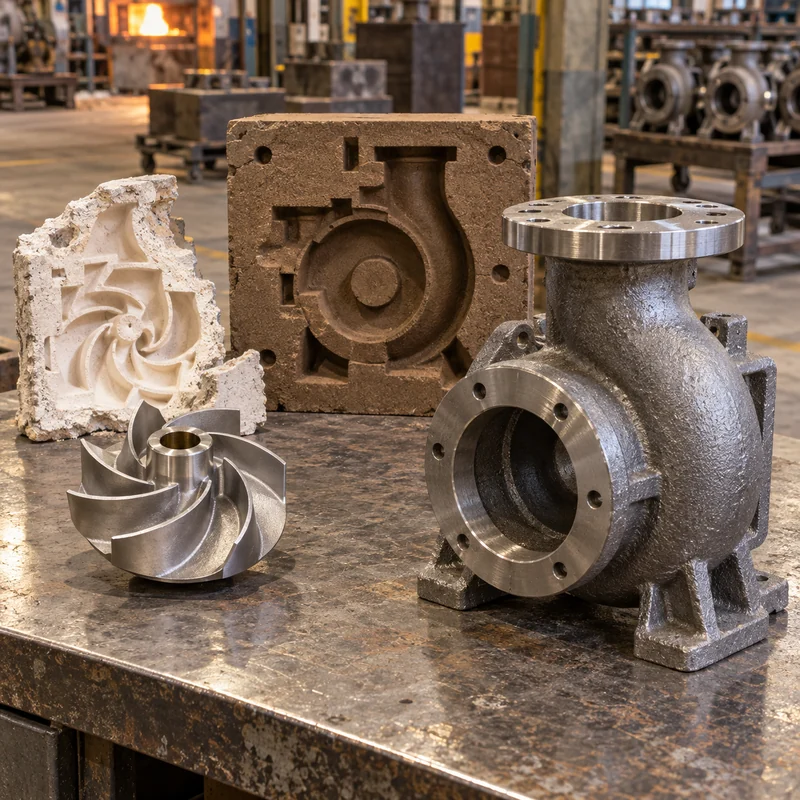
Investment casting generally suits detailed near-net shapes, while sand casting offers a flexible route for many larger or less intricate components. The better choice depends on the finished drawing, alloy, quantity, inspection requirements, and machining needed after casting. Neither process eliminates the need to plan critical bores, sealing faces, datums, or material verification.
This guide compares the routes from the perspective of an engineer purchasing a finished component. It does not assign universal size limits, surface roughness, or tolerances: foundry capability and the particular geometry must establish those values.
Understand the Different Mold Routes
Investment casting uses an expendable pattern, commonly wax, surrounded by a ceramic mold system. After pattern removal and mold preparation, molten alloy fills the cavity. The shell is removed after solidification, and the casting is separated, cleaned, and processed as specified.
Sand casting forms a cavity in a sand-based mold using a pattern or another qualified mold-making route. Cores can create internal passages. The mold is broken away after casting. The Steel Founders’ Society of America describes geometry, patternmaking, coremaking, molding, pouring, and cleaning as key stages; further operations depend on the purchase specification.
Separate Cast Features From Machined Interfaces
Mark the drawing to show features that can remain as cast and those requiring machining. A decorative contour may be acceptable as cast while a bearing bore, gasket face, threaded port, or assembly datum needs a controlled finishing operation. Avoid specifying machining-level requirements on every surface without a functional reason.
For each finished interface, define the datum scheme, required stock, cutter access, and inspection method. The casting supplier and machining supplier need compatible assumptions. A near-net blank with insufficient stock in one location can be unusable despite excellent appearance elsewhere.
Compare Practical Selection Factors
| Decision | Investment casting consideration | Sand casting consideration |
|---|---|---|
| Fine external detail | Often attractive for detailed near-net geometry | Review mold method and whether detail needs machining |
| Part envelope | Check shell handling, pouring, and foundry capability | Often worth evaluating for large components |
| Internal passages | Core design and removal still require review | Core support, position, and removal are central issues |
| Finished interfaces | May reduce some machining scope | Plan stock and setups for required precision |
| Production economics | Pattern and shell work affect cost and lead time | Pattern, molding method, and core complexity affect economics |
Use the table to generate supplier questions rather than selecting a process automatically. A simple small part may not justify investment casting, while a complicated larger part may still be feasible through a specialized investment foundry.
Review Geometry and Solidification Together
Large section changes, isolated heavy masses, sharp internal corners, and poorly supported features can complicate filling and solidification. Ask the foundry to review wall transitions, fillets, feeding, and the proposed part orientation. The shape must work with the selected alloy and mold system.
Gates, risers, and cutoff locations also affect the finished part. Agree where remnants may remain and where removal must be controlled. Keep gate-removal work away from critical cosmetic or functional interfaces where practical, and document any permitted blending or repair.
Select Alloy and Heat Treatment Before Comparing Prices
Use a specific alloy designation and applicable material standard rather than asking for steel or aluminum alone. Required mechanical properties, corrosion exposure, operating temperature, weldability, and heat-treatment condition can narrow the feasible processes and suppliers.
Define whether test results apply to separately cast specimens, attached coupons, or the component itself. Those approaches do not establish identical evidence. If a casting will be heat treated before machining, plan the dimensional and hardness checks at the appropriate stage.
Plan CNC Machining Around Reliable Datums
The first setup must establish a useful relationship between the as-cast geometry and the final interfaces. Specify locating areas and accessible surfaces, and review how casting variation affects clamping. A blank that rocks on an uncontrolled surface can create inconsistent material removal.
Discuss milling of casting interfaces with the blank model, finished model, alloy condition, and inspection requirements. For rotational features, the turning process overview helps frame questions about bores, faces, and concentric surfaces. Confirm scope and machine capacity before finalizing the route.
Choose Inspection From the Failure Consequences
Dimensional inspection, visual checks, material identification, mechanical testing, and nondestructive examination answer different questions. Define the required method, coverage, acceptance criteria, and reporting. A statement such as X-ray available is not an acceptance standard.
For pressure-containing, fatigue-sensitive, or highly loaded parts, involve the responsible engineer in selecting acceptance requirements. Agree how discontinuities, weld repairs, and rework are handled. Test records should trace to the relevant heat, lot, and revision when that evidence is required.
Compare Delivered Cost Rather Than Casting Price
Include tooling, samples, casting, heat treatment, straightening where permitted, machining, inspection, finish, packaging, freight, and expected scrap. A more expensive blank can be economical if it removes substantial machining and inspection work; a lower-cost casting may win when its extra stock is easy to remove.
Request comparable quantities and releases. Separate one-time tooling from recurring unit cost, clarify ownership and maintenance, and ask how design changes affect the existing pattern equipment. There is no universal break-even quantity between these two processes.
Release a Coordinated First Article
Approve the casting and machining drawings together. Record the alloy, treatment, process route, datums, inspection plan, and approved deviations. Review a first article against the actual assembly, particularly where an as-cast profile sits close to a machined mounting feature.
If the first article requires a geometry change, identify whether it affects the pattern, shell, core, machining fixture, or inspection program. Keep the change record with both suppliers so the next lot does not combine mismatched revisions.
Frequently Asked Questions
Is investment casting always more accurate?
It often offers advantages for detail and near-net shape, but actual dimensional capability depends on geometry, alloy, tooling, and process control. Obtain a feature-specific commitment.
Does sand casting always cost less?
No. Compare the finished component including cores, machining, inspection, tooling, and the order quantity.
Can either process deliver precision bearing bores directly?
Do not assume so. Discuss the fit and verification requirements and plan machining where necessary.
What does MTSPi need for a machining review?
Supply the blank and finished drawings, material condition, stock allowance, critical interfaces, quantity, and required reports through the manufacturing enquiry page.