

Categories
Manufacturing Process Comparisons

CNC Milling vs. Turning: Which Process Is Right for Your Project?

Choosing between CNC milling and CNC turning can be a pivotal decision for your manufacturing project. This guide breaks down the core differences, practical applications, and key factors to help you select the optimal subtractive manufacturing process for your specific part geometry and production goals.

Understanding the Core Differences Between CNC Milling and Turning

If you’re new to CNC machining, the terms “milling” and “turning” might sound similar. But in practice, they’re fundamentally different approaches to shaping material. Think of it like the difference between a sculptor and a potter. Both create shapes, but their tools and methods are distinct. Understanding this CNC milling vs CNC lathe distinction is the first step to making an informed decision for your prototype or production run.

How They Work: A Simple Analogy

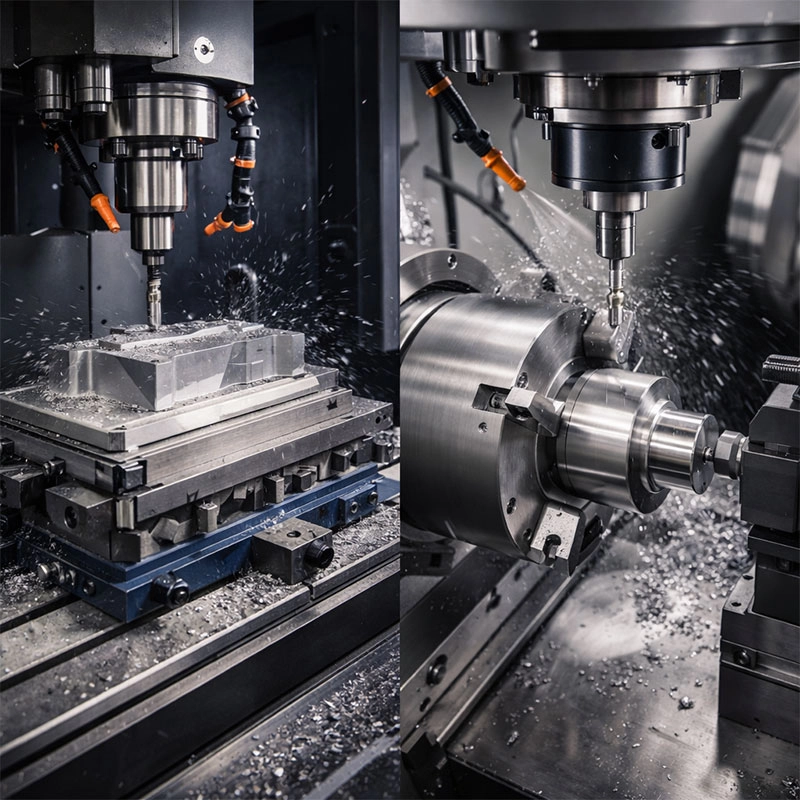
Let’s keep it simple. In CNC turning (often done on a CNC lathe), the workpiece is the one that spins. It’s clamped in a chuck and rotated at high speed. Then, a stationary cutting tool is brought into contact with it, peeling away material to create cylindrical shapes. Imagine a piece of clay spinning on a potter’s wheel as the potter’s hands shape it—that’s turning.

In CNC milling, the opposite happens. The workpiece is held stationary on a table, and a rotating cutting tool (the mill) moves across it along multiple axes (X, Y, and Z). This is like a sculptor using a rotating chisel to carve details into a stationary block of wood. This multi-axis movement allows milling to create incredibly complex and non-rotationally symmetric features, which is why comparing 3 axis vs 5 axis milling is also a common consideration for intricate parts.

When to Choose CNC Milling for Your Project

So, when does the “sculptor’s” method win? CNC milling services are your go-to for parts that aren’t primarily round. If your design has flat surfaces, pockets, slots, complex contours, or detailed 3D shapes, milling is almost certainly the answer. It excels at creating features like engine blocks, brackets, molds, and enclosures. The real power of milling lies in its versatility; you can machine a wide range of materials from aluminum and steel to plastics and composites. For operations like creating deep cavities or threading a hole that isn’t on the centerline, a milling machine with the right tools is indispensable.

When to Choose CNC Turning for Your Project

On the other hand, if your part is defined by its roundness, CNC turning is typically faster and more cost-effective. This process is ideal for producing shafts, pins, bolts, nuts, and any component where the critical shape is concentric around a central axis. The process is exceptionally efficient for high-volume production of such round parts. Furthermore, modern CNC lathes can perform secondary operations like drilling cross-holes or milling flats—often called “turn-mill” machines—which blurs the line a bit. But at its heart, turning is the master of cylindrical machined parts.

Making the Right Choice for Your Part

You might find that some projects clearly lean one way, while others could potentially use either process. Don’t worry, this is common! The best approach is to start with your part’s design and work backwards. I always tell my clients that the geometry is the ultimate guide.

Key Questions to Ask

Here’s a quick mental checklist we can run through:
1. Is the primary shape cylindrical or rotational? If yes, lean towards turning.
2. Does it have complex 3D surfaces, slots, or pockets? If yes, milling is likely needed.
3. What is the required tolerance and surface finish? Both processes can achieve high precision, but the optimal method depends on the feature.
4. What’s the production volume? Turning often has a speed advantage for simple round parts in bulk.

Sometimes, the most cost-effective solution involves both processes. A part might be roughed out on a lathe and then have detailed features added by a mill. This is where working with an experienced machine shop is invaluable.

What About Hybrid Machining?

It’s worth mentioning that the line between milling and turning continues to blur with advanced multi-axis machining centers. A Swiss-type lathe or a mill-turn center can perform both rotating workpiece operations and rotating tool operations in a single setup. This is fantastic for reducing handling time and improving accuracy for complex components. If you’re curious about the capabilities of these advanced systems, resources like the Basics of Mill-Turn Technology on Modern Machine Shop offer a great technical deep dive.

Conclusion: Partnering for Precision

The debate of CNC milling vs turning isn’t about which is better overall, but which is better for *your specific part*. By understanding the core principle—rotating tool vs. rotating workpiece—you’re already ahead. My friendly advice? Start with a clear CAD model and have a conversation with your machining partner. Share your goals for function, budget, and timeline. A good shop will help you navigate the choice between subtractive manufacturing processes, and might even suggest design tweaks (DFM – Design for Manufacturability) to make your part stronger, cheaper, and faster to produce. For further reading on material properties and machining guidelines, the Machine Design learning resources library is a trustworthy place to continue your research.
Categories
Manufacturing Process Comparisons

CNC Milling vs. Turning: Which is Best for Your Precision Parts?

Choosing between CNC milling and CNC turning can be confusing when you need high-accuracy components. This guide breaks down the fundamental differences in how these two subtractive manufacturing processes work, their unique strengths, and how to decide which one is the optimal choice for your specific precision part project.

Understanding the Core Distinctions: CNC Milling and Turning Processes

Let’s start with the basics. The main difference between CNC milling and CNC turning boils down to what moves and what stays still. Imagine you’re sculpting a piece of wood. In one method, you move the chisel around a stationary block (that’s like milling). In the other, you spin the block against a stationary chisel (that’s like turning). This simple analogy is at the heart of precision machining.

How CNC Milling Works

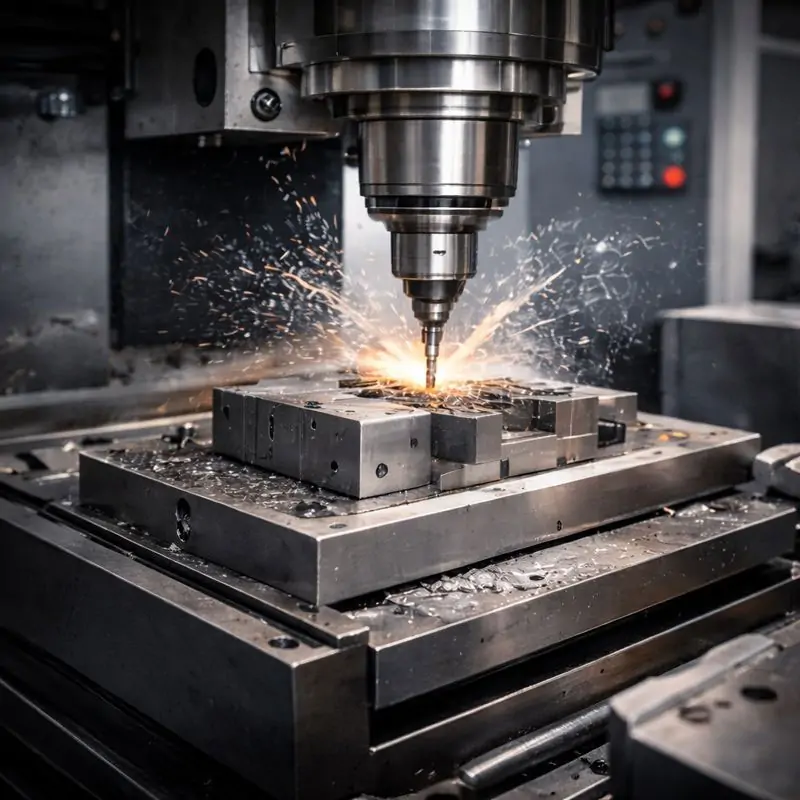
In the CNC milling process, your raw material (called the workpiece) is held stationary in a vise or fixture. A rotating cutting tool, which can have multiple cutting edges, then moves along various axes (X, Y, and Z) to remove material. Think of it like a highly sophisticated, programmable drill that can also slide sideways to carve out slots, pockets, and complex 3D contours. This method is fantastic for creating parts with intricate features that aren’t symmetrical, like engine blocks, brackets, or molds. You might also hear this referred to as CNC machining in a broader sense, though that term can encompass both milling and turning.

How CNC Turning Works

Now, let’s look at CNC turning. Here, the workpiece is the star of the show—it rotates at high speed on a spindle. A single-point cutting tool is then fed into the spinning material, shaving it away to create cylindrical shapes. This is the go-to process for making anything that is fundamentally round: shafts, bolts, pins, and bushings. The machines that perform this operation are often called CNC lathes or turning centers. If you’re wondering about the difference between a lathe and a milling machine, remember: the lathe spins the part, the mill spins the tool.

Strengths and Typical Applications

Each process shines in different scenarios. Knowing their strengths helps you match the right manufacturing technique to your part’s design, which is key for cost-effectiveness and quality in precision part manufacturing.

When to Choose CNC Milling

You’ll want to lean towards CNC milling services when your component has complex geometries. This includes parts with flat surfaces, pockets, slots, threaded holes, or detailed 3D surfaces. For example, a mounting plate with an array of precisely located holes and a recessed cavity is a perfect job for a milling machine. It’s also ideal for working with block-like raw materials. The versatility of multi-axis milling machines allows for incredible complexity in a single setup. You can learn more about the capabilities of modern machine tools from resources like the Engineering.com platform.

When to Choose CNC Turning

Opt for CNC turning when your part design is primarily rotational or axisymmetric. Need a smooth, perfectly round diameter? Turning is your friend. It excels at producing parts like connectors, nozzles, and rollers with excellent concentricity and surface finish on the outer diameter. It’s generally faster and more cost-effective for high-volume production of simple cylindrical shapes. For creating internal features on a cylindrical part, like a drilled hole or an internal thread, turning machines use stationary tools brought into the rotating workpiece, a operation sometimes specifically called out in requests for precision turned components.

Making the Choice: Which Process is Best for Your Part?

So, how do you decide? I often advise clients to start by looking at the basic shape of their part. Ask yourself: “Is the core shape of my part round?” If the answer is a clear yes, turning is likely the most efficient starting point. If the part is more of a block, plate, or has a complex, non-round shape, milling is the probable candidate. Remember, many finished parts actually use both processes—this is where CNC milling and turning combined comes in. A part might be turned to create its basic cylindrical form and then moved to a mill to add cross-holes or flat features. A great resource for understanding material properties and how they interact with these processes is the ASM International knowledge base.

Clearing Up Common Misconceptions

Let’s tackle a couple of common mix-ups. First, one isn’t universally “better” than the other; they are different tools for different jobs. Second, while turning is often faster for simple rounds, modern 5-axis milling can be incredibly efficient for complex parts, reducing or eliminating the need for multiple setups. Lastly, both processes achieve extremely high precision; the choice isn’t about accuracy but about the most effective *path* to that accuracy based on the part geometry. Understanding these key differences in CNC machining helps you have a more productive conversation with your manufacturing partner.

In the end, the best choice for your precision parts depends entirely on their design. By understanding the fundamental motion of milling versus turning, you’re well-equipped to make an informed decision that leads to a better-made, more cost-effective component. When in doubt, a quick sketch or 3D model shared with a trusted machine shop can provide the perfect guidance.

Request A Quote

We'll Send You Back with Price Immediately!

DEC 1-31

XMAS SPECEIL

Up to

40% off

CNC Milling vs. Turning: Which is Best for Your Precision Parts?

We'll Send You Back with Price Immediately!