

Choosing between ABS and Nylon for your CNC machining project can be tricky. Both are fantastic engineering plastics, but they shine in different areas. This friendly guide breaks down their properties, machining quirks, and ideal uses to help you pick the perfect material for your part.
Getting to Know ABS and Nylon
Hey there! So you’re planning a CNC project and the material choice has come down to ABS plastic versus Nylon. It’s a common crossroads. Think of it like choosing between a reliable sedan and a rugged off-road vehicle—both will get you there, but the best ride depends on the terrain. Let’s meet our contenders properly before we pit them against each other in a machinable plastics comparison.
What is ABS Plastic?
ABS, or Acrylonitrile Butadiene Styrene, is like the friendly, all-around workhorse of the plastic world. You’ve definitely held it—it’s the same stuff used in LEGO bricks, car dashboards, and protective cases. Its popularity in CNC machining plastics comes from its great balance. It’s tough, has good impact resistance, and is relatively inexpensive. It also machines beautifully, leaving a nice, smooth surface finish that’s easy to post-process. For more on its general properties, you can check out this resource from Ensinger Plastics.
What is Nylon (Polyamide)?
Nylon, known technically as Polyamide or PA, is the tough, resilient athlete. Originally famous for stockings, it’s now a superstar in engineering for its strength, wear resistance, and flexibility. In the world of CNC machining nylon, you’ll often hear about grades like Nylon 6 and Nylon 66. It’s the go-to for parts that need to endure friction, bear loads, or operate in tougher environments. However, it has a bit of a reputation for being “thirsty”—it absorbs moisture from the air, which can affect machining and final part dimensions.
Head-to-Head: Key Properties for Machining
Alright, let’s put them side-by-side. When you’re comparing ABS vs Nylon for CNC, you’re really looking at a trade-off between impact toughness and mechanical strength. Here’s a breakdown of the key factors that will influence your engineering plastic selection.
Strength & Toughness
This is where their personalities really differ. Nylon is the stronger of the two. It has a higher tensile strength and excellent fatigue resistance, meaning it can handle repeated stress and strain without failing. It’s fantastic for gears, bearings, and structural components. ABS, while strong, excels in toughness and impact resistance. It can take a sudden shock or drop better than Nylon. So, if your part might get bumped or knocked around, ABS could be your hero. For a deep dive into material data, MatWeb is an excellent database.
Heat & Moisture Resistance
Here’s a big one for functional parts. Nylon generally handles higher temperatures better than ABS. Its heat deflection temperature is higher, so it won’t soften or warp as easily in warm environments. But remember that “thirsty” nature? That absorbed moisture can actually make Nylon softer and less stiff during machining if it’s not pre-dried. ABS is more dimensionally stable in humid conditions but has a lower thermal limit. So, for a part under the hood of a car? Lean Nylon. For a housing in a climate-controlled room? ABS is fine.
Wear and Chemical Resistance
If your part involves sliding, rubbing, or any kind of friction, Nylon is the undisputed champion. Its natural lubricity and wear resistance are why it’s the classic choice for bushings, rollers, and wear pads. It also resists oils, fuels, and many solvents quite well. ABS has decent chemical resistance to some acids and alkalis but doesn’t like hydrocarbons (like gasoline) and can be scratched more easily. So, for a durable plastic part that needs to slide smoothly, Nylon wins every time.
The CNC Machining Process for Each
Now, how do they behave on the machine? Both are considered very machinable plastics, but they have their own quirks. A good machinist knows these tricks, which can affect the cost and quality of your final part.
Machining ABS: Tips and Tricks
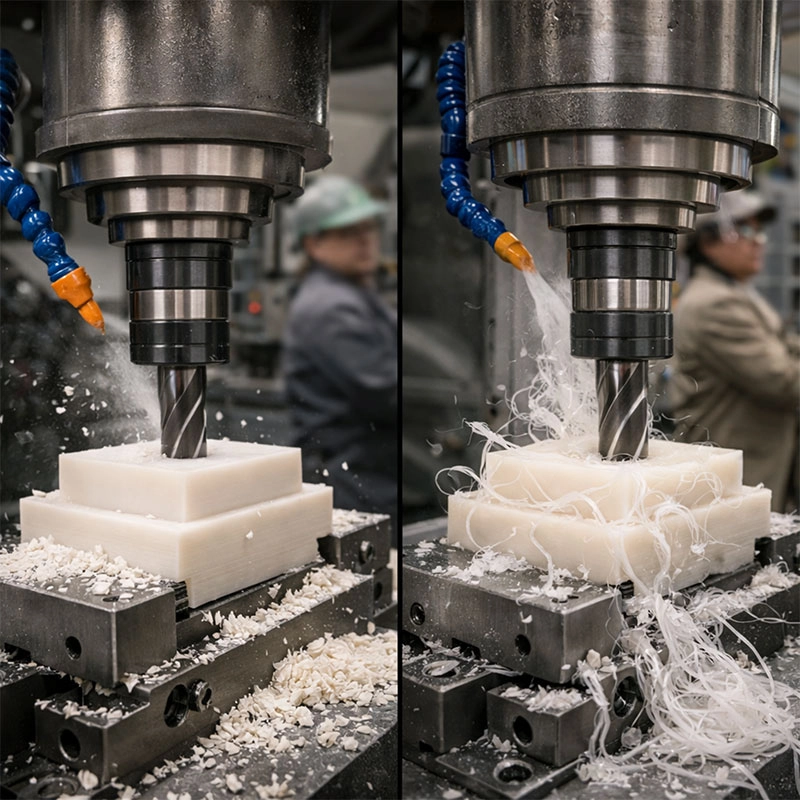
Machinists often describe ABS as “forgiving” and “easy to work with.” It cuts cleanly, produces manageable chips (not long, stringy ones), and allows for high feed rates. You get a great surface finish right off the tool, and it’s easy to sand, glue, or paint afterward. The main watch-out is heat. Too much localized heat from aggressive cutting can melt or gum up the plastic. Using sharp tools, proper coolant (often compressed air is enough), and the right speeds and feeds keeps everything smooth. It’s a top pick for prototype machining because of this ease.
Machining Nylon: Handling the Challenges
CNC machining Polyamide requires a bit more finesse. The two big challenges are moisture and flexibility. As we mentioned, nylon should be pre-dried before machining to ensure dimensional stability and prevent bubbling or a poor surface finish. Secondly, because it’s somewhat flexible, it can deflect or vibrate during cutting if not properly supported, leading to inaccuracies. Using very sharp tools with high rake angles and secure workholding is key. The payoff is worth it—you get a strong, durable part with excellent wear properties.
Choosing Your Winner: Application-Based Advice
So, who wins the ABS versus Nylon machining battle? The answer, as you’ve probably guessed, is: “It depends on your project!” Let’s make it simple with some real-world scenarios.
Choose ABS Plastic Machining when: Your priority is good impact resistance, a lower cost, and excellent machinability. It’s perfect for prototypes, enclosures, housings, consumer product parts, and models that need a nice painted finish. Think of a custom dashboard panel, a jig or fixture for assembly, or a protective cover.
Choose Nylon CNC Material when: You need high mechanical strength, wear resistance, and fatigue endurance. It’s the ideal candidate for functional, moving parts like gears, bearings, bushings, pulleys, and insulators. If your part will face friction, constant load, or a slightly tougher environment, Nylon is your material.
My final piece of friendly advice? Talk to your CNC machining partner early. Describe the function, environment, and stresses your part will face. A good shop can guide you through this plastic material comparison and help you select the right stock material to ensure your project is a total success. Happy making!