

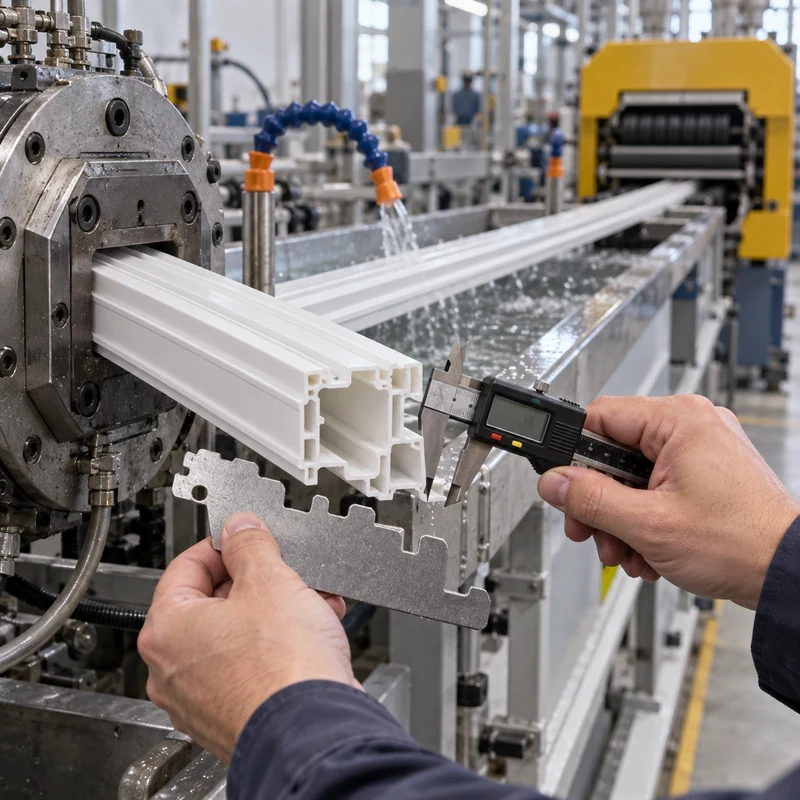
Plastic extrusion continuously pushes molten polymer through a shaped die, then cools and pulls the profile to size. The process is efficient for rails, seals, channels, tubes, trim, and structural profiles, but dimensional control depends on much more than the die opening.
A profile can leave the die near nominal and still twist, bow, shrink, or change wall thickness during cooling and pulling. This guide connects geometry, material, tooling, process settings, inspection, and downstream CNC work.
Quick Answer
Use balanced walls, generous transitions, realistic tolerances, and datums that can be measured consistently. Control melt temperature, output, cooling, puller speed, and material condition together. Prototype the cross-section before committing to long production runs.
Key Engineering Factors
| Factor | Practical effect | Control method |
|---|---|---|
| Wall variation | Uneven flow and cooling create distortion | Keep thickness transitions gradual |
| Die swell | Profile expands after leaving the die | Compensate through tooling and stable process settings |
| Cooling | Uneven shrink creates bow and twist | Balance water, air, support, and line speed |
| Puller speed | Changes section size and residual stress | Monitor speed against output rate |
| Material lot | Viscosity and shrinkage can vary | Use controlled resin specifications and incoming checks |
How Extrusion Tolerances Are Created
The finished dimension results from die geometry, melt rheology, pressure, drawdown, cooling shrinkage, calibration, haul-off speed, and residual stress. Tightening a drawing tolerance without changing the process does not create capability.
Cross-Section Design Rules
Balanced geometry promotes even flow and cooling. Thick masses cool slowly while thin walls freeze early, producing stress and distortion. Hollow chambers need webs and radii that allow material to divide and reunite without weak lines.
- Keep nominal walls as uniform as function allows
- Avoid abrupt heavy-to-thin transitions
- Use radii instead of sharp internal corners
- Provide enough support for thin fins and lips
- Discuss hollow chambers and weld lines with the die maker
Datum and Tolerance Strategy
Dimension the profile from stable, functional surfaces. Do not chain every cross-section dimension when one datum scheme can control assembly. Separate critical fit dimensions from cosmetic or non-functional geometry.
- Use profile or contour tolerances where appropriate
- Specify bow and twist over a defined length
- State measurement temperature and conditioning
- Identify cut-length and end-squareness separately
Materials and Shrinkage
PVC, ABS, polycarbonate, polyethylene, polypropylene, nylon, TPE, and filled compounds behave differently. Fillers can reduce shrinkage but change surface, wear, and flow. Hygroscopic polymers require drying.
Cooling, Calibration, and Cutoff
Vacuum calibration can hold demanding external surfaces. Water temperature, spray distribution, support rollers, and puller alignment influence straightness. Cutoff adds length variation, burrs, and end deformation.
Inspection and Process Capability
Use gauges or optical systems for recurring cross-sections, and confirm results after the profile reaches stable temperature. Capability should be demonstrated over time, not inferred from one first sample.
- Measure multiple positions across the run
- Track key dimensions with process settings
- Inspect bow, twist, surface, color, and cut ends
- Retain approved samples and gauge methods
When CNC Secondary Operations Help
Drilling, milling, routing, tapping, and end machining can add accurate interfaces after extrusion. Fixtures must support the profile without crushing it, and datums should match the final assembly.
Frequently Asked Questions
What is a realistic extrusion tolerance?
It depends on material, section size, geometry, calibration, and measurement length. Ask the supplier for demonstrated capability on comparable profiles.
Why do extrusions twist?
Asymmetric walls, uneven cooling, off-center pull, residual stress, and material variation can all create twist.
Can extruded plastic be CNC machined?
Yes. CNC operations are common for holes, slots, pockets, threads, and precision ends when the part is supported correctly.