

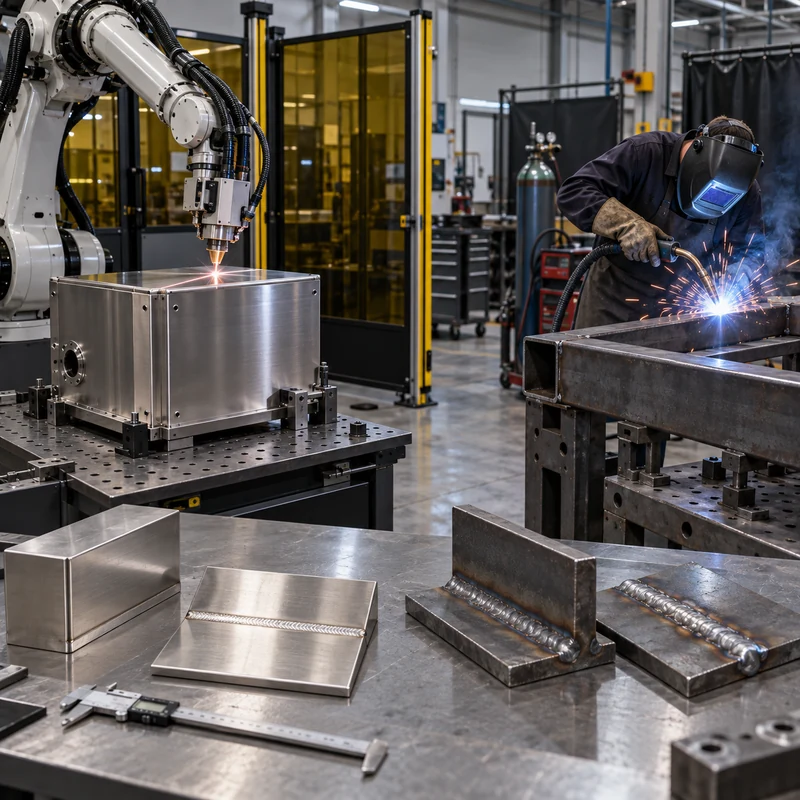
Laser welding and MIG welding can both create strong production joints, but they differ in energy concentration, fit-up tolerance, speed, automation, filler use, heat input, and equipment cost. The right process starts with the joint and production system, not a headline about speed.
This comparison focuses on practical design, quoting, distortion, and inspection for fabricated and machined assemblies.
Quick Answer
Choose laser welding for precise repeatable joints, low heat input, limited distortion, and automated sheet-metal production with excellent fit-up. Choose MIG for versatile structural fabrication, thicker sections, larger gaps, repairability, and lower equipment barriers.
Comparison at a Glance
| Factor | Option A | Option B |
|---|---|---|
| Heat source | Concentrated laser beam | Electric arc with wire electrode |
| Fit-up | Requires tight consistent joints | More tolerant of gaps with filler |
| Speed | Very high in automated cells | Productive but generally slower |
| Distortion | Often lower due to focused heat | Higher heat input can increase movement |
| Investment | High equipment and safety cost | Lower and widely available |
Process Fundamentals
Laser welding focuses optical energy into a small zone and may operate with or without filler. MIG continuously feeds consumable wire through a shielding-gas torch, making filler addition part of the process.
Joint Design and Fit-Up
Laser joints need consistent gap, edge position, focus, and cleanliness. MIG can bridge more variation but still needs suitable preparation, access, and control.
- Define joint gap and edge condition
- Provide fixture and clamp access
- Avoid hidden reflections for laser cells
- Plan torch angle and stickout for MIG
- Control coatings and contamination
Materials and Thickness
Both methods can join steels, stainless, and selected aluminum alloys. Reflective materials, coatings, dissimilar combinations, and crack-sensitive alloys require process development. Thick sections may need multi-pass MIG or hybrid strategies.
Distortion and CNC Interfaces
Laser welding often protects nearby precision features through lower heat input, but fixtures and sequence still matter. MIG assemblies may require post-weld machining of datums, bores, and sealing faces.
Production Economics
Laser systems cost more but can deliver rapid automated cycles and low finishing labor at volume. MIG equipment is accessible and flexible for mixed fabrication. Calculate fixture, programming, filler, gas, cleanup, inspection, and rework.
Inspection and Quality
Visual inspection, dimensional checks, cross-sections, leak testing, penetrant, radiography, or other NDT may be appropriate. Acceptance criteria should match joint consequence.
- Approve weld procedure and samples
- Monitor penetration and porosity
- Check distortion against final datums
- Trace parameters for critical programs
Frequently Asked Questions
Is laser welding stronger than MIG?
Strength depends on joint design, penetration, material, defects, and procedure. Either can meet demanding requirements when correctly engineered.
Does laser welding need filler wire?
Not always. Autogenous laser welding is common, but filler may help metallurgy, gap bridging, or reinforcement.
Which process is cheaper?
MIG is usually cheaper to start. Laser can lower unit cost in repeatable automated production where speed and reduced finishing offset capital cost.