

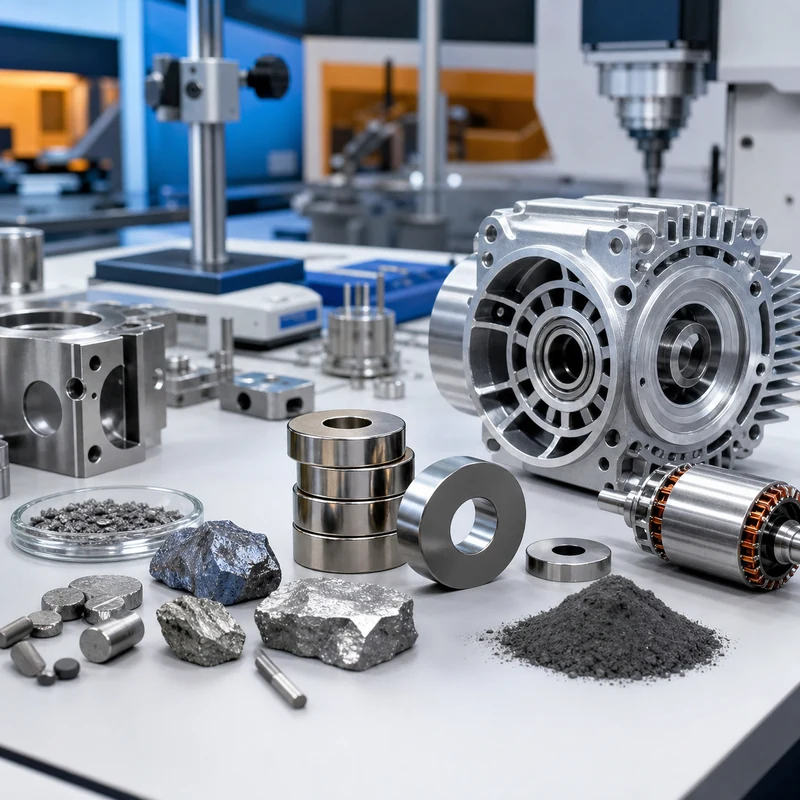
Rare earth metals are a family of 17 elements valued less for ordinary strength and more for magnetic, optical, electrical, catalytic, and high-temperature behavior. They are important in motors, sensors, displays, medical equipment, aerospace systems, renewable energy hardware, robotics, and precision electronics.
For manufacturing teams, rare earth metals are usually not selected like aluminum, steel, or titanium. They are most often used inside magnets, coatings, alloys, ceramics, polishing compounds, catalysts, and electronic materials. The surrounding housings, brackets, shafts, heat sinks, fixtures, and assembly parts still rely on conventional CNC materials. This guide explains the practical role of rare earth materials and how to think about them during custom CNC machining and product development.
What Are Rare Earth Metals?
Rare earth metals include the 15 lanthanide elements plus scandium and yttrium. The name can be confusing because many of these elements are not extremely scarce in the earth’s crust. They are called rare because they are commonly dispersed, mixed with other minerals, and difficult to separate into high-purity usable materials.
| Group | Elements |
|---|---|
| Lanthanides | Lanthanum, cerium, praseodymium, neodymium, promethium, samarium, europium, gadolinium, terbium, dysprosium, holmium, erbium, thulium, ytterbium, lutetium |
| Related rare earth elements | Scandium and yttrium |
Why Rare Earth Metals Matter in Manufacturing
Rare earth materials solve problems that common structural metals cannot solve alone. Neodymium and dysprosium help create compact high-strength permanent magnets. Europium and terbium support display and lighting phosphors. Cerium is used in polishing and catalysts. Yttrium appears in ceramics, lasers, and high-performance materials. Scandium can improve certain aluminum alloys.
This does not mean rare earth metals replace structural metals. A motor may use rare earth magnets, but its housing may still be machined from aluminum. A sensor may depend on rare earth functional materials, while the enclosure may use stainless steel, brass, plastic, or titanium.
Common Rare Earth Metals and Uses
| Element | Symbol | Manufacturing Relevance |
|---|---|---|
| Neodymium | Nd | Strong permanent magnets for motors, robotics, sensors, and compact assemblies |
| Dysprosium | Dy | Improves high-temperature magnet performance in demanding systems |
| Terbium | Tb | Phosphors, magnetostrictive materials, electronics, and specialty devices |
| Samarium | Sm | Samarium-cobalt magnets for high-temperature and harsh environments |
| Cerium | Ce | Polishing compounds, catalysts, glass additives, and alloy uses |
| Lanthanum | La | Batteries, optical glass, catalysts, and specialty alloys |
| Yttrium | Y | Ceramics, lasers, phosphors, thermal barrier materials, and electronics |
| Scandium | Sc | Aluminum alloy modification for lightweight high-performance components |
Key Properties
Magnetic performance
The best-known rare earth application is permanent magnets. Neodymium-based magnets provide very high magnetic strength in a small package. Samarium-cobalt magnets are useful where heat resistance and corrosion behavior matter. These magnets appear in electric motors, actuators, speakers, sensors, holding fixtures, and compact motion-control systems.
Optical and luminescent behavior
Some rare earth elements emit specific colors or interact with light in useful ways. This makes them important in displays, LED lighting, lasers, fiber optics, medical imaging, inspection instruments, and optical glass.
Electrical and electronic function
Rare earth materials can influence magnetic fields, electronic behavior, and signal performance. They are not usually used as basic conductors like copper, but they help electronic systems achieve functions that standard metals cannot provide by themselves.
Temperature and stability advantages
Certain rare earth additions improve performance at elevated temperature. This is especially important for motors, aerospace hardware, energy systems, and industrial machinery where heat can reduce magnetic strength or dimensional stability.
Light Rare Earths vs Heavy Rare Earths
Rare earth elements are often grouped into light rare earth elements and heavy rare earth elements. Light rare earths generally have lower atomic numbers and are more abundant. Heavy rare earths are often less available and can be more strategically sensitive because they are important for high-performance magnets and specialized technologies.
| Category | Typical Elements | Practical Note |
|---|---|---|
| Light rare earth elements | Lanthanum, cerium, praseodymium, neodymium, samarium | Often used in magnets, catalysts, glass, polishing, batteries, and alloys |
| Heavy rare earth elements | Europium, gadolinium, terbium, dysprosium, yttrium, lutetium and related elements | Important for high-temperature magnets, phosphors, lasers, ceramics, and advanced electronics |
Rare Earth Metals vs Common CNC Metals
In CNC machining, material selection usually starts with strength, weight, corrosion resistance, machinability, thermal behavior, surface finish, and cost. Rare earth metals are different. They are selected for functional behavior inside a system rather than for ordinary load-bearing structure.
| Material Family | Main Role | Typical CNC Relevance |
|---|---|---|
| Rare earth materials | Magnetic, optical, catalytic, electronic, and high-temperature functions | Usually used as magnets, additives, ceramics, coatings, or specialty components |
| Aluminum | Lightweight structures, housings, heat sinks, brackets, prototypes | Excellent machinability and weight reduction |
| Stainless steel | Corrosion-resistant structural and mechanical parts | Good for medical, food, marine, and industrial components |
| Titanium | High strength-to-weight ratio and corrosion resistance | Useful for aerospace, medical, and high-performance parts |
| Copper and brass | Electrical, thermal, fittings, bushings, connectors | Strong conductivity and good machinability depending on grade |
Design Notes for Parts That Use Rare Earth Magnets
Many CNC machined parts interact with rare earth magnets even if the rare earth material itself is not machined as the main component. Examples include motor housings, sensor mounts, magnetic couplings, robotics grippers, test fixtures, encoder parts, and compact electromechanical assemblies.
- Allow realistic pocket clearance for magnet installation and adhesive thickness.
- Consider magnet orientation and assembly sequence before finalizing the housing design.
- Protect brittle magnets from impact, edge loading, and press-fit stress.
- Account for heat exposure because magnet strength can drop if the grade is not suitable.
- Use coatings or encapsulation when corrosion or fluid exposure is possible.
- Define inspection points for critical magnet seats, alignment features, and mating surfaces.
Material Selection for Advanced Assemblies
Rare earth materials often work best as part of a broader material system. A compact motor may combine rare earth magnets, copper windings, machined aluminum housing, stainless fasteners, and engineered plastic insulation. A sensor assembly may combine magnetic material with a machined bracket, sealed enclosure, and precision-located reference surfaces. MTSPi can review these surrounding CNC components through our materials library, surface treatment planning, and quality assurance workflow.
Quality and Inspection Considerations
For rare-earth-related assemblies, inspection should focus on the features that control fit, alignment, thermal path, and reliability. The machined part may need tight flatness, bore position, pocket depth, thread quality, or surface finish even when the functional rare earth element is purchased separately.
- Check magnet pockets, bores, datum surfaces, and locating shoulders against the drawing.
- Confirm surface finish where adhesives, seals, bearings, or magnetic components contact the part.
- Plan coating thickness so plated or anodized surfaces do not close up critical fits.
- Use documented inspection when the part supports motors, sensors, aerospace equipment, or medical devices.
How MTSPi Supports Manufacturing Projects
MTSPi does not treat rare earth metals as a generic substitute for normal CNC materials. Instead, we help engineers choose the right machined support parts around the functional material. Send the 3D model, 2D drawing, material preference, magnet or electronic component requirements, quantity, surface finish, and inspection expectations through our contact page. We can then review material options, machining strategy, tolerance risk, finishing, and assembly-critical features.
Related MTSPi Resources
FAQ
Are rare earth metals actually rare?
Not always. Many are reasonably abundant in the earth’s crust, but they are difficult to mine, separate, refine, and supply in high-purity forms.
Are rare earth metals stronger than steel?
No. Their main value is functional performance such as magnetism, optical behavior, and electronic properties. Steel, aluminum, titanium, and other engineering metals are usually better for structural CNC parts.
Which rare earth element is used in strong magnets?
Neodymium is widely used in strong permanent magnets. Dysprosium or terbium may be added for higher-temperature performance, while samarium-cobalt magnets are used in some harsh environments.
Can rare earth metals be CNC machined?
Some rare earth materials can be processed, but they are not common everyday CNC stock materials. In most projects, CNC machining is used for the surrounding housings, brackets, fixtures, and precision parts that hold or protect rare earth components.
What industries use rare earth materials?
Electric vehicles, robotics, aerospace, medical devices, renewable energy, electronics, sensors, lighting, displays, and industrial automation all use rare earth materials in different ways.