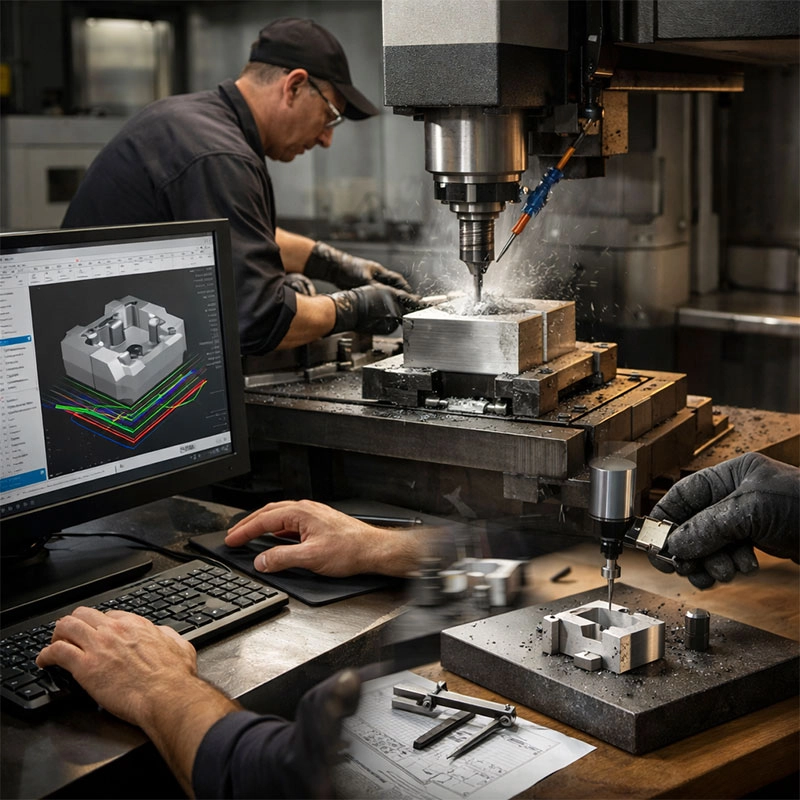
Quick answer: CNC machining works by using computer-controlled machine motion to remove material from a solid workpiece until the final part matches the CAD model and drawing. A typical project moves through drawing review, material selection, CAM programming, machine setup, cutting, deburring, surface finishing, inspection, and shipping. The same workflow can produce prototypes, fixtures, replacement parts, and repeat production components in metal or plastic.
What CNC Machining Does
CNC machining is a subtractive manufacturing process. The machine does not build the part from nothing; it starts with bar, plate, billet, casting, forging, extrusion, or plastic stock and removes everything that is not part of the final geometry. This is why CNC machining is useful for accurate holes, pockets, flat faces, slots, threaded features, bores, contours, and assembly surfaces.
The word CNC means computer numerical control. The computer controls tool movement, spindle speed, feed rate, coolant, tool changes, and machine coordinates. The operator still matters, because fixture strategy, tool choice, cutting data, workholding, and inspection planning decide whether the programmed process will make a stable part.
CNC Machining Process Step by Step
| Step | What happens | Why it matters |
|---|---|---|
| 1. CAD and drawing review | The supplier checks the 3D model, 2D drawing, material, tolerances, threads, surface finish, and quantity. | This catches features that are expensive, unclear, impossible to inspect, or hard to machine. |
| 2. DFM feedback | The engineer reviews tool access, corner radii, wall thickness, pocket depth, hole depth, and setup direction. | Small design changes can reduce cost and improve quality without changing part function. |
| 3. CAM programming | The part model is converted into toolpaths, cutting strategies, tool lists, speeds, feeds, and setup sheets. | Programming controls machining time, tool wear, surface quality, and risk of collision. |
| 4. Workholding and setup | The material is held in a vise, chuck, fixture, soft jaws, pallet, or custom fixture. | Rigid workholding helps maintain tolerance and repeatability. |
| 5. Machining operations | The machine performs milling, turning, drilling, boring, reaming, tapping, profiling, or facing operations. | This creates the final shape and functional features. |
| 6. Deburring and finishing | Sharp edges are removed and the part may receive anodizing, plating, polishing, blasting, or coating. | Finishing affects appearance, corrosion resistance, wear, and sometimes dimensions. |
| 7. Inspection | Parts are checked with calipers, micrometers, gauges, CMM, height gauges, or visual inspection. | Inspection confirms whether the part meets the drawing before shipment. |
Main CNC Machining Methods
CNC Milling
CNC milling uses rotating cutting tools to remove material from a fixed workpiece. It is a strong choice for plates, brackets, housings, pockets, slots, drilled holes, tapped holes, flat surfaces, and complex prismatic shapes. 3-axis milling is efficient for simple access geometry, while 4-axis and 5-axis machining help when parts need multi-side access or complex angles.
CNC Turning
CNC turning rotates the workpiece while cutting tools shape the diameter, face, groove, bore, or thread. It is commonly used for shafts, pins, bushings, sleeves, spacers, nozzles, fittings, rollers, and round precision parts. Live tooling can add milled flats, cross holes, or slots without moving the part to a separate mill.
Hole Machining
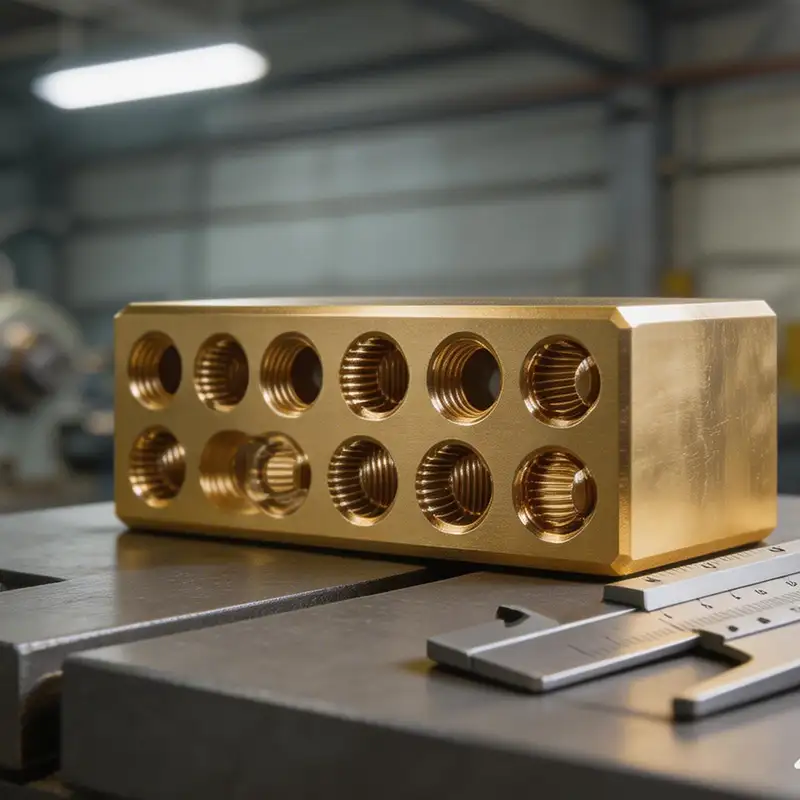
Most CNC parts include holes, and different hole operations serve different goals. Drilling creates the hole, boring improves diameter and alignment, reaming improves size and finish, and tapping or thread milling creates internal threads. Precision holes should not be treated the same as simple clearance holes.
Materials Used in CNC Machining
CNC machining works with aluminum, stainless steel, carbon steel, tool steel, brass, copper, bronze, titanium, nickel alloys, ABS, POM, nylon, acrylic, PC, PEEK, PTFE, and other engineering materials. Material choice changes cutting speed, tool wear, heat behavior, tolerance stability, cost, surface finish, and lead time.
For example, aluminum is fast to machine and good for prototypes, housings, brackets, and lightweight components. Stainless steel is stronger and more corrosion resistant but usually slower to machine. Brass cuts cleanly and works well for fittings and electrical parts. Plastics need sharp tools and heat control because they can flex, melt, or move after machining. Use the CNC materials guide when the part function is still unclear.
What Controls CNC Machining Accuracy?
Accuracy depends on more than the machine brand. Tool wear, fixture stiffness, material stress, thermal expansion, cutting strategy, setup count, part geometry, operator method, and inspection process all affect the final result. Thin walls, deep pockets, long shafts, hard materials, and tight hole patterns are more difficult than simple block-shaped parts.
Critical drawings should identify datums, true position, hole fit, thread class, surface finish, and inspection method. A supplier can hold a tolerance more reliably when the part has a stable datum structure and the critical features are clear. For demanding parts, connect the project with MTSPi’s quality assurance process.
Design Rules That Make CNC Parts Easier to Manufacture
- Use practical inside corner radii instead of sharp internal corners.
- Avoid deep narrow pockets unless the function truly requires them.
- Do not apply tight tolerances to every dimension; reserve them for functional features.
- Give thread size, pitch, depth, and blind/through condition clearly.
- Separate cosmetic surfaces from non-cosmetic surfaces on the drawing.
- Confirm finish requirements before machining because coating can change dimensions.
- Send both 3D CAD and 2D drawings when tolerance and finish matter.
CNC Machining Cost Drivers
The main cost drivers are material price, part size, machining time, setup count, complexity, tolerance, surface finish, inspection, and quantity. A part with many setups, tight tolerances, deep pockets, small tools, and cosmetic finishing will cost more than a simple plate with standard tolerances. Batch quantity can reduce unit price because programming and setup time are spread across more parts.
CNC Machining vs 3D Printing, Casting, and Molding
| Process | Best for | Limitation |
|---|---|---|
| CNC machining | Accurate real-material parts, prototypes, low-volume production, fixtures, replacement parts | Material waste and tool access constraints |
| 3D printing | Complex shapes, fast concept models, internal channels, lightweight structures | Surface finish, tolerance, and material limitations vary by process |
| Casting | Complex metal shapes and larger production volumes | Tooling, porosity risk, and post-machining needs |
| Injection molding | High-volume plastic production | High tooling cost and longer upfront development |
FAQ
What files are needed for CNC machining?
A 3D CAD file is best for programming, while a 2D drawing is important for tolerances, threads, surface finish, material, inspection notes, and revision control.
Is CNC machining only for metal parts?
No. CNC machining is used for metals and engineering plastics, including aluminum, stainless steel, brass, copper, ABS, POM, nylon, acrylic, PC, and PEEK.
Can CNC machining make one prototype?
Yes. CNC is often used for one-off prototypes because it produces parts from real materials without mold tooling.
Why are tight tolerances more expensive?
Tight tolerances require more careful setups, slower cutting, better fixtures, more stable materials, and more inspection time.
How can I reduce CNC machining cost?
Use standard materials, practical tolerances, accessible features, standard thread sizes, and clear drawings. Ask for DFM feedback before ordering.
Need CNC machining support?
Send CAD files, drawings, quantity, material, finish, and tolerance notes. MTSPi can review the best route before quoting.
Conclusion
CNC machining works by turning digital part data into controlled cutting operations. The best results come from clear drawings, suitable materials, practical tolerances, stable setups, planned finishing, and inspection that matches the part function.