

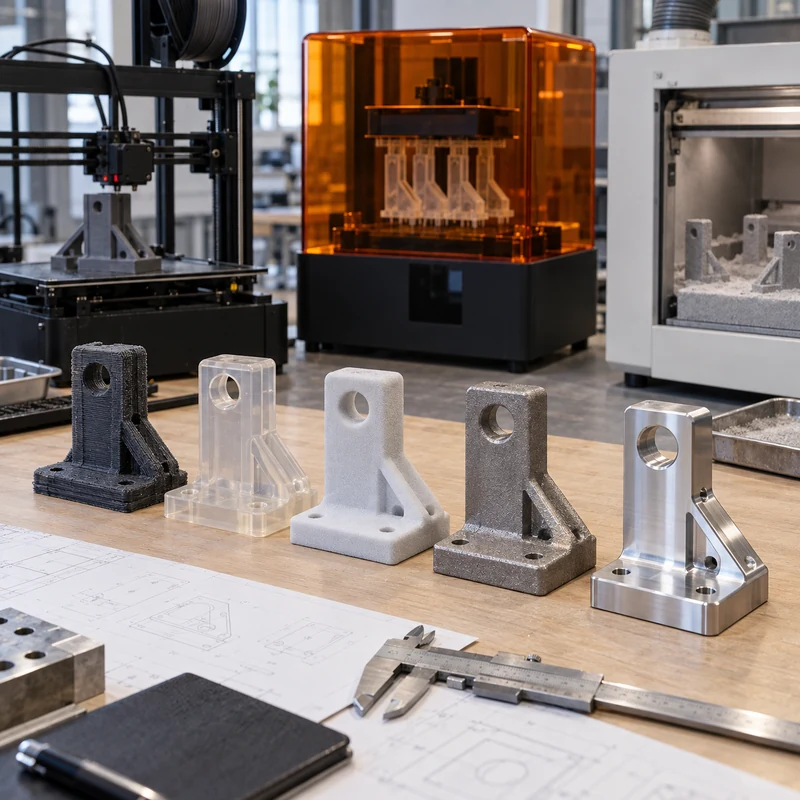
3D printing prototype cost can range from a small desktop build to an expensive certified metal component. Price is driven by process, material, bounding volume, build height, supports, machine time, nesting, post-processing, inspection, quantity, and failure risk.
A useful estimate begins with what the prototype must prove. A visual model, fit-check part, functional nylon component, transparent flow model, and metal load-bearing prototype should not use the same process or budget.
Quick Answer
Choose the least expensive process that answers the current design question. FDM often suits early form and fit, SLA suits detail and smooth appearance, SLS or MJF suits functional nylon, and metal powder-bed fusion suits valuable complex metal geometry. Use CNC when production material, tight tolerances, or machined surfaces are essential.
Key Engineering Factors
| Factor | Practical effect | Control method |
|---|---|---|
| Part size | Larger bounding volume consumes capacity | Hollow noncritical volumes and split models carefully |
| Build height | More layers increase machine time | Orient around function, finish, and risk |
| Support | Adds material and removal labor | Place supports on noncritical surfaces |
| Material | Engineering and metal feedstocks cost more | Match material to the test purpose |
| Finishing | Sanding, dyeing, machining, and coating add labor | Specify only required surfaces |
Cost by Prototype Purpose
Appearance models prioritize detail, color, and finish. Fit models prioritize dimensions and interfaces. Functional models add material behavior, load, temperature, and fatigue. Certification or end-use parts add traceability and inspection.
Process Cost Differences
FDM has low material and equipment cost but visible layers and directional strength. SLA provides fine detail but requires washing, curing, and support finishing. SLS and MJF nest parts in powder and suit functional batches. Metal printing adds powder control, supports, heat treatment, and machining.
Geometry That Raises Price
Tall builds, large solid volumes, extensive supports, trapped powder, thin fragile features, difficult cleaning, and tight tolerances raise cost. A complex-looking lattice may be economical if it prints support-free, while a simple tall wall may dominate build time.
- Separate cosmetic and functional surfaces
- Avoid unnecessary solid mass
- Provide drain and powder-removal openings
- Use realistic minimum walls and holes
- Add stock for machined critical features
Quantity and Build Utilization
Unit cost can fall when multiple parts share setup and build capacity, especially in powder-bed systems. However, a larger batch also increases exposure if the design is unverified. Order a small validation lot before scaling.
Post-Processing and Inspection
Support removal, blasting, curing, dyeing, smoothing, painting, heat treatment, HIP, CNC finishing, threaded inserts, and CMM inspection can exceed the raw print cost. Quote them explicitly.
When to Move to CNC or Injection Molding
Move to CNC when the design needs production-intent stock, tight bores, flat sealing faces, threads, surface roughness, or predictable isotropic behavior. Consider molding when design and demand stabilize enough to recover tooling cost.
- Use printing for fast learning
- Use CNC for material and tolerance validation
- Use bridge tooling for uncertain early demand
- Calculate total lifetime cost before production tooling
RFQ Checklist
Send a STEP file, process or material preference, quantity, finish, color, critical tolerances, inspection level, and delivery requirement. Explain what the prototype must prove so the supplier can recommend alternatives.
Frequently Asked Questions
What is the cheapest 3D printing process?
FDM is often cheapest for simple early prototypes, but the best value depends on size, detail, quantity, material, and finishing.
Why is metal 3D printing expensive?
Metal systems require costly equipment, controlled powder, long builds, supports, heat treatment, safety procedures, inspection, and frequent CNC post-processing.
Is 3D printing always cheaper than CNC machining?
No. CNC can be more economical for simple geometry, production material, precise features, and small batches where printed post-processing is extensive.