

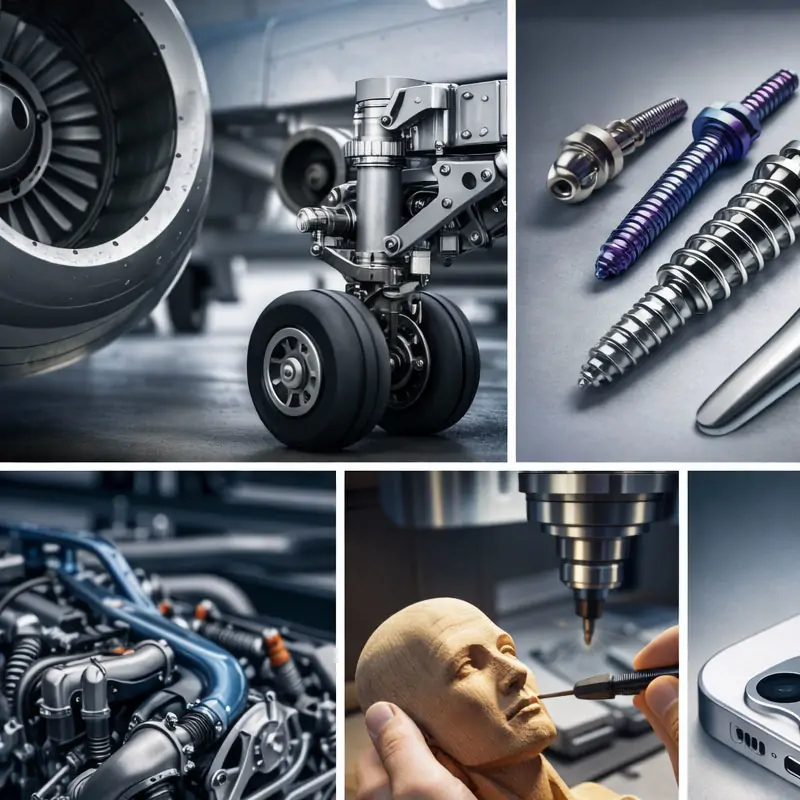
Ever wondered how complex metal and plastic parts are made with such incredible precision? The answer often lies in CNC machining. This guide will explore the diverse applications of CNC technology, moving beyond the factory floor to show you five surprising places where it shapes our everyday world.
- Common Applications of CNC Machining Technology
- 1. Aerospace: Crafting the Sky’s Backbone
- 2. Medical: Precision for Life-Saving Devices
- 3. Automotive: From Prototypes to High-Performance Parts
- 4. Art and Sculpture: Where Engineering Meets Creativity
- 5. Consumer Electronics: The Tech in Your Pocket
- Concluding Thoughts on CNC Uses
Common Applications of CNC Machining Technology
When we talk about the uses of CNC machining, it’s easy to picture big industrial factories. And you’re right—it’s a cornerstone of mass production. But the real magic of computer numerical control is its incredible versatility. It’s a subtractive manufacturing process where a computer directs cutting tools to carve a solid block of material into a finished part. This method is fantastic for creating everything from simple brackets to geometries that would be impossible to make by hand. Whether you’re looking at CNC milling for complex 3D shapes or CNC turning for symmetrical parts, the technology’s core value is repeatable, high-precision fabrication.
1. Aerospace: Crafting the Sky’s Backbone
Let’s start high up—literally. The aerospace industry relies on CNC machining for some of its most critical components. Think about the landing gear, turbine blades, and structural brackets inside an aircraft. These parts face extreme stress, temperature changes, and must be incredibly lightweight. That’s where CNC manufacturing shines. It can work with tough materials like titanium and high-grade aluminum alloys, machining them into strong, complex, and lightweight forms that are essential for flight safety and fuel efficiency.
Why CNC is Non-Negotiable Here
The margin for error in aerospace is virtually zero. Every component must meet exacting specifications, and that’s a perfect job for a CNC machine shop. The process ensures that the tenth part produced is identical to the thousandth, which is crucial for maintenance and safety. For a deeper dive into the standards these parts must meet, you can read about aerospace manufacturing practices on NASA’s official website.
2. Medical: Precision for Life-Saving Devices
This is one of the most impactful applications of CNC technology. If you or a loved one has ever needed a knee replacement, a spinal implant, or even a intricate surgical tool, chances are it was made with CNC. These devices are not one-size-fits-all; they often need to be customized to fit a patient’s unique anatomy. CNC machining allows for this custom, patient-specific production from biocompatible materials like surgical-grade stainless steel or cobalt-chrome, all while maintaining a sterile, contaminant-free process.
Meeting the Highest Standards
The medical field demands the ultimate in precision and cleanliness, known as CNC precision machining. A hip implant, for example, must have a perfectly smooth surface to integrate with bone and a specific geometry to allow for natural movement. The controlled environment of a CNC machine, guided by detailed digital models from MRI or CT scans, makes this level of customization and quality not just possible, but routine.
3. Automotive: From Prototypes to High-Performance Parts
From the family sedan to a Formula 1 race car, CNC plays a huge role. In the development phase, engineers use CNC prototyping to create functional models of engine blocks, cylinder heads, and custom intake manifolds to test their designs. In aftermarket and racing, enthusiasts rely on CNC to produce high-strength, lightweight parts that can withstand incredible forces. So, when you’re searching for what can you make with a CNC machine in the auto world, the list is nearly endless.
The Role of CNC in Rapid Prototyping
Before a new car model hits the road, its parts are tested extensively. CNC machining allows teams to quickly turn a digital design into a physical part they can hold, test, and refine. This rapid prototyping speeds up innovation dramatically. It’s much faster than traditional tooling methods, letting engineers iterate designs until they get everything just right.
4. Art and Sculpture: Where Engineering Meets Creativity
Here’s a surprising one that answers the question what is the purpose of CNC milling beyond industry. Artists and sculptors are increasingly using CNC routers to create large-scale works, intricate furniture, and stunning architectural details. They can take a 3D model of a complex, organic shape and machine it from wood, foam, or soft metals. This doesn’t replace the artist’s vision; it gives them a powerful new tool to execute it with a level of detail and scale that would be incredibly time-consuming or impossible by hand.
The CNC Machine as an Artist’s Tool
Imagine a sculptor wanting to create a large, twisting metal sculpture. Instead of weeks of welding and shaping, they can design it on a computer and use a CNC machine to cut the pieces with perfect precision. They then assemble and finish the work. It’s a beautiful fusion of digital design and physical craftsmanship. You can see examples of how technology influences modern art at institutions like the Museum of Modern Art.
5. Consumer Electronics: The Tech in Your Pocket
Look at your smartphone, laptop, or smartwatch. The sleek metal casing, the precisely placed ports, the tiny internal brackets—many of these are made using CNC machining processes. For prototypes and low-to-medium volume production, CNC is ideal for creating the perfect unibody aluminum chassis that feels premium and durable. It allows for tight tolerances that ensure all the buttons, cameras, and screens fit together seamlessly.
Machining the Unseeably Small
The components inside our gadgets are getting tinier and more complex. Precision CNC machining can produce the small, heat-resistant fixtures that hold circuit boards or the precise molds used to make plastic components. This application shows how CNC isn’t just for big, heavy metal parts; it’s equally adept at creating the miniature, high-tolerance parts that make our modern digital life possible.
Concluding Thoughts on CNC Uses
So, what is CNC machining used for? As we’ve seen, it’s far more than just an industrial workhorse. It’s a fundamental technology that builds the planes we fly in, the medical devices that heal us, the cars we drive, the art that inspires us, and the electronics we depend on every day. Its power lies in transforming digital dreams into precise, reliable, and tangible reality. Whether you’re an engineer, a designer, or just someone curious about how things are made, the world of CNC machining is full of fascinating and surprising examples.