

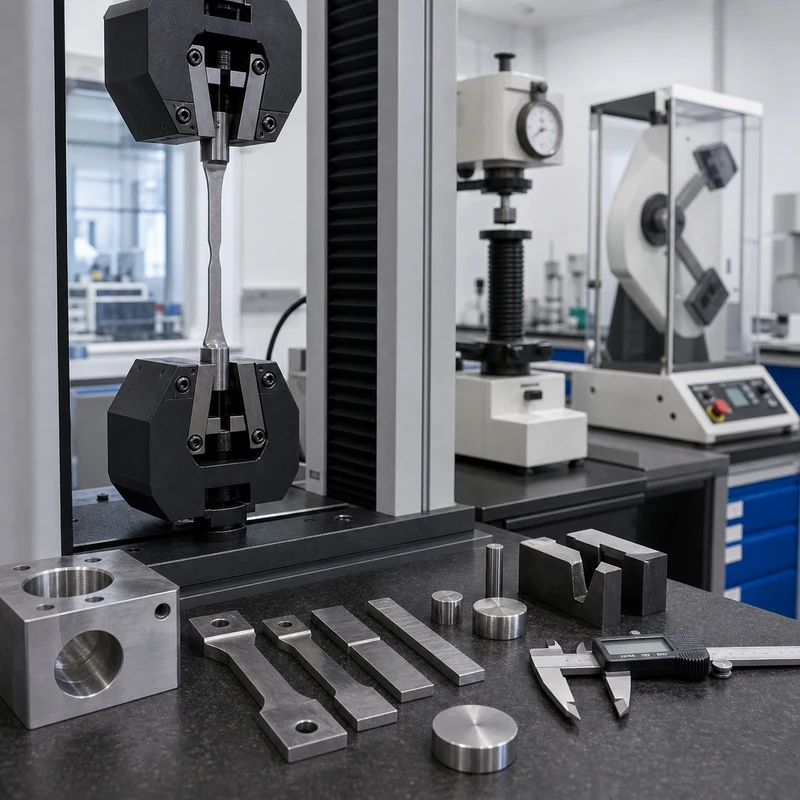
Mechanical testing measures how a material or finished part behaves under force, load, impact, bending, wear, or repeated stress. For machined components, testing helps confirm that the selected material and manufacturing route can meet real service conditions, not just drawing dimensions.
In a complete manufacturing plan, mechanical testing works alongside dimensional inspection, material certification, and quality assurance controls. It is especially useful for load-bearing parts, safety-related assemblies, and components that operate under heat, vibration, or fatigue.
Why Mechanical Testing Matters
- It verifies strength, ductility, hardness, and other performance properties.
- It helps compare candidate materials before production.
- It supports failure analysis when parts crack, deform, or wear too quickly.
- It provides objective data for quality documents and customer approval.
Common Mechanical Testing Methods
| Test Method | What It Measures | Typical Use |
|---|---|---|
| Tensile testing | Strength, yield point, elongation | Material qualification and comparison |
| Hardness testing | Resistance to indentation | Heat treatment checks and wear expectations |
| Impact testing | Energy absorbed during fracture | Low-temperature or shock-load applications |
| Fatigue testing | Life under repeated loading | Rotating, vibrating, or cyclic-load components |
| Compression testing | Behavior under crushing force | Spacers, blocks, structural parts |
| Bend testing | Ductility and crack resistance | Sheet, welds, and formed parts |
Testing Before and After Machining
Material testing may happen before machining to confirm that incoming stock meets specification. Finished-part testing may happen after machining, heat treatment, coating, or assembly. For example, a stainless shaft might need hardness verification after heat treatment, while an aluminum bracket may need dimensional checks after surface finishing to confirm coating buildup has not affected assembly features.
How to Choose the Right Test
The correct test depends on how the component will fail if something goes wrong. A cosmetic cover does not need the same test plan as a load-bearing aerospace bracket. Engineers should connect each test to a functional requirement, such as clamp load, wear life, fracture resistance, or dimensional stability.
- Define the service environment: temperature, load, chemicals, and vibration.
- Identify critical material properties from the design.
- Choose a recognized test method when documentation is required.
- Plan sample size and acceptance criteria before production starts.
Mechanical Testing and CNC Part Quality
CNC machining controls shape, tolerance, and finish, but it does not automatically guarantee material performance. When both geometry and material behavior matter, combine machining with certificates, inspection records, and test results. MTSPi can help align machining, inspection, and documentation for production projects.
Related MTSPi Resources
FAQ
Does every CNC part need mechanical testing?
No. Testing should match the risk, function, material, and customer requirements of the part.
Is hardness testing destructive?
Some hardness tests leave small marks, while others are more suitable for finished surfaces. The method should be chosen carefully.
Can mechanical testing replace dimensional inspection?
No. It answers different questions. Mechanical testing checks performance properties, while dimensional inspection checks geometry.