

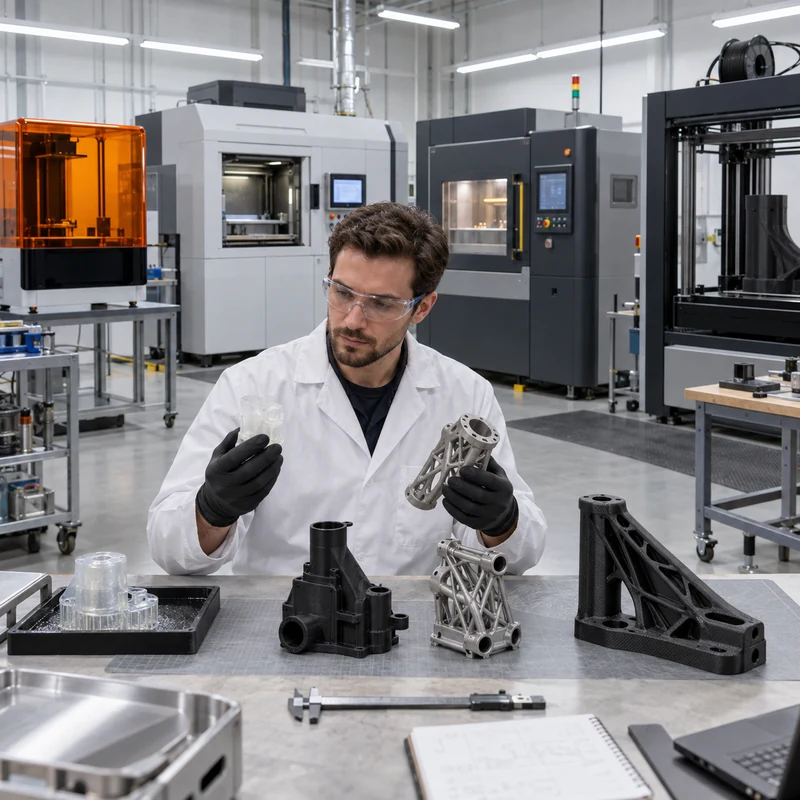
Industrial 3D printing is not one process. Resin vat systems, polymer powder-bed machines, metal powder fusion, filament extrusion, and pellet extrusion produce very different parts even when they start from the same CAD file. The best choice depends on the requirement that cannot be compromised.
A useful selection method filters processes in order: material, build size, feature detail, service conditions, geometry, surface requirements, and quantity. This prevents a visually attractive prototype from being mistaken for a production-capable part.
Quick Answer
Use SLA or DLP for fine visual detail, SLS or MJF for durable nylon geometry without support structures, FDM for economical engineering thermoplastics, FGF for very large parts, and metal powder-bed fusion for high-value metal geometry. Add CNC machining when datums, bores, sealing faces, or tight fits exceed as-printed capability.
Comparison at a Glance
| Process family | Typical material | Best fit | Key limitation |
|---|---|---|---|
| SLA / DLP | Photopolymer resin | Detailed visual and fit models | Creep, UV aging, and brittle grades |
| SLS / MJF | Nylon powder | Functional parts and complex channels | Grainy surface and moderate tolerance |
| Metal powder fusion | Steel, aluminum, titanium, nickel alloy | Load-bearing metal geometry | Cost, supports, stress relief, finishing |
| FDM | Filament thermoplastics | Fixtures, housings, and heat-resistant prototypes | Layer anisotropy and visible layer lines |
| FGF | Pellet thermoplastics | Large tools, patterns, and structures | Coarse detail and machining allowance |
1. Start With Material and Service Conditions
Ask whether the part must be metal, a production thermoplastic, an elastomer, transparent, sterilizable, chemically resistant, or stable at temperature. Material requirements remove unsuitable processes faster than comparing nominal resolution.
Resin can reproduce small details but usually does not behave like molded ABS or polycarbonate. Nylon powder processes offer better toughness for functional assemblies. FDM and FGF can use engineering thermoplastics, but orientation affects strength. Metal systems serve demanding thermal and mechanical duties, with post-build heat treatment often required.
- Define sustained and peak temperature
- List fluids, cleaners, and UV exposure
- Separate cosmetic tests from structural tests
- Identify flame, medical, or aerospace documentation needs
2. Check the Complete Build Envelope
A part must fit along all three machine axes, including supports and orientation. Splitting a large model introduces joints, alignment error, finishing labor, and weaker load paths.
Large-format extrusion is often more practical than joining many small prints. Conversely, a huge machine does not guarantee fine features: nozzle size, layer height, and thermal movement still control detail.
3. Separate Resolution From Tolerance
Layer height and pixel size describe the machine’s smallest increments, not guaranteed dimensional accuracy. Part size, orientation, shrinkage, thermal history, support strategy, and measurement method determine actual results.
For critical interfaces, print near-net geometry and machine the mating faces. This hybrid route is common for metal prints, large FGF tools, and nylon components that need precise bores or sealing surfaces.
- Mark inspection datums on the drawing
- Define general and critical tolerances separately
- Add stock to faces that will be machined
- Confirm fixture access before printing
4. Let Geometry Decide Support Strategy
Powder-bed nylon surrounds the part with loose powder, enabling internal passages and complex overhangs without attached supports. Resin, filament, pellet, and metal processes require deliberate support and removal access.
Hollow resin parts need drainage. Metal channels may trap powder or support material. Long flat walls can warp. Design reviews should address escape holes, minimum walls, unsupported spans, trapped volumes, and inspection access before the build starts.
5. Plan Surface Finish as an Operation
SLA and DLP can deliver smooth visual surfaces after support removal and light finishing. SLS and MJF have uniform powder texture. FDM and especially FGF retain layer lines. Metal powder fusion normally needs blasting plus machining on critical faces.
Polishing changes texture but cannot create a precision datum. Machining controls dimensions but may not reach every cosmetic surface. Specify appearance zones and functional zones separately so the quote includes the right operations.
6. Match the Process to Quantity and Design Maturity
Printing is valuable while CAD changes frequently because there is no hard tool to remake. Unit cost remains relatively linear, so tooling becomes attractive after geometry stabilizes and demand rises.
A practical development route may use resin for early appearance, nylon for functional testing, CNC machining for production-material validation, and vacuum casting or injection molding for repeated plastic parts.
A Seven-Step RFQ Checklist
A complete request reduces quotation uncertainty and prevents the supplier from choosing a process based only on file format.
- Material or required properties
- Overall dimensions and smallest features
- Critical tolerances and datums
- Loads, temperature, and chemical exposure
- Internal channels and support-removal access
- Surface finish and color
- Prototype quantity and expected future volume
Frequently Asked Questions
Which industrial 3D printing process is most accurate?
SLA and DLP generally reproduce the finest small details, but accuracy depends on geometry and scale. Tight functional dimensions may still require secondary machining.
When should CNC machining replace 3D printing?
Use CNC machining when the part needs production-grade stock properties, precise datums, threads, sealing surfaces, predictable tolerances, or a finish that is difficult to achieve additively.
Can printed parts be used for production?
Yes, when the material, process control, inspection, traceability, and economics meet the application. Production suitability must be demonstrated rather than assumed.