

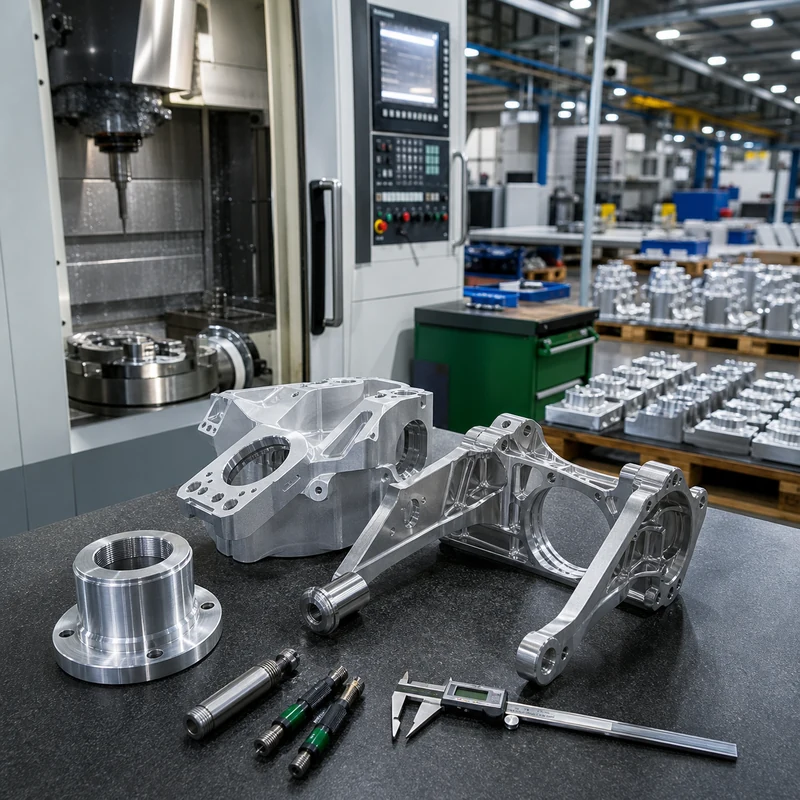
Mexico is an important manufacturing market for buyers who need CNC machined parts, precision assemblies, prototypes, and repeat production support. The right supplier can shorten development cycles and reduce sourcing risk, but a country-level search is only a starting point. Engineering teams still need to verify process capability, material control, inspection discipline, communication quality, and delivery reliability.
This MTSPi guide explains how to evaluate CNC machining companies in Mexico without relying on a simple brand list. It focuses on practical buying criteria for custom components in aerospace, automotive, medical, robotics, electronics, and industrial equipment. MTSPi can also review drawings through its CNC machining services workflow when a project needs an alternate sourcing path.
Why Buyers Look at Mexico for CNC Machining
Mexico has become a major nearshore manufacturing option for North American supply chains. Buyers often consider Mexican CNC machining suppliers for automotive, aerospace, medical device, electronics, and industrial equipment programs where geography, communication time zone, and logistics can reduce friction.
The market can be attractive for prototype support, production machining, and regional supply-chain resilience. As with any sourcing region, the buyer still needs to verify machine capability, inspection systems, material control, export experience, and the supplier’s ability to handle drawings and revision changes correctly.
Supplier Evaluation Checklist
| Evaluation Area | What to Confirm | Why It Matters |
|---|---|---|
| Process fit | 3-axis milling, 4-axis indexing, 5-axis machining, CNC turning, mill-turn, EDM, grinding, or Swiss-type capability | The equipment and setup strategy must match the actual geometry |
| Material experience | Aluminum, stainless steel, tool steel, titanium, brass, copper, and engineering plastics | Material behavior affects tolerance, burrs, tool wear, finish, and lead time |
| Quality planning | CMM inspection, calibrated gauges, first-article reports, in-process checks, and revision control | Precision parts need measurable evidence, not only visual approval |
| Production range | Prototype, low-volume, bridge production, and repeat-batch support | A strong sample must translate into stable repeat orders |
| Finishing control | Anodizing, passivation, plating, bead blasting, polishing, heat treatment, and packaging | Post-processing can change dimensions, appearance, and delivery risk |
| Communication | DFM feedback, drawing questions, response time, English documentation, and change tracking | Clear technical communication prevents rework |
Match the Supplier to the Part Type
A supplier that is excellent for simple brackets may not be the best choice for a thin-wall housing, a tight-concentricity shaft, a cosmetic aluminum enclosure, or a 5-axis aerospace-style component. Build the shortlist around the part, not around the marketing category.
| Part Requirement | Supplier Capability to Look For | Inspection Focus |
|---|---|---|
| Complex multi-face geometry | 5-axis machining or reliable multi-setup fixture planning | Datum relationships, profile tolerance, and repeat setup error |
| Turned shafts and sleeves | CNC turning, mill-turn, or Swiss-type machining | Diameter, runout, concentricity, thread quality, and surface finish |
| Cosmetic enclosures | Stable aluminum milling plus finishing coordination | Visible surfaces, edge breaks, anodizing allowance, and packaging |
| Medical or aerospace-style parts | Controlled processes, material records, and documented inspection | Critical dimensions, traceability, CMM data, and nonconformance handling |
| Production batches | Fixture control, tool-life rules, and repeatable process documentation | Lot-to-lot consistency and sampling plan |
Quality Questions to Ask Before Placing an Order
- Which dimensions are highest risk, and how will they be measured?
- How many setups are planned, and how will datum transfer be controlled?
- Will inspection be performed before or after surface treatment?
- Can the supplier provide a sample inspection report for similar tolerances?
- How are material certificates, drawing revisions, and process changes controlled?
- What packaging method protects cosmetic surfaces and precision edges during shipment?
Cost, Lead Time, and Hidden Risk
Unit price is only one part of sourcing cost. Buyers should also account for material availability, fixture cost, programming effort, inspection time, finishing lead time, export paperwork, logistics, and the cost of rework if requirements are misunderstood. A quote that ignores tolerance, finish, inspection, or packaging assumptions is not complete.
Nearshore sourcing can reduce transit time and simplify communication for North American teams, but it does not remove technical risk. Compare total landed cost, quality evidence, finishing lead time, packaging, customs process, and the supplier’s ability to maintain repeat-batch consistency.
When MTSPi Can Be a Practical Alternative
MTSPi supports custom CNC machining projects that need engineering review, competitive production cost, broad material options, finishing coordination, and inspection documentation. Services include CNC milling, CNC turning, 5-axis CNC machining, prototype machining, and low-volume production. For material selection, review the CNC materials library.
RFQ Package for Accurate Supplier Comparison
| RFQ Item | Recommended Detail |
|---|---|
| 3D CAD model | STEP or equivalent neutral file |
| 2D drawing | Tolerances, GD&T, threads, surface finish, datums, and critical notes |
| Material | Grade, temper, standard, and certificate requirement |
| Finish | Process, color, thickness, cosmetic surfaces, and masking notes |
| Quantity | Prototype quantity, annual volume, release schedule, and repeat order expectations |
| Inspection | Critical dimensions, report format, sampling level, and CMM needs |
Related MTSPi Resources
FAQ
How should I compare CNC machining companies in Mexico?
Compare suppliers by part fit, machine capability, material experience, tolerance control, inspection method, communication, finishing support, and repeat-production reliability.
Should I choose the lowest CNC machining quote?
Not automatically. A low quote can be useful, but it should include the same material, tolerance, finish, inspection, lead-time, and packaging assumptions as the competing quotes.
What files should I send for a CNC machining quote?
Send a 3D CAD file, a 2D drawing, material grade, finish requirements, quantity, target lead time, inspection requirements, and notes on the features that matter most to function.