

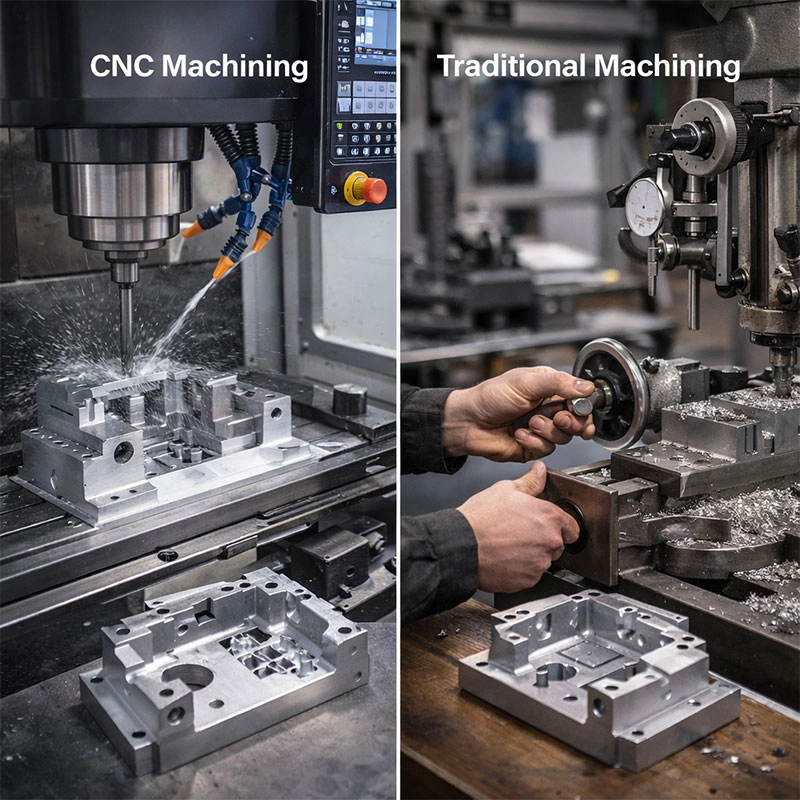
Choosing between CNC and traditional machining can be a pivotal decision for your manufacturing project. This guide breaks down their core differences in automation, precision, and cost to help you make an informed choice that aligns with your specific needs and budget.
The Core Differences: Automation vs. Craftsmanship
At its heart, the debate between CNC machining vs manual machining is about how control is exerted over the cutting tools. Think of it like driving: one is a pre-programmed, hands-off cruise control, and the other is a fully manual stick shift requiring constant input. This fundamental shift changes everything about the machining process.
How CNC Machining Works
CNC, or Computer Numerical Control machining, is all about automation. A machinist writes a program (using G-code) that tells the machine—be it a mill, lathe, or router—exactly what to do. Once set up, the machine runs the program with minimal human intervention, producing part after identical part. This method is fantastic for precision machining of complex geometries that would be incredibly time-consuming or impossible to do by hand. It’s the go-to for high-volume production or parts with tight tolerances.
How Traditional Machining Works
Traditional machining, often called conventional machining or manual machining, relies on the skill of a machinist operating machines like engine lathes, milling machines, or drill presses. The machinist directly controls the movement of the cutting tool using hand wheels, levers, and their expert judgment. This method offers incredible flexibility for one-off parts, quick prototypes, or repairs. The comparison of manual vs automated machining really shines here—it’s the difference between a custom-tailored suit and one bought off the rack.
Which Machining Process Fits Your Project?
So, how do you decide? There’s no single “best” option—only the best one for *your* job. Let’s walk through some common scenarios to see where each method excels. I often tell my clients that understanding the advantages of CNC over manual machining (and vice versa) is the key to a successful and cost-effective project.
When to Choose CNC Machining
You’ll likely want to lean towards CNC milling and turning services if your project has these characteristics:
Volume & Repeatability: Need 50, 500, or 5,000 identical parts? CNC is your friend. The initial setup and programming take time, but once done, reproducing parts is fast and consistent.
Complex Designs: Does your part have intricate contours, complex 3D shapes, or precise holes at odd angles? Computer-controlled machining handles these with ease, following the digital blueprint to the letter.
Extreme Precision: For parts where tolerances are measured in thousandths of an inch (or less), the automated precision of CNC is hard to beat. It minimizes human error.
Material Considerations: While both methods work with many materials, CNC is often more efficient for machining tough alloys or materials that benefit from highly consistent cutting parameters.
When to Choose Conventional Machining
Don’t count out traditional milling and lathe work just yet! It’s often the perfect choice for:
Prototypes & One-Offs: Need a single part made quickly to test a concept? A skilled manual machinist can often have it in your hands faster and for less money than programming a CNC machine.
Simplicity & Speed for Simple Parts: If you have a basic bracket with a few holes, the setup time on a manual mill or drill press can be almost instantaneous.
Modifications & Repairs: This is where traditional machining shines. Fixing a worn shaft, adding a new keyway to an existing gear, or modifying a casting on the fly is often easier and more intuitive on a manual machine.
Lower Budget for Simple Jobs: For very low-volume, simple parts, the lower overhead of a manual shop can mean significant cost savings. You’re paying primarily for skilled labor, not machine programming and amortization.
Making Your Final Decision: A Practical Guide
Feeling stuck? Let’s make it practical. Grab your project notes and ask yourself these questions, which get to the heart of the difference between CNC and manual machining:
What’s my quantity? (Low volume = lean traditional. High volume = lean CNC).
How complex is the geometry? (Simple shapes = either works. Complex curves = likely CNC).
What are my tolerance requirements? (Very tight = CNC. More forgiving = traditional can work).
What’s my timeline and budget? (Fast/cheap for one part = traditional. Consistent cost per part for many = CNC).
My best advice? Have a conversation with your machine shop. A good shop, like many reputable ones you can find through industry resources such as Thomasnet for supplier discovery or by reviewing standards on ASME’s website, will discuss these factors with you. They can tell you if your part is a better candidate for a CNC machine tool or a manual one, often saving you time and money. Remember, the goal isn’t to use the “most advanced” technology, but the *most appropriate* one to get your project from idea to finished part successfully.