Choosing between CNC machining and manual machining is a fundamental decision in manufacturing. This guide breaks down the key differences in precision, cost, and skill requirements to help you select the best milling process for your specific project needs, whether it’s a one-off prototype or high-volume production.
Understanding the Basics
Let’s start by getting familiar with our two main players. At its heart, the debate between CNC vs manual milling is about how we control the cutting tool that shapes a block of material into a finished part. Think of it like the difference between driving a car yourself and using a sophisticated autopilot system.
What is Manual Milling?
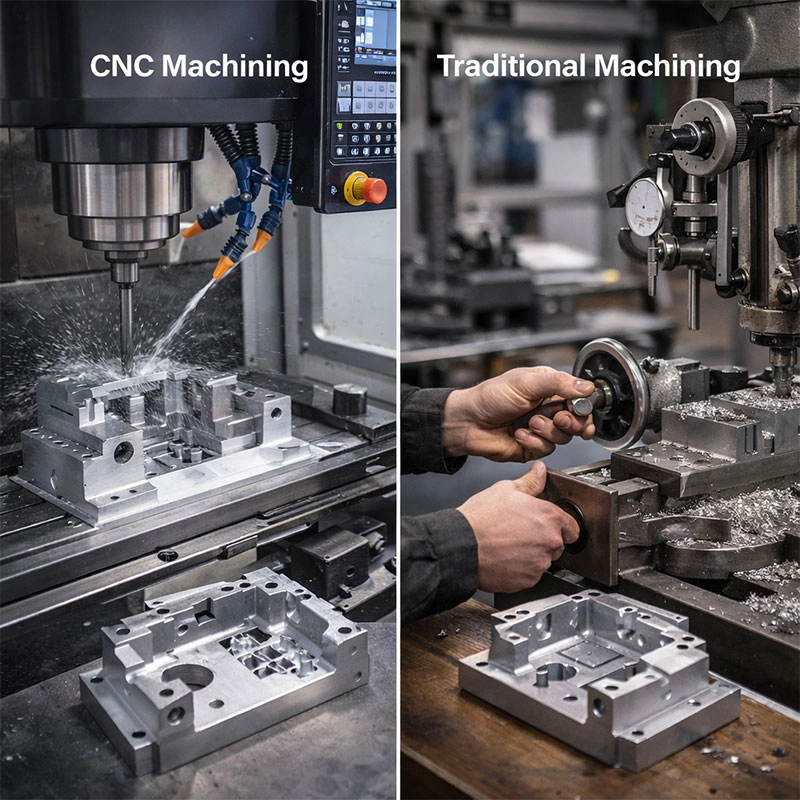
Manual milling, or conventional milling, is the hands-on, traditional approach. A skilled machinist directly operates the machine using handwheels and levers to control the movement of the workpiece and the cutting tool. It’s a tactile process where the operator’s experience, feel, and judgment are everything. They make real-time decisions about feed rates, depth of cut, and tool changes. This method is fantastic for quick, one-off jobs, repairs, or when you need to “make it work” with a personal touch. You might also hear it called knee mill or bridgeport milling operations, named after classic machine styles.
What is CNC Milling?
CNC milling, short for Computer Numerical Control milling, is the modern counterpart. Here, the machinist’s role shifts from direct operator to programmer and supervisor. They write code (often G-code) that instructs the machine’s computer on every single movement. The CNC machine then executes these instructions with incredible consistency. This process is central to subtractive manufacturing and is a cornerstone of automated machining. It’s perfect for producing identical parts over and over, or for creating highly complex geometries that would be nearly impossible to make by hand. For a deeper dive into the programming side, you can check out this resource on G-code fundamentals.
Head-to-Head Comparison
Now, let’s put them side-by-side. When you’re weighing manual machining vs CNC machining, several key factors will guide your decision. It’s not about which is universally better, but which is better *for you*.
Precision and Complexity
This is often the deciding factor. CNC milling machines excel here. They can hold tolerances within thousandths of an inch (or even tighter) repeatedly, part after part. They effortlessly create complex 3D contours, intricate pockets, and precise holes. Manual milling relies on the operator’s skill and measuring tools; while a master machinist can achieve high precision on a manual mill, it’s more time-consuming and difficult to maintain across multiple parts. So, if your project asks “how to achieve tight tolerances,” CNC is usually the answer.
Production Speed and Volume
Think about your batch size. For a single part or a very small run, a manual mill can be faster. There’s no programming time—you just set up and start cutting. However, for any kind of volume, CNC wins hands down. Once the program is proven, the machine can run unattended for hours, producing parts much faster than a human ever could. This makes CNC the go-to for high volume production.
Cost Considerations
Cost isn’t just about the machine price tag. Manual mills are significantly cheaper to purchase and maintain. However, CNC milling services factor in programming time and setup, which adds cost upfront. For low quantities, this can make manual more economical. But for larger runs, that upfront cost gets spread over many parts, making CNC more cost-effective per unit. You also have to consider labor costs over time.
Skill and Labor
The skills required are different. Manual milling demands years of hands-on experience to develop the “feel.” It’s a craft. CNC milling requires skills in computer-aided design (CAD), computer-aided manufacturing (CAM) software, and an understanding of machining principles to write efficient, safe code. Finding and training a traditional manual machinist can be challenging today, while the industry is increasingly geared toward CNC machining processes.
Flexibility and Setup
Need to make a quick change or adjustment on the fly? The manual mill offers immediate flexibility. You can see a problem and correct it instantly. Changing a program on a CNC machine, however, requires stopping, editing the code, and potentially re-proving the toolpath. For prototyping or one-off modifications, that hands-on control can be a huge advantage.
Making the Right Choice for Your Project
So, how do you decide? Let’s match the technology to typical project scenarios. I often tell people to start by asking: “What is the primary goal for this part?
When to Choose Manual Milling
Choose a manual mill when you’re dealing with low volume milling or truly unique pieces. It’s ideal for:
– Quick prototypes where form is more important than ultra-tight tolerance.
– Repair work or modifying existing parts.
– Educational settings where learning the fundamentals of cutting forces and tool behavior is key.
– Simple, flat, or squared parts that don’t require complex programming.
If your shop already has the skilled talent and the project is a simple bracket or a repair job, firing up the bridgeport mill is often the most sensible path.
When to Choose CNC Milling
Opt for CNC when precision, complexity, or volume are priorities. It’s the best fit for:
– Parts with complex geometries, curves, or 3D surfaces.
– Production runs where every part must be identical.
– Materials that are difficult to machine, where consistent parameters are crucial.
– Projects requiring extremely tight tolerances.
– Situations where you have a digital CAD model ready to go.
For insights into designing parts specifically for this process, look at guidelines for design for manufacturability (DFM).
Common Misconceptions Cleared Up
Let’s tackle a few myths I hear all the time. First, “CNC does everything automatically.” Not quite! A skilled person is still essential for programming, tool selection, fixture design, and monitoring. Second, “Manual milling is obsolete.” Far from it! Many job shops thrive with manual machines for specific tasks. Finally, “CNC is always more expensive.” As we saw, for one-off parts, the programming cost can make manual the cheaper option. The real answer to benefits of CNC over manual depends entirely on context.
Conclusion and Final Thoughts
In the end, the choice between CNC and manual milling isn’t a battle with one winner. It’s about selecting the right tool from your manufacturing toolbox. Manual milling offers unparalleled hands-on control and simplicity for small jobs. CNC milling delivers unbeatable precision, repeatability, and efficiency for complex or high-volume work. Many successful machine shops actually use both, leveraging the strengths of each. My advice? Honestly assess your project’s requirements for precision, quantity, complexity, and budget. That assessment will clearly point you toward the milling method that is right for *your* project.