Categories
CNC Machining Basics

Discover the Top 5 CNC Machining Advantages for Your Projects

When you’re planning a new project, choosing the right manufacturing method is crucial. CNC machining offers a powerful set of benefits that can save you time, money, and headaches. Let’s explore the top five advantages of using CNC technology and see how it can make your next idea a reality.

Unmatched Precision and Consistency

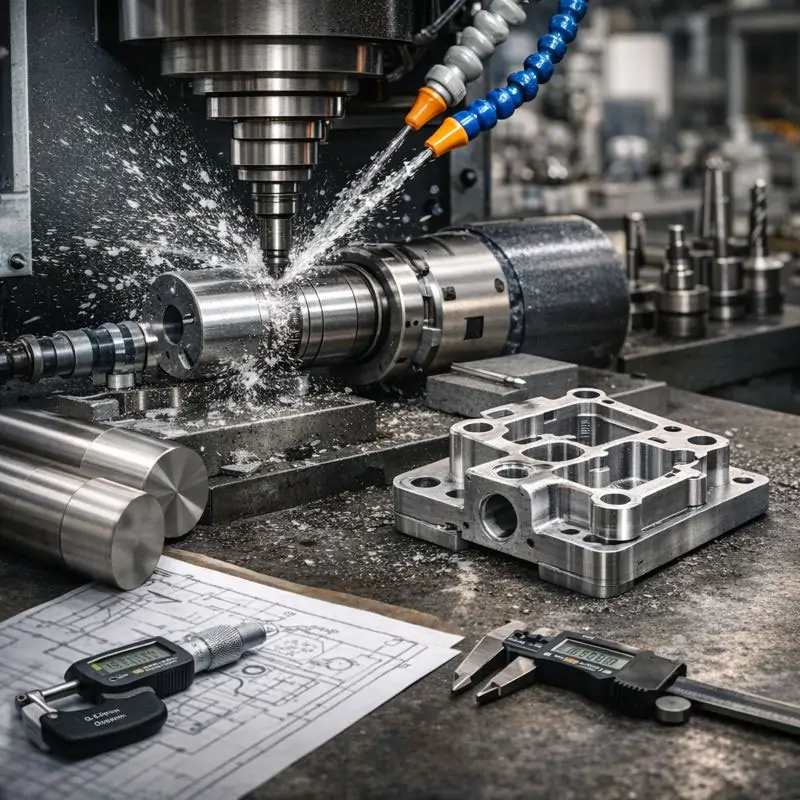
One of the biggest benefits of CNC milling and turning is the incredible accuracy it delivers. We’re talking about tolerances within thousandths of an inch, something nearly impossible to achieve consistently by hand. This precision is controlled by computer programs, meaning every single part in a run is virtually identical to the last. Whether you need ten parts or ten thousand, you can trust they will all fit and function exactly as designed. This eliminates the “part variation” headache that can stall assembly lines and derail project timelines.

How This Precision Works for You

Imagine you’re creating a custom drone frame. The motor mounts need to be perfectly aligned, or you’ll get vibration and poor performance. With computer numerical control machining, the machine follows the digital blueprint to the letter, drilling each mounting hole in the exact same spot on every frame. This level of CNC manufacturing accuracy is why industries from aerospace to medical devices rely on it for critical components. It turns complex designs into reliable, repeatable reality.

Incredible Efficiency and Speed

Once the program is set, a CNC machine can work tirelessly—24/7 if needed—with minimal supervision. This automation translates directly into faster production times compared to manual machining. What might take a skilled machinist hours to complete can often be done in a fraction of the time. Plus, modern machines can often perform multiple operations (like milling, drilling, and tapping) in a single setup. This efficiency is a major reason why CNC machining benefits businesses by shortening lead times and getting products to market faster. You’re not just buying a part; you’re buying back valuable time.

Remarkable Material and Design Versatility

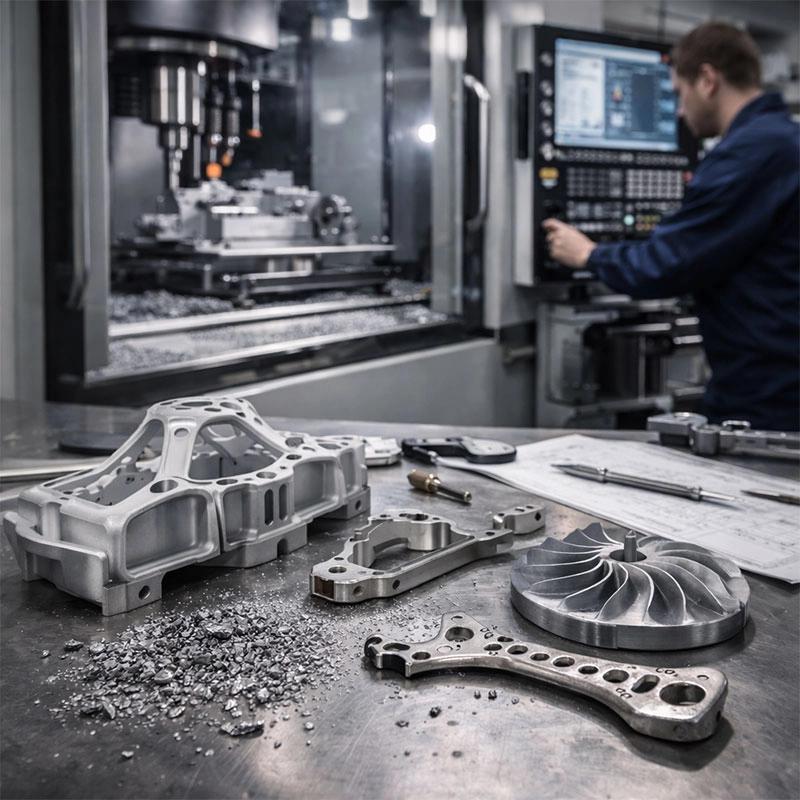
Wondering about the advantages of CNC over traditional machining when it comes to materials? The range is astounding. From metals like aluminum, steel, and titanium to various plastics and even woods, CNC systems can handle them all. This flexibility extends to design complexity as well. Intricate 3D contours, deep pockets, and fine details that would be costly or impossible with manual methods are standard fare for a 5-axis CNC mill. This opens up a world of possibilities for innovative product design and functional prototyping. You’re truly limited only by your imagination (and the laws of physics!).

Enhanced Safety and Reduced Labor Intensity

This is a significant but often overlooked perk. In CNC machine shop operations, the operator’s primary role is to monitor the process, load materials, and perform quality checks—not to stand directly over a spinning cutter. The cutting happens inside an enclosed workspace, dramatically reducing the risk of accidents associated with manual lathes or mills. This creates a safer work environment and allows skilled personnel to focus on programming, optimization, and quality assurance rather than repetitive, physically demanding tasks. It’s a smarter, safer way to build things.

Excellent Scalability for Any Volume

Whether you need a one-off prototype or a full production run, CNC is a fantastic choice. For prototyping, you can quickly iterate designs by simply modifying the digital file. When you’re ready for production, that same file can run to manufacture hundreds or thousands of identical parts with ease. This seamless transition from CNC prototyping advantages to full-scale manufacturing makes it a uniquely scalable solution. You don’t need to switch processes or retool extensively, which saves money and maintains consistency across your entire product lifecycle. It’s as suitable for a startup’s first batch as it is for an established company’s ongoing needs.

Key Benefits of CNC Machining for Modern Manufacturing

So, what does all this mean for your project? In short, CNC machining provides a reliable, precise, and flexible foundation for bringing ideas to life. The combination of digital accuracy, material flexibility, and efficient production empowers designers and engineers to solve problems in new ways. By leveraging these top advantages of CNC technology, you can reduce costs, accelerate development, and produce higher-quality parts. It’s a cornerstone of modern making, turning complex digital designs into tangible, high-performance objects you can hold in your hand. Ready to see what it can do for you?
Categories
Manufacturing Process Comparisons

CNC vs. Traditional Machining: Which Is Right for Your Project?

Choosing between CNC and traditional machining can be a pivotal decision for your manufacturing project. This guide breaks down their core differences in automation, precision, and cost to help you make an informed choice that aligns with your specific needs and budget.

The Core Differences: Automation vs. Craftsmanship

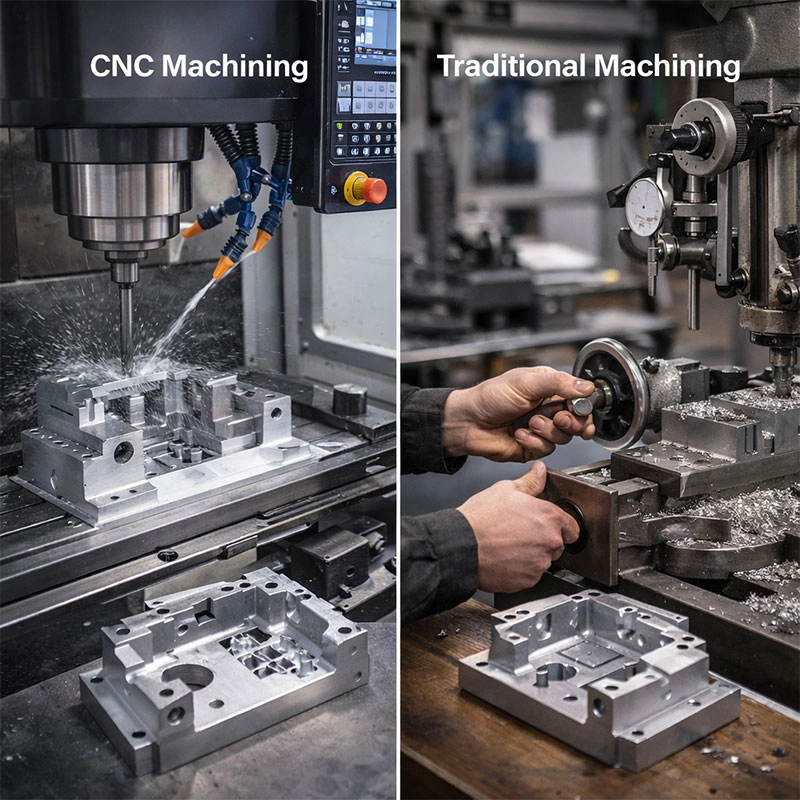
At its heart, the debate between CNC machining vs manual machining is about how control is exerted over the cutting tools. Think of it like driving: one is a pre-programmed, hands-off cruise control, and the other is a fully manual stick shift requiring constant input. This fundamental shift changes everything about the machining process.

How CNC Machining Works

CNC, or Computer Numerical Control machining, is all about automation. A machinist writes a program (using G-code) that tells the machine—be it a mill, lathe, or router—exactly what to do. Once set up, the machine runs the program with minimal human intervention, producing part after identical part. This method is fantastic for precision machining of complex geometries that would be incredibly time-consuming or impossible to do by hand. It’s the go-to for high-volume production or parts with tight tolerances.

How Traditional Machining Works

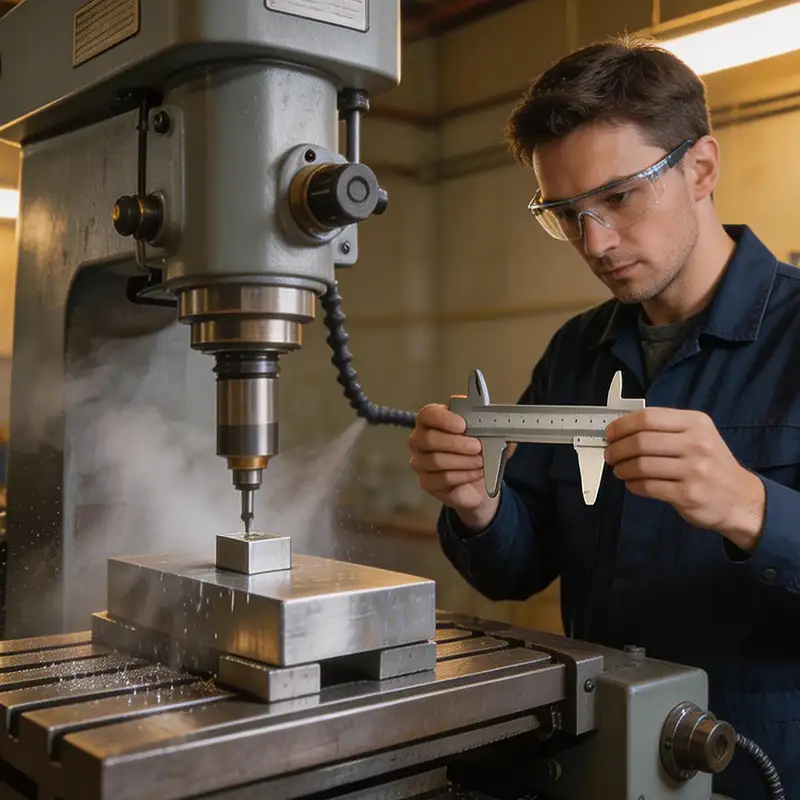
Traditional machining, often called conventional machining or manual machining, relies on the skill of a machinist operating machines like engine lathes, milling machines, or drill presses. The machinist directly controls the movement of the cutting tool using hand wheels, levers, and their expert judgment. This method offers incredible flexibility for one-off parts, quick prototypes, or repairs. The comparison of manual vs automated machining really shines here—it’s the difference between a custom-tailored suit and one bought off the rack.

Which Machining Process Fits Your Project?

So, how do you decide? There’s no single “best” option—only the best one for *your* job. Let’s walk through some common scenarios to see where each method excels. I often tell my clients that understanding the advantages of CNC over manual machining (and vice versa) is the key to a successful and cost-effective project.

When to Choose CNC Machining

You’ll likely want to lean towards CNC milling and turning services if your project has these characteristics:

Volume & Repeatability: Need 50, 500, or 5,000 identical parts? CNC is your friend. The initial setup and programming take time, but once done, reproducing parts is fast and consistent.

Complex Designs: Does your part have intricate contours, complex 3D shapes, or precise holes at odd angles? Computer-controlled machining handles these with ease, following the digital blueprint to the letter.

Extreme Precision: For parts where tolerances are measured in thousandths of an inch (or less), the automated precision of CNC is hard to beat. It minimizes human error.

Material Considerations: While both methods work with many materials, CNC is often more efficient for machining tough alloys or materials that benefit from highly consistent cutting parameters.

When to Choose Conventional Machining

Don’t count out traditional milling and lathe work just yet! It’s often the perfect choice for:

Prototypes & One-Offs: Need a single part made quickly to test a concept? A skilled manual machinist can often have it in your hands faster and for less money than programming a CNC machine.

Simplicity & Speed for Simple Parts: If you have a basic bracket with a few holes, the setup time on a manual mill or drill press can be almost instantaneous.

Modifications & Repairs: This is where traditional machining shines. Fixing a worn shaft, adding a new keyway to an existing gear, or modifying a casting on the fly is often easier and more intuitive on a manual machine.

Lower Budget for Simple Jobs: For very low-volume, simple parts, the lower overhead of a manual shop can mean significant cost savings. You’re paying primarily for skilled labor, not machine programming and amortization.

Making Your Final Decision: A Practical Guide

Feeling stuck? Let’s make it practical. Grab your project notes and ask yourself these questions, which get to the heart of the difference between CNC and manual machining:

What’s my quantity? (Low volume = lean traditional. High volume = lean CNC).

How complex is the geometry? (Simple shapes = either works. Complex curves = likely CNC).

What are my tolerance requirements? (Very tight = CNC. More forgiving = traditional can work).

What’s my timeline and budget? (Fast/cheap for one part = traditional. Consistent cost per part for many = CNC).

My best advice? Have a conversation with your machine shop. A good shop, like many reputable ones you can find through industry resources such as Thomasnet for supplier discovery or by reviewing standards on ASME’s website, will discuss these factors with you. They can tell you if your part is a better candidate for a CNC machine tool or a manual one, often saving you time and money. Remember, the goal isn’t to use the “most advanced” technology, but the *most appropriate* one to get your project from idea to finished part successfully.

Categories
CNC Machining Basics

Discover Why Use Precision CNC Machining for Superior Results

When you need parts that fit perfectly every single time, precision CNC machining is the go-to solution. This guide explores the core benefits of this advanced manufacturing process, from unmatched accuracy to incredible material versatility, explaining why it’s essential for achieving superior, reliable results in your projects.

Unmatched Accuracy and Repeatability

Let’s start with the most obvious reason: precision. When we talk about precision machining, we’re referring to the ability to produce parts with extremely tight tolerances, often within microns. Imagine you’re assembling a high-performance engine or a medical device; a tiny deviation can lead to failure. That’s where CNC precision shines. The computer-controlled process follows the digital design to the letter, eliminating the human error you might find in manual machining. Once the program is perfect, the machine can reproduce that exact part hundreds or thousands of times with incredible consistency. This repeatability is a game-changer for maintaining quality across large production runs.

Why Tight Tolerances Matter

You might wonder, “How critical can a thousandth of an inch really be?” In many industries, it’s everything. For instance, in aerospace or precision manufacturing for medical implants, components must fit together seamlessly under extreme stress or within the human body. This level of high precision machining ensures safety, functionality, and longevity. It’s the difference between a part that works and one that becomes a costly liability.

Ability to Create Complex Geometries

Another compelling reason to use CNC machining is its capability to handle designs that would be impossible or prohibitively expensive with other methods. Need intricate contours, deep cavities, or complex 3D shapes? A multi-axis CNC machine can approach the material from almost any angle in a single setup. This flexibility allows engineers and designers to innovate without being constrained by manufacturing limitations. Whether it’s a custom bracket with organic curves or a mold with fine details, CNC milling and turning bring the most sophisticated blueprints to life.

Incredible Material Versatility

One of the fantastic aspects of CNC processing is its compatibility with a vast range of materials. From metals like aluminum, stainless steel, and titanium to various plastics, composites, and even wood, the same machine can be adapted to cut them all. This versatility answers the question of why choose CNC machining for prototyping. You can test your design in the final intended material right from the start, getting a true sense of its performance, weight, and feel. It removes the guesswork and helps you make better decisions early in the development cycle.

Enhanced Efficiency and Scalability

Efficiency isn’t just about speed; it’s about smart workflow. Once the initial setup and programming are complete, CNC machines can run with minimal supervision, often through the night. This automation of the cutting process translates to faster turnaround times and lower labor costs per part. Furthermore, scaling up is straightforward. Whether you need 50 units or 50,000, the process remains consistent. This seamless transition from low-volume to high-volume production makes precision CNC services incredibly cost-effective in the long run. For a deeper dive into manufacturing processes, you can explore resources from the American Society of Mechanical Engineers (ASME).

From Prototype to Production

This scalability is a key benefit of CNC machining. You can use the same machine and program to create a one-off prototype for verification and then immediately ramp up to full-scale production. There’s no need to retool or change the entire manufacturing method, which saves a tremendous amount of time and money. It provides a smooth, reliable path from your initial concept to market.

Superior Surface Finish and Part Integrity

Finally, let’s talk about quality. Precision computer numerical control doesn’t just shape a part; it can leave an excellent surface finish right off the machine. The controlled, precise movement of the cutting tool results in cleaner cuts with less burr and stress on the material. This means parts often require less secondary finishing work, and the material’s structural integrity is better preserved. For components subject to fatigue or precise mating, this superior finish and integrity are crucial for performance and durability. In essence, choosing precision CNC is an investment in a superior final product that looks, feels, and performs exactly as intended.

Categories
CNC Machining Basics

Discover 5 Key Benefits of Precision CNC Machining for Your Projects

Precision CNC machining offers a game-changing approach to manufacturing. By understanding its core advantages, you can unlock new levels of quality, efficiency, and cost-effectiveness for your projects, from prototypes to full-scale production.

Unmatched Accuracy and Repeatability

When we talk about the advantages of CNC machining, the first thing that comes to mind is its incredible precision. Think of it like a master craftsperson who never gets tired and makes the exact same perfect cut, thousands of times in a row. This isn’t just about making parts look good; it’s about ensuring they function perfectly every single time. For industries like aerospace, medical devices, or automotive, where a tiny deviation can have big consequences, this level of control is non-negotiable.

Hitting Those Tight Tolerances

Modern CNC milling and turning centers can achieve tolerances measured in microns. This means you can design complex components with intricate features and trust that the finished part will match your digital model exactly. This repeatability is a huge benefit—whether you’re making ten parts or ten thousand, the first and the last will be virtually identical. It removes the variability often found in manual machining and gives you peace of mind.

Superior Part Quality and Consistency

Closely tied to accuracy is the overall quality you get. Precision manufacturing produces parts with excellent surface finishes and structural integrity right off the machine. You might find you need little to no secondary finishing work, which speeds up your project timeline. This consistency is a dream for assembly lines, as every component fits together seamlessly without extra filing or adjustment. It’s one of the key reasons businesses choose CNC machining services for critical components.

Remarkable Material and Design Versatility

One of my favorite aspects is how flexible this process is. Wondering about the benefits of CNC machining for prototypes? It’s perfect because you can quickly test designs in the actual material you plan to use for production. The process works with a stunning array of materials—from metals like aluminum, stainless steel, and titanium to various plastics and composites. This machining process versatility allows you to select the ideal material for strength, weight, corrosion resistance, or cost without being limited by the manufacturing method.

Enhanced Efficiency and Faster Turnaround

Once the computer-aided design (CAD) model is programmed into the machine, the production process is highly efficient. Complex parts that might take a skilled machinist days to make manually can be completed in hours. This speed is a major advantage of automated machining. Furthermore, because the machines can run unattended for long periods, you get faster project completion times. This efficiency is crucial for meeting tight deadlines and getting your product to market sooner.

Long-Term Cost Savings

While the initial setup for precision CNC cutting might seem like an investment, it leads to significant savings down the road. The reduction in manual labor, minimized errors and reworks, and faster production cycles all contribute to a lower cost per part, especially for medium to high-volume runs. It transforms your cost structure from a variable expense to a more predictable one.

Reduced Material Waste

The precision of the tool paths means material is removed only where absolutely necessary. This subtractive manufacturing approach, guided by advanced software, is far more material-efficient than traditional methods. You use less raw material, and you also spend less on waste disposal. For more on sustainable manufacturing practices, you can read about material efficiency from sources like the U.S. Department of Energy. This careful use of resources is both economically and environmentally smart.

In wrapping up, integrating high-accuracy CNC fabrication into your workflow isn’t just about keeping up with technology; it’s about actively improving your outcomes. The five key benefits we’ve explored—extreme accuracy, consistent quality, design freedom, operational efficiency, and cost-effectiveness—work together to give your projects a serious competitive edge. Whether you’re refining a prototype or scaling up production, these advantages make a compelling case for choosing this advanced manufacturing path.

Request A Quote

We'll Send You Back with Price Immediately!

DEC 1-31

XMAS SPECEIL

Up to

40% off

Discover 5 Key Benefits of Precision CNC Machining for Your Projects

We'll Send You Back with Price Immediately!