

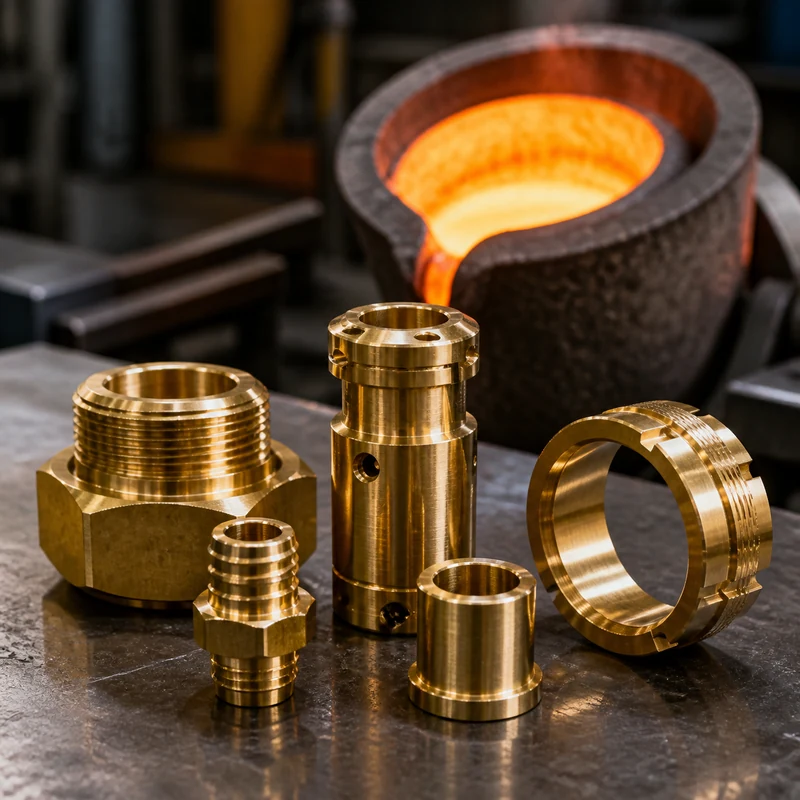
Brass does not have one universal melting point. It is a family of copper-zinc alloys, and each composition passes through a melting interval between its solidus and liquidus temperatures. For common wrought brasses, that interval is often roughly 880–950°C (1,616–1,742°F), but the certified range for the specified grade should control any thermal process.
This distinction matters in manufacturing. A part may begin to lose strength, distort, or develop a low-melting constituent well before the alloy becomes completely liquid. Engineers planning brazing, heat exposure, casting, or failure analysis should therefore work from alloy identity and service conditions—not a single generic number.
Melting Point, Solidus, and Liquidus
The solidus is the temperature below which the alloy is fully solid. Between solidus and liquidus, solid and liquid phases coexist. Above the liquidus, the alloy is fully molten. Published values can vary with chemistry limits, test method, and source, so they are useful for preliminary design but are not a substitute for a mill certificate or grade-specific data sheet.
| Brass family | Typical composition tendency | Approximate melting behavior | Manufacturing note |
|---|---|---|---|
| Cartridge brass | Higher copper, commonly near 70/30 Cu-Zn | About 915–955°C | Good cold formability; verify grade before heating |
| Yellow brass | Commonly near 65/35 Cu-Zn | About 900–940°C | Broad commercial use; zinc loss is a heating concern |
| Free-machining brass | Copper-zinc with machinability additions | Often about 885–930°C | Excellent cutting behavior; composition and compliance matter |
| Naval brass | Copper-zinc with tin | Often about 890–940°C | Chosen for corrosion performance; use certified values |
| Red brass/gunmetal-type alloys | Higher copper, often with tin/lead variants | Often higher and grade dependent | Do not group unlike casting and wrought grades |
The ranges above are orientation values, not furnace setpoints. Exact limits must come from the applicable material specification.
Why Composition Changes the Range
Copper melts at a substantially higher temperature than zinc. Increasing zinc generally lowers the brass melting interval, while tin, lead, silicon, aluminum, nickel, and other additions alter phase behavior in different ways. Small chemistry differences may also change hot ductility, oxidation, fumes, and suitability for joining.
Zinc Loss and Fume Control
Zinc is volatile at elevated temperature. Prolonged or poorly controlled heating can change surface chemistry, create oxide, and produce hazardous fumes. Any melting, brazing, or hot-working operation needs suitable ventilation, exposure controls, clean charge material, and a validated process. Do not use appearance alone to judge alloy condition.
Melting Is Not the Same as Safe Service Temperature
A brass component can soften, creep, lose temper, relax a press fit, or damage a seal hundreds of degrees below its melting interval. The allowable service temperature depends on load, time, temper, geometry, environment, joining method, and the governing code. For a machined assembly, thermal expansion may shift alignment or preload before metallurgical damage occurs.
| Question | Value to use |
|---|---|
| Will the alloy fully melt? | Liquidus temperature for the exact grade |
| When can incipient melting begin? | Solidus and phase-specific data |
| Can the part carry load while hot? | Temperature-dependent strength and creep data |
| Will a press fit remain stable? | Expansion, modulus, yield, geometry, and dwell time |
| Can it be brazed or soldered? | Filler range, base-alloy solidus, joint design, and process window |
Implications for CNC-Machined Brass Parts
Most brass machining occurs far below melting temperatures, yet local heat still affects size, finish, tool life, and chip formation. Sharp tools, stable workholding, appropriate cutting data, and chip evacuation help prevent rubbing and built-up material. MTSPi’s brass CNC machining workflow considers grade, geometry, surface finish, and inspection temperature together.
Grade Identification
Calling out only “brass” leaves purchasing and production too much freedom. Specify the recognized alloy designation, temper, stock form, and any restrictions on lead or other constituents. If conductivity, dezincification resistance, potable-water compliance, or color is functional, state it explicitly on the controlled drawing.
Thermal Fit and Tolerance
Brass expands more than many steels. In mixed-material assemblies, temperature changes can alter clearances and interference fits. Define the operating range and functional condition, then apply tolerances to the interfaces that matter. For critical dimensions, MTSPi’s quality assurance process can align inspection method and reporting with the drawing.
Joining Brass Without Damaging the Base Material
- Soldering: uses a comparatively low-temperature filler and is appropriate for selected electrical or fluid joints.
- Brazing: provides stronger joints at higher temperature, but the process window must remain safely below damaging base-alloy conditions.
- Welding: is grade sensitive because zinc loss, porosity, cracking, and fume generation must be controlled.
- Mechanical joining: avoids bulk heating but introduces thread, preload, galvanic, and sealing considerations.
Practical Material and Process Checklist
- Identify the exact alloy and governing material specification.
- Obtain solidus/liquidus and hot-property data from the qualified source.
- Separate melting limits from allowable service temperature.
- Account for zinc fumes, oxidation, ventilation, and operator safety.
- Validate filler metal, flux, atmosphere, dwell time, and joint clearance.
- Review thermal expansion across the complete assembly.
- Inspect heat-affected dimensions and surfaces after the process.
Frequently Asked Questions
What temperature does brass melt at?
Many common brasses melt across roughly 880–950°C, but the correct answer is a grade-specific solidus-to-liquidus range.
Why is there no single brass melting point?
Brass contains multiple elements. Different phases begin and finish melting at different temperatures.
Can brass fail below its melting range?
Yes. Softening, creep, stress relaxation, oxidation, or loss of temper may make a part unusable well below melting.
Does machining melt brass?
Correct CNC cutting removes chips without bulk melting. Excessive rubbing can create harmful local heat and poor finish, which is controlled through tooling and process parameters.
Conclusion
Treat brass melting behavior as a grade-dependent interval, not a single lookup value. For reliable parts, combine certified chemistry and solidus/liquidus data with hot strength, service load, thermal expansion, joining conditions, and manufacturing controls. Explore MTSPi’s machining materials resources or send an RFQ for a grade-specific review.