

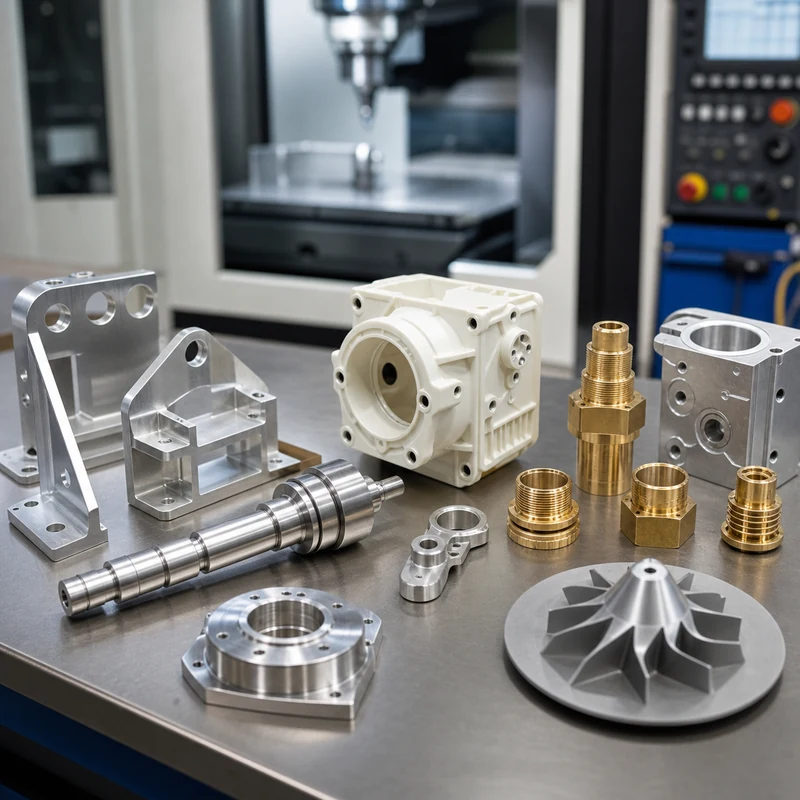
CNC machines can make a wide range of products, from simple plates and brackets to precision housings, shafts, heat sinks, fixtures, molds, connectors, robotic parts, and medical or aerospace components. The same core idea applies across all of them: a digital toolpath controls a cutting process so the finished part matches the model and drawing.
The best CNC product is not defined only by shape. It also depends on material, tolerance, surface finish, quantity, inspection level, and how the part will be assembled. MTSPi supports custom machined parts through CNC machined products, material planning, and production-oriented quality control.
Examples of CNC-Made Products
| Product Type | Examples | Common Process |
|---|---|---|
| Structural parts | Brackets, plates, frames, mounting blocks, machine bases | 3-axis milling, 4-axis milling, 5-axis machining |
| Rotational parts | Shafts, bushings, spacers, collars, rollers, pins | CNC turning, Swiss-type machining, mill-turn |
| Enclosures and housings | Sensor housings, electronics cases, motor covers, valve bodies | Milling, drilling, tapping, boring |
| Thermal parts | Heat sinks, cold plates, cooling blocks, finned components | Milling, drilling, surface finishing |
| Tooling and fixtures | Inspection fixtures, assembly jigs, soft jaws, nests, gauges | Milling, turning, grinding-ready machining |
| Molds and dies | Mold inserts, cavities, cores, die details | 3-axis and 5-axis milling |
| Decorative or functional panels | Nameplates, engraved plates, dashboard panels, prototypes | Milling, engraving, finishing |
Parts by Industry
Aerospace and drones
CNC machining can produce lightweight brackets, sensor mounts, landing gear parts, housings, antenna components, and structural frames. Aluminum and titanium are common because weight and strength matter.
Medical and life science
Medical projects often use stainless steel, titanium, aluminum, and engineering plastics for instrument components, housings, fixtures, and test hardware. Inspection, material control, and finish quality are especially important.
Robotics and automation
Robots need accurate joints, grippers, end-effectors, actuator housings, bearing blocks, shafts, sensor mounts, and lightweight plates. CNC machining is useful because fit and repeatability affect motion performance.
Electronics and semiconductor equipment
CNC machines can make enclosures, heat sinks, vacuum-compatible components, connector blocks, precision plates, and fixture hardware for electronics and semiconductor workflows.
Materials Used for CNC Products
- Aluminum for lightweight prototypes, housings, brackets, and heat sinks.
- Stainless steel for corrosion-resistant and durable components.
- Brass and copper for fittings, contacts, thermal parts, and electrical components.
- PEEK, POM, nylon, ABS, PC, and acrylic for insulated, lightweight, or low-friction parts.
What Cannot Be Made Efficiently With CNC?
CNC machining is not always the best answer. Thin sheet-metal parts may be better suited to laser cutting and bending. Very high-volume plastic parts may justify injection molding. Extremely large cast shapes may need casting first, followed by CNC finishing. The right process depends on geometry, volume, material, and cost target.
Design Tips for CNC-Made Products
- Use realistic internal radii instead of sharp inside corners.
- Avoid very deep narrow pockets unless they are functionally necessary.
- Specify only the tolerances that affect fit, motion, sealing, or inspection.
- Choose finishes early because anodizing, plating, polishing, and coating change dimensions and appearance.
- Include drawings for threads, critical dimensions, flatness, surface roughness, and inspection notes.
From Idea to Finished Part
A typical project starts with CAD files and a drawing, then moves through manufacturability review, material selection, machining strategy, finishing, inspection, and shipment. For early-stage designs, rapid prototyping helps test fit and function before committing to a larger production run.
Related MTSPi Resources
FAQ
Can a CNC machine make finished products?
Yes. CNC machines can make finished components and, in some cases, complete products. Many projects still require secondary operations such as finishing, assembly, marking, or inspection.
Is CNC better for metal or plastic parts?
CNC works well for both. The best material depends on strength, weight, temperature, friction, chemical exposure, appearance, and cost.