

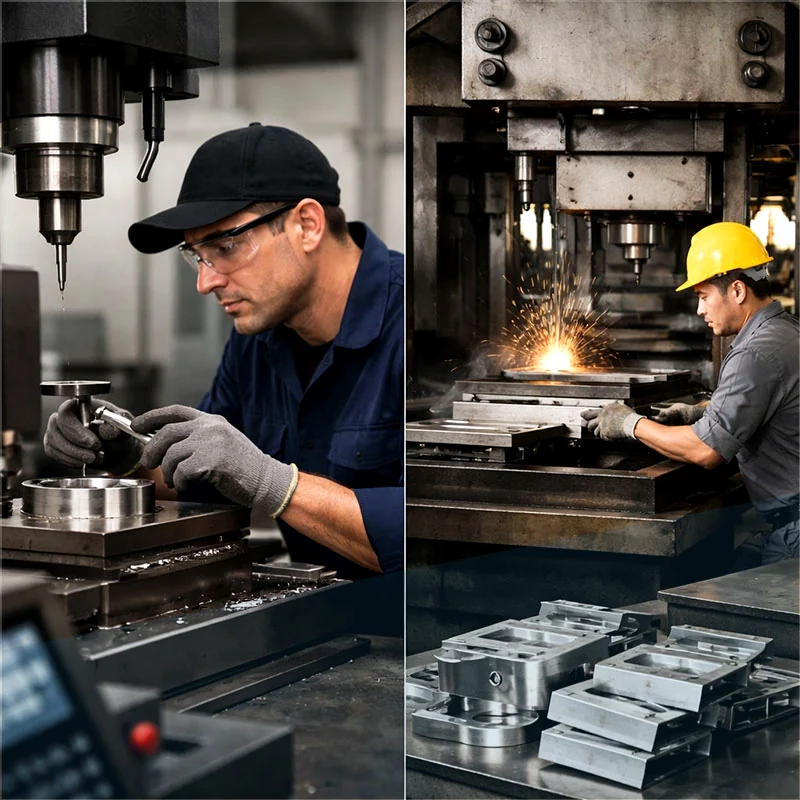
Precision Metal Stamping: What Determines Part Accuracy and When CNC Is Better is a practical manufacturing question because the answer affects cost, lead time, material behavior, inspection, and the path from prototype to production. For MTSPi CNC customers, the key is not simply naming a process, but understanding how the process connects with machined parts, fixtures, tolerances, surface requirements, and final assembly.
This guide explains precision metal stamping from an engineering and purchasing point of view. It is written for product developers, mechanical engineers, sourcing teams, and buyers who need clear decisions rather than generic process descriptions.
Quick Answer
Stamping is ideal for high-volume sheet metal parts with repeatable 2D or formed features. CNC machining is better when quantities are low, geometry is thicker or more complex, tolerances are very tight, or the design is still changing.
Key Differences at a Glance
| Point | Option A | Option B |
|---|---|---|
| Best volume | Medium to high volume | Prototype to low-volume precision batches |
| Tooling | Dedicated die required | Soft tooling and fixtures |
| Geometry | Sheet metal cuts and forms | 3D shapes, pockets, bores, threads |
| Design changes | Can be expensive after hard tooling | Easier to revise |
| Accuracy drivers | Die wear, springback, material thickness | Machine rigidity, toolpath, setup, inspection |
How the Process Choice Affects Real Parts
A manufacturing method should be selected around the feature that actually controls function. Cosmetic surfaces, hidden support features, threads, bores, sealing faces, heat-transfer areas, and assembly datums do not carry the same risk. When those requirements are mixed together without priority, quotes become inconsistent and production becomes harder to control.
The safest workflow is to define the part requirement first, then match the process. A printed prototype may answer shape questions, a molded sample may answer appearance questions, and a CNC machined sample may answer tolerance, material, and functional questions. Many successful projects use more than one method before the final design is locked.
Design and Manufacturing Considerations
- Use generous bend radii where possible to reduce cracking and springback variation.
- Keep holes away from bends unless the tooling plan supports them.
- Define burr direction when assembly or safety is affected.
- Prototype critical interfaces with CNC or soft tooling before hard dies.
- Do not choose stamping only because the final volume is uncertain.
Cost, Lead Time, and Risk Factors
Cost is driven by setup, tooling, material, machine time, inspection, finishing, and revision risk. A low unit price is not always the lowest project cost if it creates rework later. For prototypes and low-volume orders, flexibility can be more valuable than a process with a lower theoretical unit cost.
- Use standard materials and standard feature sizes when they do not weaken the design.
- Separate critical tolerances from general dimensions so the supplier knows where to focus.
- Confirm surface finish and cosmetic requirements before production begins.
- Avoid late changes to mounting holes, connector openings, datum faces, and threaded features.
- Send CAD files and 2D drawings together when tolerances, threads, or finishes matter.
Quality Checks Before Production
A good quality plan checks the features that influence assembly and performance. Depending on the part, this may include dimensional inspection, thread gauges, surface roughness, flatness, perpendicularity, burr control, coating thickness, visual appearance, and fit with mating parts.
When This Topic Matters for CNC Buyers
precision metal stamping matters when a team is comparing prototype routes, validating a design, replacing a weak supplier, or trying to reduce manufacturing cost without damaging function. The best choice is usually the process that answers the current engineering question with the least unnecessary risk.
MTSPi CNC Engineering Notes
MTSPi CNC supports precision CNC milling, turning, rapid prototyping, low-volume production, finishing, and inspection for custom parts. If your project uses molding, casting, welding, PCB assemblies, or 3D printing, CNC machining can still be important for datums, holes, threads, sealing faces, fixtures, and production-ready prototypes.
Frequently Asked Questions
Can this process replace CNC machining?
Sometimes it can replace CNC for non-critical geometry, but CNC is often still needed when tight tolerances, real engineering material, threads, flat sealing faces, or precise mating features are required.
What files help MTSPi CNC review a project?
STEP or STP files are useful for geometry. A 2D drawing is important for tolerances, materials, threads, surface finish, inspection requirements, and notes that are not obvious from the CAD model.
How do I reduce manufacturing risk?
Define critical features, avoid unnecessary tight tolerances, confirm material and finish requirements, and use prototypes to validate assembly before committing to higher-volume tooling or production.