

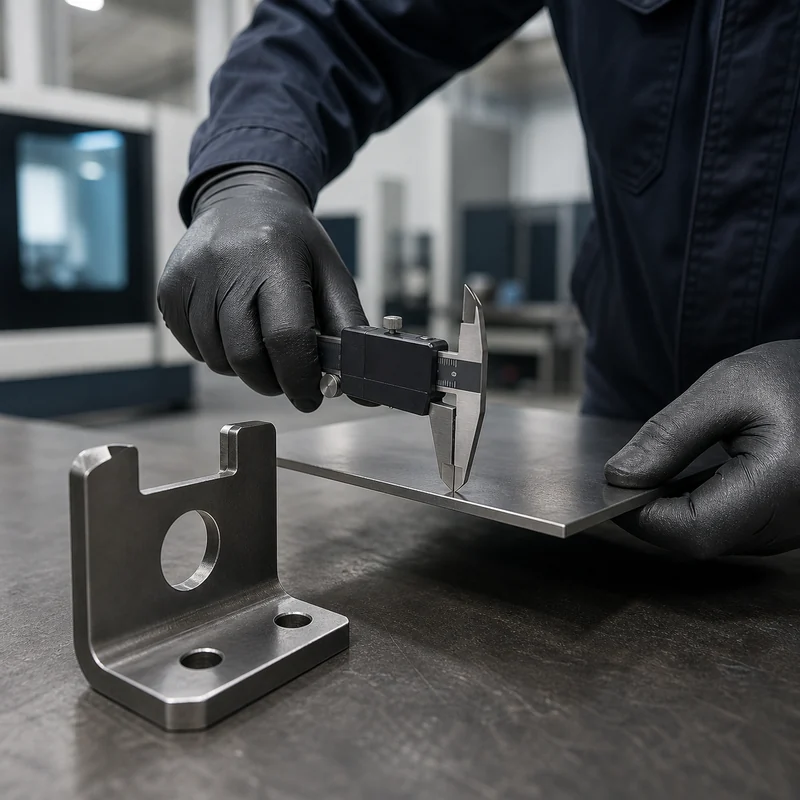
14 Gauge Steel Thickness Chart
| Material / gauge reference | Approx. thickness | Notes |
|---|---|---|
| Standard steel, 14 gauge | 0.0747 in / 1.90 mm | Common reference for sheet steel |
| Galvanized steel, 14 gauge | May differ slightly by standard | Confirm coating and base metal requirements |
| Stainless steel, 14 gauge | Often close but not always identical | Check supplier chart and tolerance |
| Aluminum gauge | Different from steel gauge | Do not substitute steel gauge values for aluminum |
Why Gauge Numbers Can Be Confusing
Gauge is a traditional sheet thickness system, and the same gauge number can mean different thicknesses for steel, stainless steel, aluminum, and nonferrous metals. A drawing should ideally show the actual thickness in inches or millimeters, especially when fit, weight, stiffness, or forming matters.
Common Uses for 14 Gauge Steel
- Brackets, panels, guards, covers, and machine frames
- Enclosures and equipment housings
- Welded fabrication parts
- Automotive and industrial sheet metal components
- Fixtures, mounting plates, and support parts
Fabrication and CNC Machining Notes
14 gauge steel is thick enough for many structural sheet applications while still being practical for cutting, bending, welding, and finishing. For machined features, hole size, edge distance, bend radius, flatness, and finish requirements should be reviewed before production.
Design Checklist for 14 Gauge Parts
| Design item | Recommendation | Reason |
|---|---|---|
| Hole edge distance | Avoid holes too close to bends or edges | Reduces tearing and distortion |
| Bend radius | Match tooling and material condition | Improves forming consistency |
| Tapped holes | Use inserts or weld nuts when thread strength is limited | Thin sheet does not provide much thread engagement |
| Surface finish | Plan powder coating, plating, or brushing early | Finishing affects appearance and protection |
When to Use CNC Machined Parts Instead
If the part needs thick bosses, precise pockets, tight positional tolerances, machined sealing surfaces, or complex 3D geometry, a machined plate or billet part may be better than sheet metal. Compare options with CNC milling services and the metal material guide.
FAQ
How thick is 14 gauge steel in mm?
A common value is about 1.90 mm for standard sheet steel, but always confirm the exact standard and material.
Is 14 gauge steel strong?
It is stronger and stiffer than thinner sheet gauges, but strength depends on material grade, part shape, bends, supports, and load direction.
Can 14 gauge steel be bent?
Yes, but bend radius, tooling, grain direction, and material grade should be considered.
Is 14 gauge stainless the same thickness as 14 gauge steel?
Not always. Gauge charts can vary by material, so specify actual thickness when accuracy matters.
Need help choosing a machining route?
Send MTSPi your drawing, material, quantity, finish, and inspection requirements. We will review the part for manufacturability before quoting.
Practical Buyer Notes
Gauge pages can attract traffic because users often need a quick thickness answer, but they rank better when they go beyond a number. The page should explain why gauge varies by material, how thickness affects fabrication, and when CNC machining is a better option.
14 gauge steel is often used in panels, brackets, guards, housings, and fabricated assemblies. Buyers should confirm actual thickness in inches or millimeters because gauge standards are not universal across steel, stainless steel, galvanized steel, and aluminum.
How to Evaluate This Topic on a Real Drawing
| Decision point | Recommended approach | Why it matters |
|---|---|---|
| Thickness callout | Use exact inch or mm thickness on drawings | Avoids confusion from gauge charts |
| Fabrication route | Use sheet metal cutting and bending for thin formed parts | Often cheaper than machining from billet |
| Machined features | Use CNC when precise pockets, bores, or thick bosses are needed | Sheet metal alone may not create complex 3D features |
| Finish | Plan powder coating, plating, or brushing before quoting | Finish affects edge quality and corrosion protection |
Common Mistakes to Avoid
- Assuming 14 gauge means the same thickness for every material.
- Trying to tap strong threads directly into thin sheet without inserts or hardware.
- Ignoring bend radius, hole-to-edge distance, and coating thickness.
- Using gauge values instead of actual thickness on production drawings.
Recommended MTSPi Review Workflow
For gauge-related pages, MTSPi should answer the thickness first, then explain fabrication decisions, design constraints, material options, and whether CNC machining or sheet metal production fits better.
- Confirm the part function, operating environment, and assembly risk.
- Review material, process, tolerance, surface finish, and inspection requirements together.
- Separate critical features from general dimensions so cost is not wasted on non-functional details.
- Use related resources such as CNC materials, surface treatment, and quality assurance to complete the specification.
- Send the final drawing package to MTSPi for quote review before production.
What to Send for a Faster Quote
Send actual thickness, material grade, flat pattern or 3D model, bend notes, finish requirements, and any hardware or threaded feature expectations.
- 3D CAD file and 2D drawing with revision number.
- Material grade or acceptable alternatives.
- Quantity, delivery target, and whether samples are required first.
- Critical dimensions, thread callouts, finish notes, and inspection requirements.
- Application notes when the part is used in heat, moisture, wear, vibration, or visible assemblies.
Conclusion
14 gauge steel is a useful thickness for durable sheet metal parts, but gauge alone is not enough for a precise manufacturing requirement. Use actual inch or millimeter thickness, define material grade, and review forming, finishing, and inspection needs before production.