

Categories
Manufacturing Process Comparisons

CNC Milling vs CNC Turning: Which Process Do You Need?

CNC milling vs CNC turning is a key search topic for buyers who need reliable custom parts, accurate dimensions, practical material advice, and clear supplier communication. Before sending a drawing or placing an order, buyers should understand the process, cost drivers, tolerance requirements, material options, lead time, inspection needs, and the questions that separate a capable machine shop from a weak supplier.

How CNC Milling Works

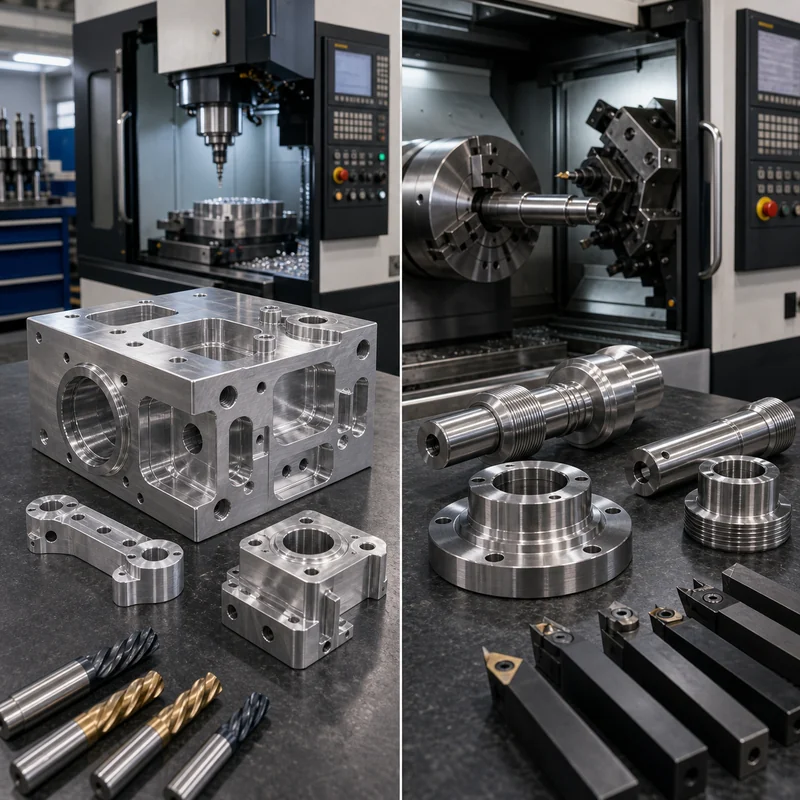
CNC milling uses rotating cutting tools to remove material from a stationary or moving workpiece. It is ideal for slots, pockets, holes, flat surfaces, contours, and complex shapes.

Buyer Notes

For a smoother quote, prepare a 3D model, 2D drawing, target material, order quantity, surface finish, tolerance requirements, and any critical assembly information. Clear specifications reduce delays and help the supplier identify manufacturability risks early.

How CNC Turning Works

CNC turning rotates the workpiece while cutting tools shape the outside or inside diameter. It is best for shafts, pins, bushings, rings, spacers, and other round parts.

Buyer Notes

For a smoother quote, prepare a 3D model, 2D drawing, target material, order quantity, surface finish, tolerance requirements, and any critical assembly information. Clear specifications reduce delays and help the supplier identify manufacturability risks early.

Parts That Need Both

Many precision parts need turning first and milling second. Examples include shafts with flats, threaded parts with cross holes, and round parts with keyways.

Buyer Notes

For a smoother quote, prepare a 3D model, 2D drawing, target material, order quantity, surface finish, tolerance requirements, and any critical assembly information. Clear specifications reduce delays and help the supplier identify manufacturability risks early.

How to Choose

Choose based on geometry first. Round symmetrical parts usually start with turning. Boxy, flat, or multi-feature parts usually need milling.

Buyer Notes

For a smoother quote, prepare a 3D model, 2D drawing, target material, order quantity, surface finish, tolerance requirements, and any critical assembly information. Clear specifications reduce delays and help the supplier identify manufacturability risks early.

FAQ

What is the difference between CNC milling and CNC turning?

For CNC milling vs CNC turning, the right answer depends on part geometry, material, tolerance, surface finish, quantity, and end-use requirements. A complete RFQ helps the supplier give a useful recommendation.

When should I use CNC milling?

For CNC milling vs CNC turning, the right answer depends on part geometry, material, tolerance, surface finish, quantity, and end-use requirements. A complete RFQ helps the supplier give a useful recommendation.

When should I use CNC turning?

For CNC milling vs CNC turning, the right answer depends on part geometry, material, tolerance, surface finish, quantity, and end-use requirements. A complete RFQ helps the supplier give a useful recommendation.

Can one part require both milling and turning?

For CNC milling vs CNC turning, the right answer depends on part geometry, material, tolerance, surface finish, quantity, and end-use requirements. A complete RFQ helps the supplier give a useful recommendation.

Practical Checklist Before Ordering

  • Confirm material grade, dimensions, tolerance, and surface finish.
  • Share both 3D files and 2D drawings when possible.
  • Identify critical features that affect fit, sealing, strength, or assembly.
  • Ask about sample lead time, MOQ, inspection reports, and packaging.
  • Compare quotes by specification, not only by unit price.

Conclusion

A good CNC machining decision balances design, material, tolerance, cost, lead time, and supplier capability. Buyers who prepare complete files and ask the right technical questions usually receive more accurate quotes, better parts, and fewer production surprises.
Categories
Design, Cost & Sourcing

What Is CNC Machining? A Practical Guide for Buyers

CNC machining is a key search topic for buyers who need reliable custom parts, accurate dimensions, practical material advice, and clear supplier communication. Before sending a drawing or placing an order, buyers should understand the process, cost drivers, tolerance requirements, material options, lead time, inspection needs, and the questions that separate a capable machine shop from a weak supplier.

What CNC Machining Means

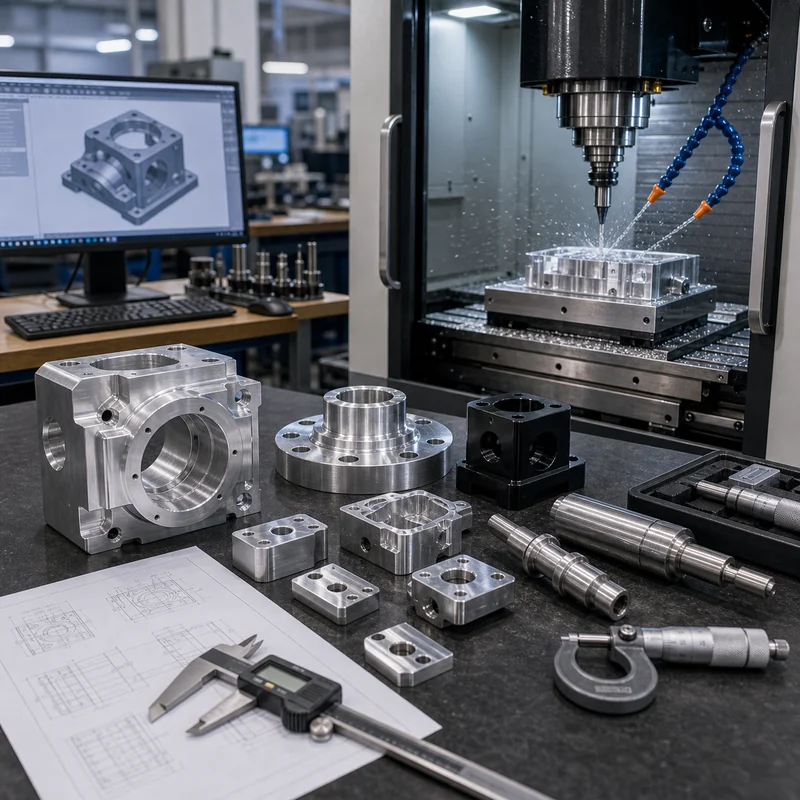
CNC machining is a subtractive manufacturing process. A programmed machine removes material from a solid block, bar, plate, or casting until the final shape is reached.

Buyer Notes

For a smoother quote, prepare a 3D model, 2D drawing, target material, order quantity, surface finish, tolerance requirements, and any critical assembly information. Clear specifications reduce delays and help the supplier identify manufacturability risks early.

Main CNC Machining Processes

Common processes include CNC milling, CNC turning, drilling, tapping, boring, grinding, and sometimes EDM for special features.

Buyer Notes

For a smoother quote, prepare a 3D model, 2D drawing, target material, order quantity, surface finish, tolerance requirements, and any critical assembly information. Clear specifications reduce delays and help the supplier identify manufacturability risks early.

Best Use Cases

CNC machining is useful for prototypes, low-volume parts, precision components, metal parts, plastic parts, and products that need tight tolerances.

Buyer Notes

For a smoother quote, prepare a 3D model, 2D drawing, target material, order quantity, surface finish, tolerance requirements, and any critical assembly information. Clear specifications reduce delays and help the supplier identify manufacturability risks early.

Buyer Checklist

Buyers should prepare drawings, material requirements, tolerance needs, surface finish expectations, order quantity, and target delivery date before requesting a quote.

Buyer Notes

For a smoother quote, prepare a 3D model, 2D drawing, target material, order quantity, surface finish, tolerance requirements, and any critical assembly information. Clear specifications reduce delays and help the supplier identify manufacturability risks early.

FAQ

What is CNC machining?

For CNC machining, the right answer depends on part geometry, material, tolerance, surface finish, quantity, and end-use requirements. A complete RFQ helps the supplier give a useful recommendation.

How does CNC machining work?

For CNC machining, the right answer depends on part geometry, material, tolerance, surface finish, quantity, and end-use requirements. A complete RFQ helps the supplier give a useful recommendation.

What products can be made by CNC machining?

For CNC machining, the right answer depends on part geometry, material, tolerance, surface finish, quantity, and end-use requirements. A complete RFQ helps the supplier give a useful recommendation.

When should I choose CNC machining for a project?

For CNC machining, the right answer depends on part geometry, material, tolerance, surface finish, quantity, and end-use requirements. A complete RFQ helps the supplier give a useful recommendation.

Practical Checklist Before Ordering

  • Confirm material grade, dimensions, tolerance, and surface finish.
  • Share both 3D files and 2D drawings when possible.
  • Identify critical features that affect fit, sealing, strength, or assembly.
  • Ask about sample lead time, MOQ, inspection reports, and packaging.
  • Compare quotes by specification, not only by unit price.

Conclusion

A good CNC machining decision balances design, material, tolerance, cost, lead time, and supplier capability. Buyers who prepare complete files and ask the right technical questions usually receive more accurate quotes, better parts, and fewer production surprises.
Categories
Manufacturing Process Comparisons

CNC Machining vs. Casting: Which Is Best for Your Project?

Choosing between CNC machining and casting is a common crossroads in manufacturing. This guide breaks down their core differences, strengths, and ideal applications in a friendly, straightforward way to help you decide which process fits your project’s budget, timeline, and quality needs.

Understanding the Core Processes

Let’s start by getting to know our two contenders. Think of it like meeting two different types of chefs—one is a master sculptor who carves a masterpiece from a solid block, and the other is a baker who pours batter into a mold. Both create amazing things, but their methods are worlds apart. This fundamental difference between subtractive manufacturing (CNC) and forming processes (casting) shapes everything about your final part.

What is CNC Machining?

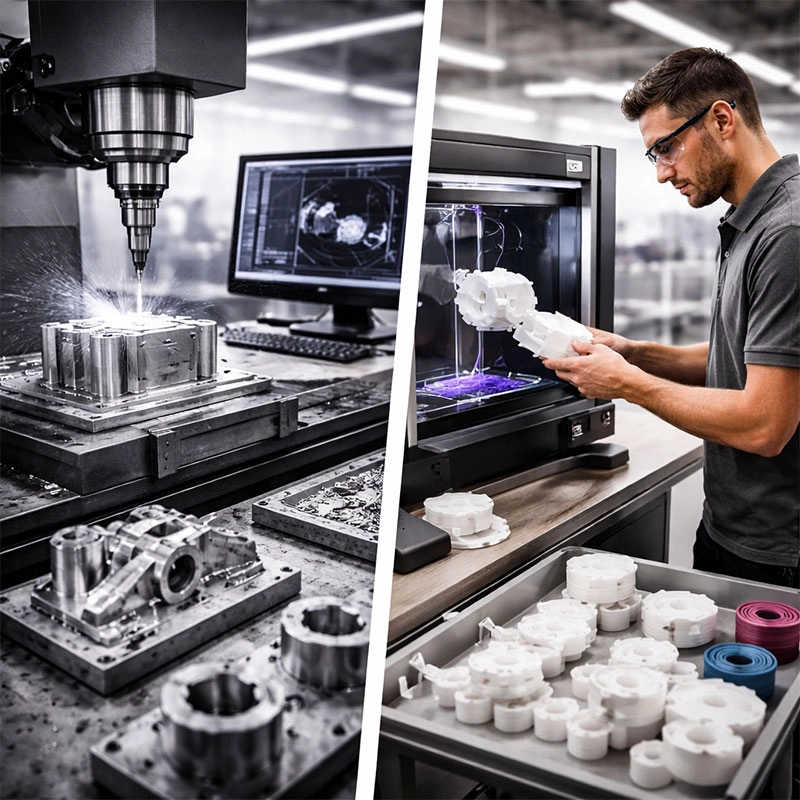
CNC machining, or computer numerical control machining, is like high-precision carving. You start with a solid block of material—metal, plastic, or wood—and a computer-guided tool precisely cuts away material until the desired shape emerges. It’s incredibly accurate, producing parts with tight tolerances and excellent surface finishes right off the machine. Common searches like cnc milling vs casting or precision machining services often lead people here when they need strong, detailed components.

What is Casting?

Casting is a formative process. It involves pouring molten metal (or other materials) into a pre-made mold cavity. Once it cools and solidifies, you break the mold away to reveal the part. Processes like die casting, investment casting, and sand casting fall under this umbrella. It’s fantastic for creating complex, hollow, or oddly shaped parts that would be very difficult or wasteful to machine from solid. If you’re looking into metal casting vs machining for high-volume production, casting is usually a key player.

Key Differences: A Head-to-Head Look

Now, let’s put them side-by-side. I find it helpful to compare a few critical factors—imagine you’re deciding between buying a custom-made suit (CNC) versus a well-fitting, ready-made one (Casting). Both are great, but one might suit your specific event better.

Material and Waste

This is a big one. CNC is a subtractive process, meaning you remove material to create the part. For complex parts, you might end up with a significant pile of chips or shavings. Casting, as an additive manufacturing cousin in the forming family, typically uses only the material needed to fill the mold, resulting in much less waste for certain shapes. So, if material cost is a major concern and your part design is casting-friendly, that process can be more efficient.

Complexity and Design Freedom

Here’s where they truly diverge. CNC machining offers incredible precision and can handle very complex geometries, but it’s limited by the tool’s ability to reach certain areas. Undercuts and internal channels can be tricky. Casting processes, especially investment casting, excel at producing parts with intricate internal passages, hollow sections, and complex organic shapes in one go—things that would be impossible to machine as a single piece. It’s the go-to for questions like how to make complex metal parts.

Strength and Performance

Machined parts are generally stronger. Why? Because they’re made from a solid, homogeneous block of material with a continuous grain structure. Cast parts can sometimes have microscopic pores or inclusions from the solidification process, which might create weak points. For high-stress applications, a machined part is often the safer bet. However, modern casting techniques have come a long way in improving integrity and consistency.

Cost and Lead Time

This often decides the race. For one-off parts or small batches, CNC machining is usually faster and more cost-effective because you skip the expensive, time-consuming mold-making step. However, for high-volume production, the equation flips. The upfront cost of creating a mold (the “tooling”) for die casting or similar is high, but once it’s made, each subsequent part is produced quickly and cheaply. It’s the classic “pay more now, save later” scenario.

How to Choose the Right Process for You

So, how do you pick? Don’t worry, it’s not as hard as it seems. I usually tell folks to ask themselves four simple questions: How many parts do I need? How complex is my design? What’s my budget? And how fast do I need them? Your answers will point you in the right direction.

When to Choose CNC Machining

Choose CNC milling or turning when:

  • You need prototypes or low-volume production (1 to 100 parts).
  • Your design requires extremely tight tolerances and superior surface finish.
  • The part is made from a material that’s difficult to cast.
  • You need the superior strength of a wrought material structure.
  • You’re on a tight timeline and can’t wait for mold fabrication.

It’s the champion of flexibility and precision for smaller runs.

When to Choose Casting

Opt for a casting method like sand casting or investment casting when:

  • You plan for high-volume production (hundreds to thousands of parts).
  • Your part has a very complex, hollow, or organic geometry.
  • You want to minimize material waste for that specific shape.
  • You’re working with metals that are easily cast, like aluminum or zinc alloys.
  • The per-part cost needs to be as low as possible at high quantities.

It’s the efficiency expert for mass production of complex shapes.

Clearing Up Common Misconceptions

I hear a few myths all the time, so let’s clear the air. First, “casting is always cheaper.” Not true for low volumes—that mold cost is a big hurdle. Second, “machined parts are always better.” For a simple bracket made in the thousands, a cast part could be perfectly adequate and more economical. Third, “you can’t get good surface finish from casting.” While machining often gives a better finish straight away, many cast parts are finished with a quick CNC machining operation on critical surfaces, a combo often called casting with secondary machining operations. The best solution is sometimes a hybrid!

Final Thoughts and Next Steps

There’s no single “winner” between CNC machining and casting. The best process is the one that best serves your specific project’s needs. My friendly advice? Start by clearly defining your part’s requirements: quantity, complexity, material, budget, and deadline. For prototypes and complex, low-volume metal parts, CNC machining is often your best friend. For high-volume runs of intricate shapes, metal casting processes will likely save the day. When in doubt, consult with a reputable machine shop or foundry—they can offer invaluable guidance based on your drawings. You can learn more about material properties for these processes from authoritative sources like ASM International. Good luck with your project

Categories
CNC Machining Basics

Demystifying the CNC Machining Process Explained Simply

Ever wondered how complex metal or plastic parts are made with such incredible precision? The answer lies in CNC machining. This guide breaks down the entire CNC manufacturing process into simple steps, from a digital design to a finished physical part. We’ll explore how it works, why it’s so valuable, and clear up some common misconceptions.

Understanding the Step-by-Step CNC Machining Workflow

Let’s walk through the CNC machining process step by step. Think of it like a highly skilled chef following a perfect recipe. The recipe is the digital design, the chef is the machine, and the ingredients are your block of material. Every action is planned and executed with precision.

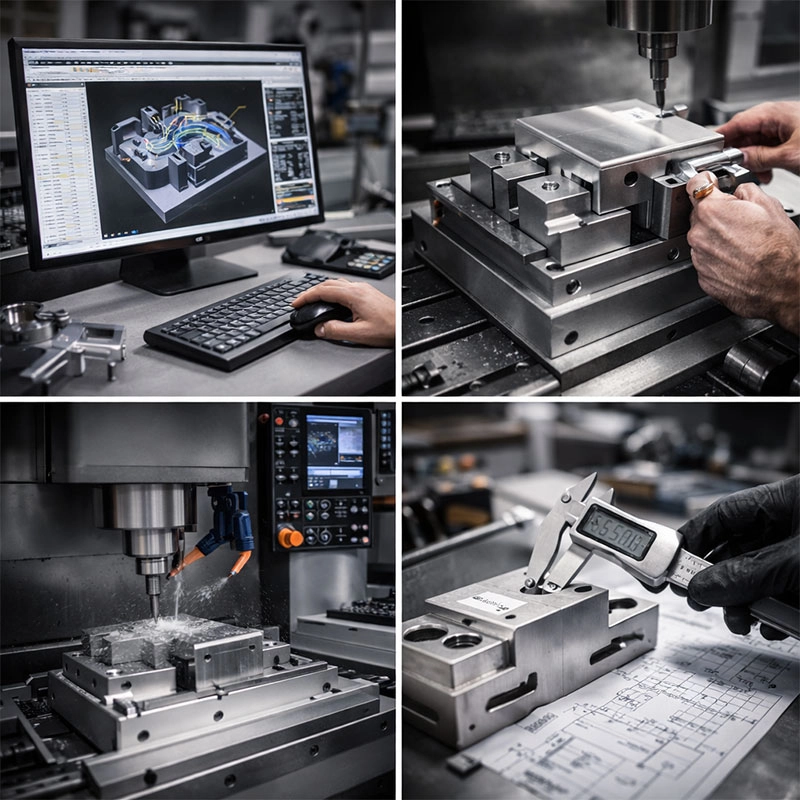
Step 1: The Digital Blueprint (CAD)

It all starts with an idea. Using Computer-Aided Design (CAD) software, an engineer or designer creates a detailed 3D model of the part. This is the master plan. It defines every dimension, curve, and hole. You might be asking, how does CNC machining work from a drawing?” Well, this 3D model is the essential first answer. It’s the source of truth for the entire CNC manufacturing process.

Step 2: Speaking the Machine’s Language (CAM)

The CAD model is beautiful, but the machine can’t understand it directly. This is where Computer-Aided Manufacturing (CAM) software comes in. The CAM programmer takes the 3D model and creates a set of instructions, called G-code. This code tells the machine exactly where to move, how fast to spin the cutting tool, and how deep to cut. It’s like translating the recipe into a language the chef understands perfectly.

Step 3: The Machine Setup

Now, we move to the shop floor. An operator secures the raw material (called the “workpiece”)—which could be aluminum, steel, plastic, or other materials—onto the machine bed. The correct cutting tools are loaded into the machine’s spindle. This setup is crucial for accuracy. A good setup ensures the CNC milling process or CNC turning operation starts from the right place every time.

Step 4: The Machining Operation

This is the main event! The machine operator starts the program. The spindle spins the cutting tool at high speeds, and it precisely removes material from the workpiece, following the paths defined by the G-code. You’ll see chips flying as the block of material is gradually shaped into the final part. Different operations like milling, drilling, and turning happen here, all part of the subtractive manufacturing family.

Step 5: Finishing Touches

Once the main cutting is done, the part often isn’t quite ready. It might have sharp edges or a rough surface. Secondary processes like deburring (removing sharp edges), sanding, polishing, or anodizing (for aluminum) are applied. This post-processing gives the part its final look, feel, and sometimes extra properties like corrosion resistance.

Why is the CNC Process So Valuable?

So, what makes this explanation of CNC machining so important for industries? The value is immense. First, it offers incredible precision and repeatability. You can make one part or a thousand, and they will all be virtually identical. This is a game-changer for everything from aerospace components to medical devices. Second, it can create incredibly complex geometries that would be impossible or prohibitively expensive to make by hand. Finally, while the initial setup and programming take time, it’s extremely efficient for production runs, saving both time and money in the long run. For a deeper dive into its applications, resources like the American Society of Mechanical Engineers (ASME) offer great insights.

How Can You Get Started with CNC Manufacturing?

If you’re curious about using CNC machining services for a project, here’s our friendly advice. Start with a clear and well-designed CAD file—this is the most important piece. Then, find a reputable machine shop. Don’t be afraid to ask questions! A good shop will guide you on material selection, design for manufacturability (making sure your design is easy to machine), and cost estimates. For beginners, starting with a simpler design in a common material like 6061 aluminum is a great way to learn the basics of CNC operation without breaking the bank.

Clearing Up Common CNC Machining Misconceptions

Let’s tackle a few myths. First, some think CNC is only for huge factories. Not true! Many small workshops and even hobbyists use desktop CNC machines. Second, it’s not always the fastest option for a single, simple part—3D printing might be quicker for a one-off prototype. Third, while highly automated, it still requires skilled humans for programming, setup, and quality control. The machine follows instructions; people provide the expertise. Understanding these nuances is key to a complete guide to computer numerical control.

In short, the CNC machining process is a powerful blend of digital design and physical precision. By understanding the workflow from CAD to finished part, you can appreciate its role in making the world around us, from your car’s engine to your smartphone’s casing. It’s a fascinating technology that turns digital dreams into tangible reality.

Request A Quote

We'll Send You Back with Price Immediately!

DEC 1-31

XMAS SPECEIL

Up to

40% off

Demystifying the CNC Machining Process Explained Simply

We'll Send You Back with Price Immediately!