Categories
Blog Industries & Applications Quality & Tolerances

Aerospace CNC Machining Supplier Evaluation Guide for 2026

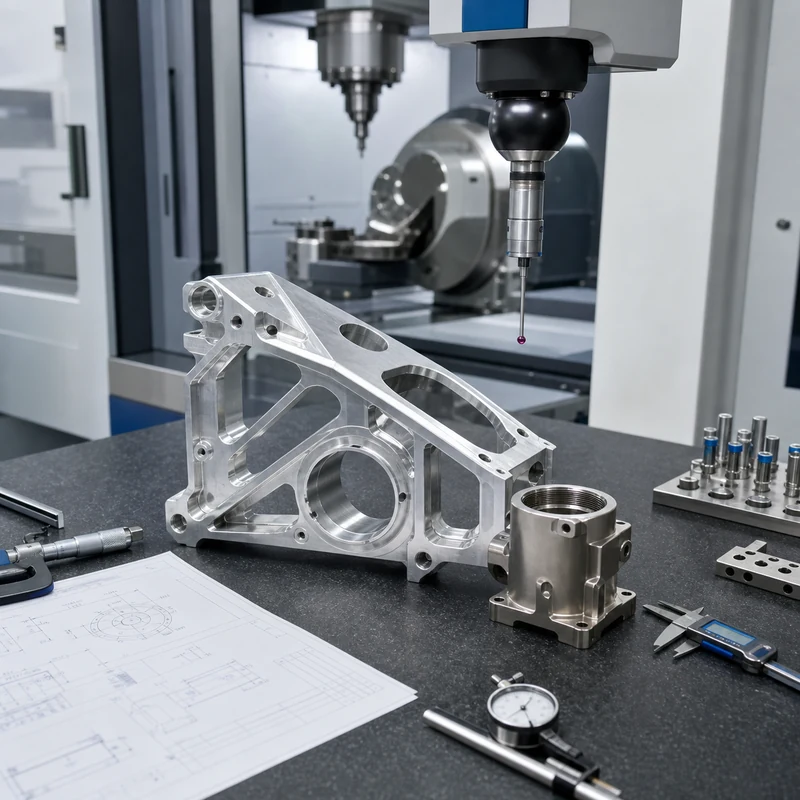
Aerospace CNC machining places heavy demands on geometry control, material knowledge, documentation, and consistency. A useful supplier evaluation should look beyond a list of machine names and focus on whether the shop can control risk across the full manufacturing route.

For MTSPi customers, the evaluation starts with part geometry, tolerance stack, material, finish, quantity, and required evidence. Those inputs help determine whether a job belongs on 5-axis machining, a turning center, a Swiss-type machine, or a simpler milling process.

What Aerospace Buyers Should Evaluate First

Evaluation point What good looks like Why it matters
Process capability The supplier can explain setup, access, fixturing, and datum strategy Complex parts fail when the route is vague.
Material experience Clear plan for aluminum, titanium, stainless, and nickel alloy behavior Aerospace materials can move, work harden, or wear tools quickly.
Inspection CMM or suitable measurement plan tied to drawing risk Tight tolerances need evidence, not assumptions.
Documentation Revision control, material records, and inspection reports Receiving teams need traceable proof.
Production fit Prototype, low-volume, or repeat-batch process is clear Capacity should match the program stage.

Machine Capability Is Only Part of the Answer

A 5-axis machine is valuable for angled features, compound surfaces, and reduced setups, but it does not automatically make a supplier qualified. Programming, toolpath verification, workholding, cutter selection, and inspection access decide whether the part can be produced reliably.

Simple aerospace brackets may still be best handled by CNC milling service. Shafts, pins, sleeves, and threaded features may need CNC turning service or Swiss-type machining. The practical route depends on the drawing, not on a marketing label.

Material and Finish Questions

Aluminum, titanium, stainless steel, and nickel alloys each need different cutting and finishing controls. If the part requires anodizing, passivation, polishing, bead blasting, or other surface treatment, the supplier should consider finish allowance before final machining.

Ask whether the shop has experience with the exact material grade, stock form, wall thickness, and inspection features on your drawing. A general claim of aerospace capability is not enough for a difficult component.

Inspection Planning for Aerospace Parts

Inspection should be planned before cutting starts. Critical datums, hole positions, profiles, thread depths, flatness, perpendicularity, and surface finish callouts may each require different tools. MTSPi aligns these requirements through CNC machining quality inspection so the final report supports real acceptance criteria.

Part feature Common concern Useful control
Thin wall pocket Distortion after roughing Balanced stock removal and interim checks
Datum hole pattern Position error across setups Stable fixture and CMM report
Titanium bracket Heat, tool wear, and burrs Controlled parameters and deburring plan
Precision shaft Runout and diameter repeatability Turning process with suitable gauge checks

Questions to Ask Before Sending an RFQ

  • Which features drive the machining route?
  • What tolerance or GD&T callouts add the most cost?
  • Can the supplier suggest design changes that reduce risk without changing function?
  • What inspection evidence will be supplied with the parts?
  • How will prototype feedback transfer into the next production batch?

Conclusion

Aerospace supplier selection is not about copying a ranking. It is about finding a machining partner that can explain the process, control the material, inspect the critical features, and provide documentation that matches the project risk. A clear evaluation checklist makes that decision more defensible.
Categories
Blog Industries & Applications Quality & Tolerances

How to Evaluate Aerospace CNC Machining Manufacturers in China

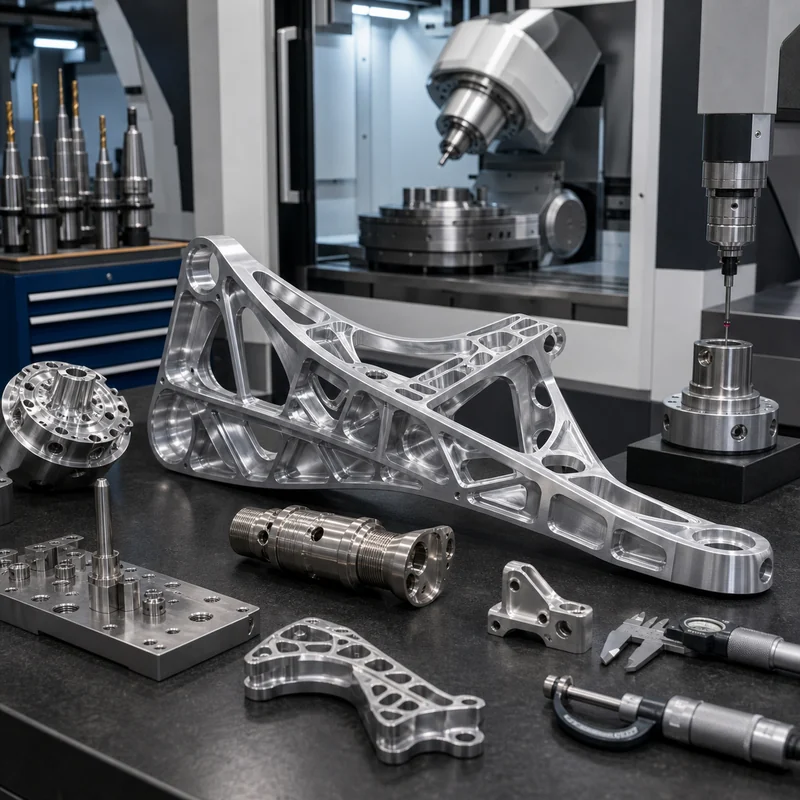
China has a large CNC machining supply base, but aerospace-style parts require a more disciplined selection process than ordinary price comparison. The right partner must be able to control material behavior, multi-axis access, tight tolerances, burrs, finishing, inspection records, and repeat orders under a documented process.

This guide focuses on how to evaluate aerospace CNC machining manufacturers without relying on a generic company list. Use it as a sourcing checklist when your parts include lightweight structures, datum-critical features, difficult materials, or inspection requirements tied to engineering drawings.

Quick Evaluation Checklist

Evaluation Area What to Check Why It Matters
Part similarity Examples of comparable brackets, housings, fittings, shafts, or precision hardware Relevant experience reduces process-learning risk
Machine capability 3-axis, 4-axis, 5-axis, turning, mill-turn, Swiss-type, fixture capacity The process must fit the part geometry, not just the RFQ keyword
Tolerance control Datum strategy, roughing and finishing sequence, thermal control, inspection plan Tight tolerances depend on process stability
Material experience Aluminum, titanium, stainless steel, alloy steel, nickel alloys, and engineering plastics Each material cuts, moves, and finishes differently
Quality system CMM inspection, calibrated gauges, first-article checks, report format, revision control Aerospace-style sourcing needs measurable evidence
Communication DFM feedback, drawing review, risk notes, English response quality, change tracking Good communication catches expensive mistakes early
Production control Tool-life rules, lot separation, packaging, repeat-order records, lead-time planning One good sample does not prove batch reliability

Start With the Part, Not the Factory Profile

A supplier with many machines may still be a poor fit for a specific part. Begin with the drawing, CAD model, material, quantity, finish, tolerance callouts, and required inspection documents. Ask the manufacturer to explain the proposed setup plan, tool access, datum control, and which features carry the highest risk.

  • Thin-wall aluminum structures may need stress-control planning and careful finishing passes.
  • Titanium components need heat management, sharp tooling, and conservative cutting strategies.
  • Small turned aerospace hardware may be better suited to Swiss-type or mill-turn machining.
  • Multi-face housings often benefit from 5-axis machining to reduce datum transfer error.

Machine Capability to Verify

For aerospace CNC machining, machine names alone are not enough. Buyers should confirm travel, spindle performance, axis configuration, fixture options, probing, tool reach, coolant strategy, and whether secondary operations are handled in-house or by a controlled partner.

Part Type Likely Process Selection Note
Lightweight brackets 3-axis or 5-axis milling Pocket depth, wall thickness, and datum access drive the route
Complex housings 5-axis milling Reduced setups can improve profile and true-position control
Bushings and spacers CNC turning Concentricity, bore finish, and face squareness matter
Small shafts and pins Swiss-type machining Good for long small-diameter parts and repeat batches
Turned parts with cross features Mill-turn machining Combines turning, drilling, milling, and tapping in one handling plan

How to Judge Tight-Tolerance Readiness

A manufacturer should be able to describe how tight dimensions will be made and measured. Listen for practical details: separate roughing and finishing, stable clamping, tool wear offsets, in-process checks, temperature awareness, and inspection methods that match the drawing. Vague claims about high precision are not enough.

  • Ask which datums will be machined first and how they will be protected.
  • Confirm whether critical dimensions apply before or after anodizing, passivation, plating, or polishing.
  • Review inspection tools for each feature: CMM, micrometer, bore gauge, pin gauge, thread gauge, or profilometer.
  • Request a sample inspection report format before placing a critical order.

Material and Finish Questions

Aerospace parts commonly use 7075 aluminum, 6061 aluminum, titanium alloys, stainless steels, and high-temperature alloys. Material choice affects cycle time, tool wear, stability, achievable finish, and inspection strategy. Finishes such as anodizing, passivation, bead blasting, polishing, or conversion coating should be planned with dimensional allowance in mind.

Requirement Question to Ask Risk If Missed
Material certificate Can the material lot be tied to the order? Traceability gaps
Heat treatment Is the required condition defined before machining? Unexpected hardness or movement
Surface finish Which faces are cosmetic, functional, or masked? Rework, dimension shift, or inconsistent appearance
Burr control Which edges must remain sharp and which must be broken? Assembly problems or part damage

Documentation and Quality Assurance

Quality assurance should be scaled to part risk. A prototype bracket may need dimensional checks and material confirmation. A production component with GD&T may need a first-article report, CMM data, gauge records, material certification, finish certification, and controlled packaging. MTSPi supports these discussions through quality assurance planning before production.

Sourcing Red Flags

  • The quote does not mention the drawing tolerances or inspection method.
  • The supplier cannot explain how the part will be fixtured.
  • The quoted lead time ignores finishing, inspection, or material procurement.
  • The response focuses only on low price instead of manufacturability and risk.
  • The supplier promises every tight tolerance without asking about feature function or measurement method.

How MTSPi Can Help

MTSPi provides custom CNC machining support for engineering teams that need precision milling, turning, 5-axis machining, material review, finishing, and inspection planning. Send your 3D model, 2D drawing, material grade, finish, quantity, and reporting needs through the RFQ page.

Related MTSPi Resources

FAQ

How should I compare aerospace CNC machining manufacturers in China?

Compare them by relevant part experience, process planning, material knowledge, inspection capability, documentation control, communication quality, and repeat-production discipline.

Does every aerospace part need 5-axis machining?

No. Some parts are better suited to 3-axis milling, turning, Swiss-type machining, or mill-turn machining. The best process depends on geometry and tolerance relationships.

What files should I send for an accurate aerospace machining quote?

Send 3D CAD, a 2D drawing with critical tolerances and GD&T, material grade, finish requirements, quantity, inspection needs, and any assembly context.

Categories
CNC Materials

CNC Machining for Aerospace Parts: Materials, Tolerances and Inspection

CNC machining aerospace parts is a key search topic for buyers who need reliable custom parts, accurate dimensions, practical material advice, and clear supplier communication. Before sending a drawing or placing an order, buyers should understand the process, cost drivers, tolerance requirements, material options, lead time, inspection needs, and the questions that separate a capable machine shop from a weak supplier.

Why Aerospace Uses CNC

Aerospace components often need strong materials, tight tolerances, lightweight designs, and repeatable quality.

Buyer Notes

For a smoother quote, prepare a 3D model, 2D drawing, target material, order quantity, surface finish, tolerance requirements, and any critical assembly information. Clear specifications reduce delays and help the supplier identify manufacturability risks early.

Common Materials

Aluminum, titanium, stainless steel, and high-performance alloys are common depending on strength, weight, corrosion resistance, and temperature needs.

Buyer Notes

For a smoother quote, prepare a 3D model, 2D drawing, target material, order quantity, surface finish, tolerance requirements, and any critical assembly information. Clear specifications reduce delays and help the supplier identify manufacturability risks early.

Tolerance and Traceability

Critical aerospace parts may require strict dimensional control, material certificates, process traceability, and documented inspection.

Buyer Notes

For a smoother quote, prepare a 3D model, 2D drawing, target material, order quantity, surface finish, tolerance requirements, and any critical assembly information. Clear specifications reduce delays and help the supplier identify manufacturability risks early.

Supplier Requirements

Buyers should confirm quality system, inspection capability, documentation, material control, and experience with precision components.

Buyer Notes

For a smoother quote, prepare a 3D model, 2D drawing, target material, order quantity, surface finish, tolerance requirements, and any critical assembly information. Clear specifications reduce delays and help the supplier identify manufacturability risks early.

FAQ

Is CNC machining used for aerospace parts?

For CNC machining aerospace parts, the right answer depends on part geometry, material, tolerance, surface finish, quantity, and end-use requirements. A complete RFQ helps the supplier give a useful recommendation.

What materials are used for aerospace CNC machining?

Choose material by strength, weight, corrosion resistance, heat resistance, machinability, appearance, and cost. If unsure, ask the supplier to recommend options based on the part function.

Why do aerospace parts need tight tolerances?

Accuracy depends on the machine, material, fixture, toolpath, feature size, and inspection method. Tight tolerances should be used only where the part function requires them.

What inspection is needed for aerospace machined parts?

For CNC machining aerospace parts, the right answer depends on part geometry, material, tolerance, surface finish, quantity, and end-use requirements. A complete RFQ helps the supplier give a useful recommendation.

Practical Checklist Before Ordering

  • Confirm material grade, dimensions, tolerance, and surface finish.
  • Share both 3D files and 2D drawings when possible.
  • Identify critical features that affect fit, sealing, strength, or assembly.
  • Ask about sample lead time, MOQ, inspection reports, and packaging.
  • Compare quotes by specification, not only by unit price.

Conclusion

A good CNC machining decision balances design, material, tolerance, cost, lead time, and supplier capability. Buyers who prepare complete files and ask the right technical questions usually receive more accurate quotes, better parts, and fewer production surprises.

Categories
Design, Cost & Sourcing

What Is CNC Machining? A Practical Guide for Buyers

CNC machining is a key search topic for buyers who need reliable custom parts, accurate dimensions, practical material advice, and clear supplier communication. Before sending a drawing or placing an order, buyers should understand the process, cost drivers, tolerance requirements, material options, lead time, inspection needs, and the questions that separate a capable machine shop from a weak supplier.

What CNC Machining Means

CNC machining is a subtractive manufacturing process. A programmed machine removes material from a solid block, bar, plate, or casting until the final shape is reached.

Buyer Notes

For a smoother quote, prepare a 3D model, 2D drawing, target material, order quantity, surface finish, tolerance requirements, and any critical assembly information. Clear specifications reduce delays and help the supplier identify manufacturability risks early.

Main CNC Machining Processes

Common processes include CNC milling, CNC turning, drilling, tapping, boring, grinding, and sometimes EDM for special features.

Buyer Notes

For a smoother quote, prepare a 3D model, 2D drawing, target material, order quantity, surface finish, tolerance requirements, and any critical assembly information. Clear specifications reduce delays and help the supplier identify manufacturability risks early.

Best Use Cases

CNC machining is useful for prototypes, low-volume parts, precision components, metal parts, plastic parts, and products that need tight tolerances.

Buyer Notes

For a smoother quote, prepare a 3D model, 2D drawing, target material, order quantity, surface finish, tolerance requirements, and any critical assembly information. Clear specifications reduce delays and help the supplier identify manufacturability risks early.

Buyer Checklist

Buyers should prepare drawings, material requirements, tolerance needs, surface finish expectations, order quantity, and target delivery date before requesting a quote.

Buyer Notes

For a smoother quote, prepare a 3D model, 2D drawing, target material, order quantity, surface finish, tolerance requirements, and any critical assembly information. Clear specifications reduce delays and help the supplier identify manufacturability risks early.

FAQ

What is CNC machining?

For CNC machining, the right answer depends on part geometry, material, tolerance, surface finish, quantity, and end-use requirements. A complete RFQ helps the supplier give a useful recommendation.

How does CNC machining work?

For CNC machining, the right answer depends on part geometry, material, tolerance, surface finish, quantity, and end-use requirements. A complete RFQ helps the supplier give a useful recommendation.

What products can be made by CNC machining?

For CNC machining, the right answer depends on part geometry, material, tolerance, surface finish, quantity, and end-use requirements. A complete RFQ helps the supplier give a useful recommendation.

When should I choose CNC machining for a project?

For CNC machining, the right answer depends on part geometry, material, tolerance, surface finish, quantity, and end-use requirements. A complete RFQ helps the supplier give a useful recommendation.

Practical Checklist Before Ordering

  • Confirm material grade, dimensions, tolerance, and surface finish.
  • Share both 3D files and 2D drawings when possible.
  • Identify critical features that affect fit, sealing, strength, or assembly.
  • Ask about sample lead time, MOQ, inspection reports, and packaging.
  • Compare quotes by specification, not only by unit price.

Conclusion

A good CNC machining decision balances design, material, tolerance, cost, lead time, and supplier capability. Buyers who prepare complete files and ask the right technical questions usually receive more accurate quotes, better parts, and fewer production surprises.

Categories
Manufacturing Process Comparisons

CNC Machining vs. Extrusion: Which Process Is Right for Your Project?

Choosing between CNC machining and extrusion can be tricky. Both are fantastic for creating metal and plastic parts, but they work in very different ways. This guide will walk you through the basics of each process, their strengths, and typical uses to help you decide which one fits your project best.

Comparing Manufacturing Methods: CNC Machining and Aluminum Extrusion

When you’re looking into CNC machining vs extrusion, it’s like comparing a sculptor to a pastry chef. One carves away from a solid block, while the other pushes material through a shaped die. Both methods, including subtractive manufacturing (CNC) and profile extrusion, are pillars of modern fabrication. Let’s break down how each one operates.

What is CNC Machining?

CNC machining is a subtractive manufacturing process. Imagine you have a solid block of metal or plastic (we call this a “blank” or “workpiece”). A computer-controlled machine uses cutting tools to precisely remove material, layer by layer, until the final part is revealed. It’s incredibly versatile, allowing for complex 3D shapes, tight tolerances, and excellent surface finishes. Common searches like how does CNC milling work or precision machining services often lead people to discover this method’s capabilities for prototypes and end-use parts.

What is Extrusion?

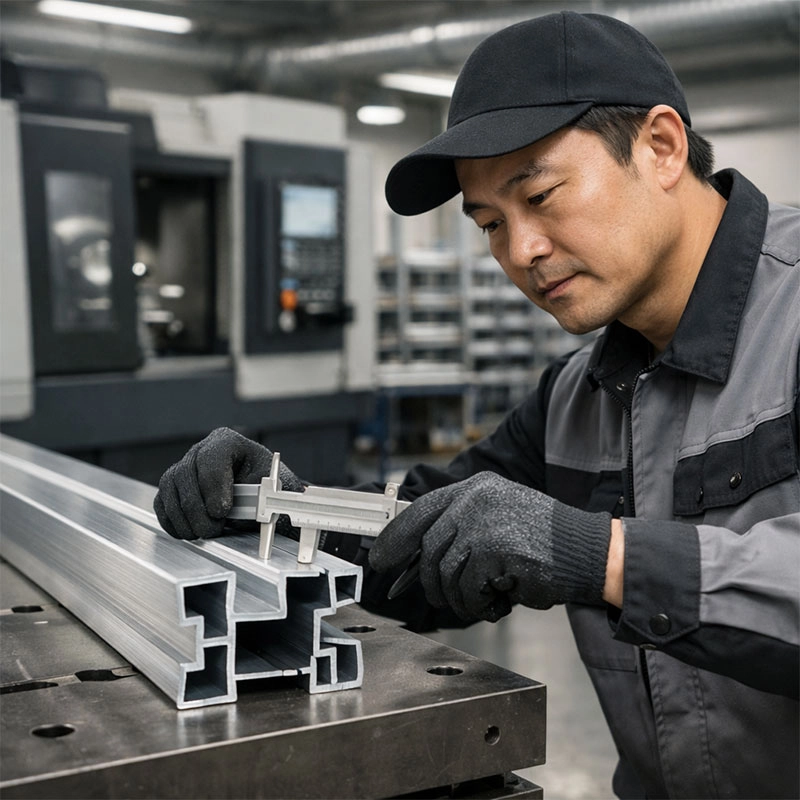
Extrusion, particularly aluminum extrusion, is a forming process. Here, a material (usually aluminum) is heated and forced through a shaped opening called a die. Think of it like squeezing playdough through a mold—the material takes on the continuous cross-sectional profile of that die. This process is fantastic for creating long, consistent shapes like rails, frames, and tracks. If you’ve ever wondered what is aluminum extrusion used for, look at window frames or structural components—they’re classic examples.

Key Differences Compared

Now that we know how they work, let’s put them side-by-side. The choice often boils down to your project’s specific needs in terms of material, design, and budget.

Material and Starting Form

CNC machining typically starts with a solid block, billet, or bar stock. You can machine a wide range of materials, from metals like aluminum and steel to various plastics. Extrusion, on the other hand, primarily works with materials that can be pushed through a die when heated—aluminum is the superstar here, but plastics like PVC are also common. The starting point for extrusion is usually cylindrical billets of these softer, more malleable materials.

Design Complexity and Geometry

This is a major differentiator. CNC is your go-to for complex, intricate, and fully three-dimensional parts. Need internal channels, undercuts, or highly detailed features? CNC milling and turning can handle it. Extrusion is ideal for parts with a constant 2D cross-section that runs along a length. It’s perfect for linear shapes. While you can do some secondary CNC machining on extruded profiles to add holes or features, the core geometry comes from that die.

Cost and Lead Time Considerations

For low to medium volumes of complex parts, CNC can be cost-effective because there’s no expensive tooling—just digital instructions. However, material waste (chips from cutting) can add cost. Extrusion requires a custom die, which is an upfront investment. But once that’s made, producing long runs of the profile becomes very economical per part. So, for a one-off prototype, CNC often wins on speed and cost. For a long production run of a simple shape, extrusion is usually the better cost-effective manufacturing choice.

Which Process is Right for Your Project?

So, how do you choose? Let’s make it practical. I often advise clients to start by sketching their part and asking a few key questions about its use and volume.

When to Choose CNC Machining

Opt for computer numerical control machining when your part has complex geometries, requires very tight tolerances (±0.001 inches or better), or needs to be made from a specific, hard-to-extrude material. It’s perfect for prototypes, custom fixtures, low-volume production, and parts that are fully 3D. If you’re searching for rapid prototyping services, you’ll likely be looking at CNC or 3D printing. For instance, a client of mine needed a custom sensor housing with intricate internal mounts—CNC was the only way to go.

When to Choose Extrusion

Choose metal extrusion or plastic extrusion when you need a long, linear part with a uniform cross-section. It’s ideal for structural components, frames, enclosures, and heat sinks. If you plan to produce thousands of feet of the same profile, the low per-part cost after the initial die is made is unbeatable. A great resource to understand standardized profiles is the Aluminum Association’s design standards. For example, if you’re building a modular frame system, extrusion allows for easy integration and consistent parts.

Clearing Up Common Misconceptions

Let’s tackle a couple of myths I hear often. First, some think extrusion is only for simple shapes and can’t be precise. While the initial profile is limited, you can achieve high precision through careful die design and secondary machining. Second, people sometimes believe CNC is always more expensive. For one-off parts, it’s often cheaper! The real cost in extrusion is the die. Finally, these processes aren’t always rivals. Many successful projects use both: an extruded aluminum profile for the main structure, with precision CNC machined brackets and connectors attached. The best choice depends on your specific design, material, and production goals.

Categories
Manufacturing Process Comparisons

CNC Machining vs Die Casting: Which is Best for Your Project?

Choosing between CNC machining and die casting can be a pivotal decision for your manufacturing project. This guide breaks down the key differences in process, materials, cost, and applications to help you select the best method for your specific needs, whether you need a few precise prototypes or thousands of identical parts.

Understanding the Core Processes

Let’s start by getting a clear picture of what each manufacturing technique actually involves. Think of it like choosing between carving a sculpture from a block of wood versus pouring molten metal into a mold. They achieve similar ends but through completely different means.

What is CNC Machining?

CNC machining, or Computer Numerical Control machining, is a subtractive manufacturing process. It starts with a solid block of material—like aluminum, steel, or plastic—and uses cutting tools to remove material, carving out the final part. It’s incredibly precise, controlled by computer programs (G-code), which is why it’s also referred to as CNC milling or precision machining. I often tell people it’s like a highly skilled, robotic sculptor that can create incredibly complex geometries with tight tolerances directly from a digital file.

What is Die Casting?

Die casting, on the other hand, is a formative process. It involves forcing molten metal—typically zinc, magnesium, or aluminum alloys—under high pressure into a reusable steel mold called a die. Once the metal cools and solidifies, the die opens to eject the part. This method is fantastic for producing high volumes of parts with excellent surface finish and consistent detail. You might also hear it called pressure die casting or metal injection molding when discussing similar high-pressure molding techniques for metals.

Key Differences: A Side-by-Side Look

Now that we know how they work, let’s compare them directly across some of the most important factors you’ll consider for your project. This comparison between subtractive and additive manufacturing (though die casting isn’t additive in the 3D printing sense) really highlights their unique strengths.

Materials and Tolerances

This is a major differentiator. CNC machining services offer incredible material flexibility. You can work with virtually any machinable metal, plastic, and even some composites. This makes it perfect for functional prototypes that need to match the final material’s properties. More importantly, CNC is the king of precision. It can hold tolerances within ±0.001 inches or even tighter, which is crucial for aerospace or medical components.

Die casting is primarily for non-ferrous metals. While it can produce parts with good dimensional accuracy, it generally can’t match the ultra-tight tolerances of CNC due to factors like metal shrinkage during cooling. Its strength lies in replicating complex shapes and fine surface details consistently across thousands of parts.

Cost and Production Volume

Here’s where the choice often becomes clear. The cost structure is opposite. CNC machining has low upfront costs—you just need the material and machine time. However, the cost per part remains relatively high and constant. It’s ideal for low-volume production and prototypes.

Die casting has very high initial costs because designing and manufacturing the hardened steel dies is complex and expensive. But once that die is made, the cost per part plummets. This makes it exceptionally economical for high-volume manufacturing. So, if you’re asking “should I use machining or casting for mass production?”, die casting usually wins on cost after a certain quantity threshold.

Lead Time and Design Flexibility

Need a part next week? CNC is your friend. Since there’s no tooling to make, lead times are short, often just a few days. It also offers maximum design flexibility; you can change the CAD file and machine a new version almost immediately.

Die casting requires several weeks to months for die design, fabrication, and testing. Making changes to the part design later usually means modifying or replacing the expensive die, which is a big deal. A common question is about die casting vs machining for complex parts. While dies can create complex shapes, undercuts and internal features are more challenging and costly than with CNC.

Choosing the Right Method for Your Project

So, how do you decide? It boils down to your project’s specific needs. Let’s walk through some typical scenarios to point you in the right direction.

When to Choose CNC Machining

Choose CNC machining if:

  • You need prototypes or a small batch of parts (1 to 100s of units).
  • Your design is still evolving, or you need the flexibility for custom one-offs.
  • You require extremely tight tolerances and superior surface finishes from the get-go.
  • Your part is made from an engineering plastic or a metal not suitable for casting.
  • Lead time is critical, and you need parts fast for testing or a pilot run.

In short, for rapid prototyping and low to medium volume needs, CNC is often the most practical and cost-effective route.

When to Choose Die Casting

Choose die casting if:

  • Your production volume is high (1,000s to millions of units).
  • The part design is finalized and unlikely to change.
  • You need thin walls, complex shapes with good detail, and a smooth surface finish “as-cast.
  • The part is suitable for metals like aluminum, zinc, or magnesium.
  • Reducing secondary operations (like extensive machining) is a priority for the final unit cost.

It’s the go-to for mass production of metal components like automotive housings, gearbox cases, or consumer electronics frames.

Clearing Up Common Misconceptions

I’ve seen a few myths pop up over the years. One big one is that die casting is always cheaper. It’s only cheaper *per part* at high volumes; for a few pieces, the die cost makes it prohibitively expensive. Another is that CNC parts are weaker. Not true! A machined part from a solid billet often has superior mechanical properties compared to a cast part, which can have internal porosity. Finally, some think you must choose one or the other. In reality, many projects use both! A part might be die cast to get the basic shape efficiently and then have critical features finished with CNC milling to achieve the required precision—a perfect hybrid approach.

Final Thoughts and Next Steps

There’s no single “best” process, only the best one for your specific project. Ask yourself about volume, budget, timeline, material, and required precision. For prototypes and complex, low-volume parts, CNC machining offers unbeatable flexibility and speed. For high-volume runs of metal parts, die casting provides unbeatable economy and consistency.

My advice? If you’re working on a prototype or small batch, start with a CNC machining service to validate your design. If mass production is the goal, use CNC for your prototypes and pre-production runs, then invest in die casting tooling for the full-scale manufacturing. For deeper technical details on materials and processes, reputable sources like the ASM International handbook or the Engineer’s Edge manufacturing guides are fantastic resources. Good luck with your project

Categories
Manufacturing Process Comparisons

CNC Machining vs Forging: Which Process Wins for Your Project?

Choosing between CNC machining and forging can be a head-scratcher. Both are fantastic ways to make metal parts, but they work in completely different ways. This guide will walk you through the key differences, strengths, and ideal uses for each process, helping you decide which one is the winner for your specific project needs.

How They Work: A Tale of Two Methods

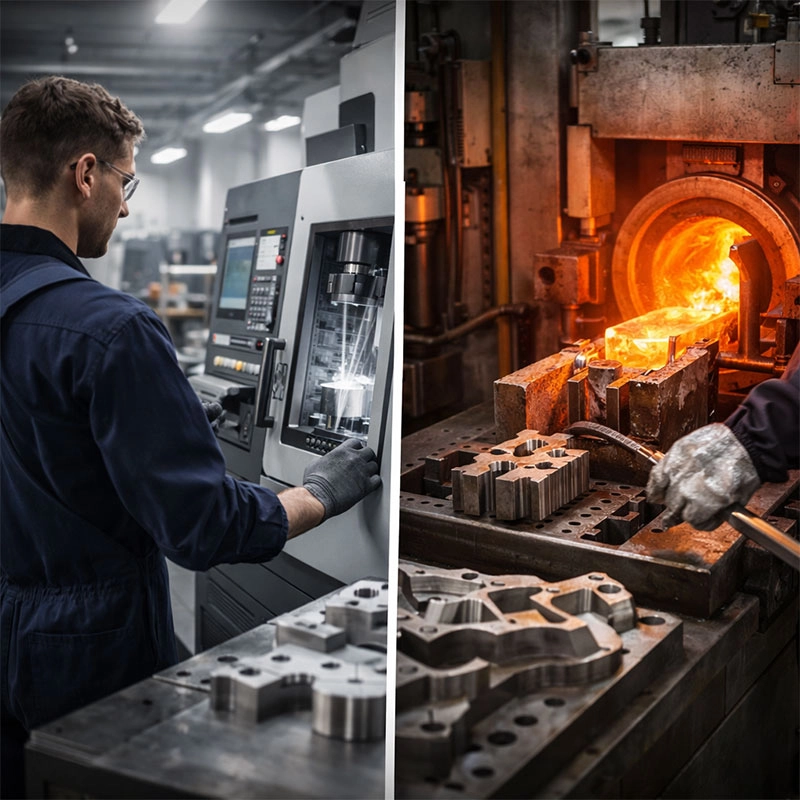
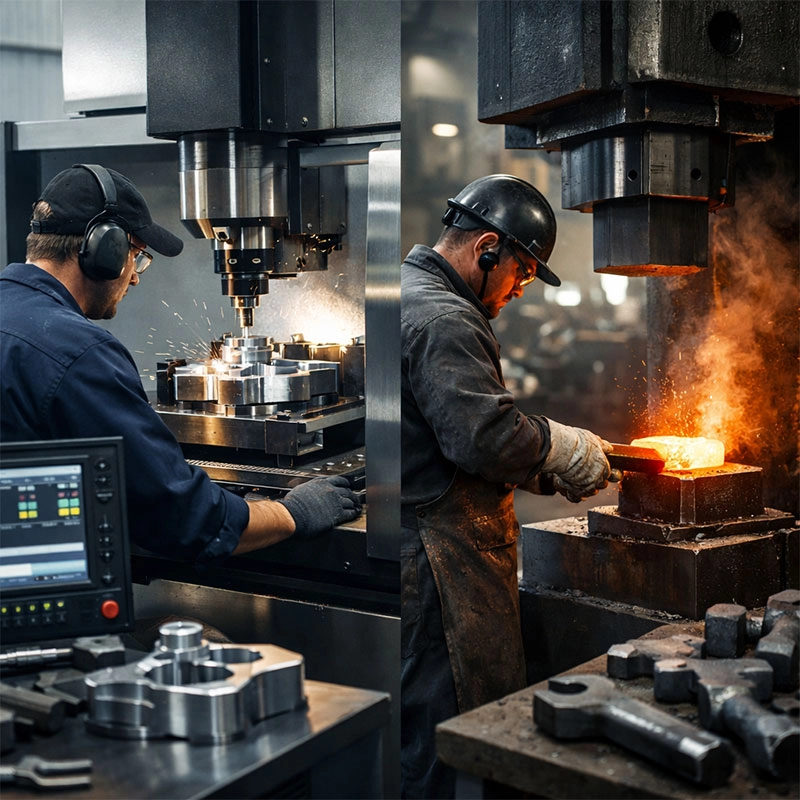
Let’s start with the basics. Imagine you’re a sculptor. CNC machining is like starting with a solid block of marble and carefully chiseling away everything that isn’t your statue. Forging, on the other hand, is like taking a lump of clay and using pressure to mold and shape it into the desired form. That fundamental difference—subtractive versus formative—shapes everything about these manufacturing processes.

The Subtractive Art of CNC Machining

CNC (Computer Numerical Control) machining is a form of precision machining. It uses computer-guided tools like mills, lathes, and routers to cut away material from a solid block (called a blank or billet). Think of it as a super-precise, automated carving process. You might also hear it called CNC milling or CNC turning, depending on the specific technique. The beauty of this method is its incredible flexibility and accuracy. Need a complex prototype with tight tolerances? CNC is often your go-to. For a deeper dive into the mechanics, resources like the American Society of Mechanical Engineers (ASME) offer great technical insights.

The Formative Power of Forging

Forging is one of the oldest metal forming techniques. It involves heating a metal workpiece and then applying compressive force—using a hammer or press—to deform it into a specific shape. This process aligns the metal’s grain structure, making it incredibly strong and durable. Common types include drop forging and press forging. It’s the preferred method for parts that must withstand immense stress, like forged crankshafts or forged connecting rods in engines. The Forging Industry Association provides excellent information on the benefits of this age-old craft.

Key Differences: Material, Strength, and More

Now that we know *how* they work, let’s look at *what* they deliver. The choice between cnc vs forging often boils down to a trade-off between three key factors: material integrity, design freedom, and cost-effectiveness for your production run.

Material Properties and Strength

This is where forging truly shines. The forging process compresses and refines the metal’s internal grain flow, following the contour of the part. This creates a continuous grain structure, dramatically increasing toughness and fatigue resistance. A forged component is typically stronger than a CNC machined part of the same material and size. Machining, however, can cut across the natural grain, which might create potential weak points in high-stress applications. So, if your main question is about forged vs machined strength, forging usually wins for dynamic, high-load parts.

Design Complexity and Precision

Here, CNC machining takes the lead. Because it’s controlled by a computer program, it can produce parts with extremely complex geometries, intricate details, and very tight tolerances that would be impossible with forging. Need internal channels, sharp corners, or a highly polished surface finish right off the machine? CNC is your friend. Forging is better suited for simpler, more solid shapes. While precision forging has advanced, it still can’t match the detail level of a 5-axis CNC machine.

Cost and Production Volume

This is a classic batch size consideration. CNC machining services have low upfront costs for tooling (often just the digital program), making them perfect for low volume production, one-off prototypes, and custom parts. However, the cost per part remains relatively steady. Forging requires expensive, custom-made dies. This makes the initial setup cost very high, but once the dies are made, the cost per part drops significantly for high-volume runs. So, for making 10 parts, CNC is cheaper. For making 10,000, forging becomes far more economical.

Choosing the Right Process for Your Project

So, how do you pick? Don’t worry, it’s not as hard as it seems once you break down your project’s requirements. Let’s match the process to the need.

When to Choose CNC Machining

You should lean towards CNC manufacturing when:
– You need prototype machining or a small batch of parts.
– Your design has complex features, tight tolerances, or excellent surface finish requirements.
– You are working with materials that are difficult to forge, like certain plastics or already-hardened metals.
– You need fast turnaround and design flexibility (making changes to a CAD file is easier than making a new forging die).
Essentially, if your priority is precision and complexity over ultimate tensile strength, CNC is the way to go.

When to Choose Forging

You should strongly consider metal forging when:
– The part will face high stress, impact, or fatigue (think automotive, aerospace, or tooling applications).
– You need superior structural integrity and reliability.
– Your production volume is high enough to justify the initial die cost.
– The part shape is relatively simple and solid.
In short, if you’re asking “is forged stronger than machined?” for a critical component, the answer is usually yes, and that’s your signal.

Clearing Up Common Misconceptions

I often hear a couple of myths that need busting. First, some folks think forging is a “low-tech” or imprecise process. Modern closed die forging is highly controlled and can produce near-net-shape parts with remarkable consistency. Second, there’s a belief that you can’t machine a forged part. Actually, it’s very common! Many forged parts undergo secondary machining (or “machining after forging”) to achieve final dimensions, drill holes, or create precision features. The processes are often partners, not just rivals.

Final Thoughts: Making Your Decision

So, which process wins? As you can see, there’s no single champion—it all depends on the goal of your project. Think of it this way: Forging is about creating supreme strength and durability from the inside out, ideal for high-volume, high-stress components. CNC machining is about achieving unparalleled precision and complexity from the outside in, perfect for prototypes, custom work, and intricate designs. My best advice? Clearly define your priorities for strength, complexity, quantity, and budget. Often, talking through these requirements with a knowledgeable CNC shop or forging supplier will quickly point you in the right direction. Good luck with your project!

Categories
Manufacturing Process Comparisons

CNC Machining vs Stamping: Which Process Wins for Your Project?

Choosing between CNC machining and stamping is a common manufacturing crossroads. This guide breaks down their core differences in cost, precision, and application to help you decide which fabrication process is the winner for your specific project needs.

Understanding the Basics: What Are We Comparing?

When you’re planning a new part, you’ll likely hear about CNC machining services and metal stamping processes. They’re both fantastic, but they work in completely different ways. Think of it like cooking: one is a meticulous chef carving a sculpture from a block of material (CNC), and the other is a high-speed cookie cutter pressing shapes out of sheet metal (stamping). Let’s get to know each one a bit better.

What is CNC Machining?

CNC, or Computer Numerical Control machining, is a subtractive manufacturing process. It starts with a solid block of material—like metal, plastic, or even wood—and uses computer-controlled cutting tools to remove material, carving out the final part. It’s incredibly precise and is perfect for creating complex, three-dimensional geometries. If you’re looking into precision machining for prototypes or low-volume custom parts, this is often the go-to method.

What is Metal Stamping?

Metal stamping, on the other hand, is a forming process. It uses a stamping press and a set of custom dies (like a specialized mold) to punch, bend, or shape sheet metal into a desired form. The key here is the die. Creating it is a significant upfront investment, but once it’s made, you can produce parts at lightning speed. This makes stamping ideal for high-volume sheet metal fabrication of components like brackets, enclosures, or automotive parts.

Head-to-Head Comparison: Where Each Process Shines

Now that we know the players, let’s put them side-by-side. This isn’t about which one is “better,” but about which one is better *for you*. I often tell my clients that the choice between CNC milling vs stamping comes down to a few key project factors.

Cost and Production Volume

This is the biggest deciding factor for most projects. CNC machining has low startup costs—you just need the digital file. But, the cost per part remains relatively high. Stamping has very high initial costs due to die creation, but the cost per part plummets as you make more. So, the rule of thumb is: low-volume production favors CNC, while high-volume manufacturing is where stamping wins on economics. For a deep dive on manufacturing economics, the Modern Machine Shop has a great resource on cost drivers.

Material and Design Flexibility

CNC is the clear champion here. It can handle a vast range of materials, from aluminum and stainless steel to engineering plastics. You can make incredibly complex parts with undercuts, deep cavities, and fine details. Stamping is primarily for ductile metals (like steel, aluminum, copper) and is best for parts with a relatively uniform thickness. Changing a design with CNC is as simple as tweaking the CAD file. With stamping, a design change often means a new, expensive die.

Precision and Surface Finish

Both can be precise, but in different ways. CNC machining typically offers tighter tolerances and superior surface finishes right off the machine. It’s the choice for parts that must fit together perfectly or have a cosmetic finish. Stamped parts can be very precise, but the precision is built into the die. The surface might have marks from the forming process and often requires secondary operations. For applications demanding the utmost accuracy, CNC turning and milling usually takes the lead.

Speed and Lead Time

For getting a first part in your hands quickly, CNC wins. There’s no tooling wait time. For mass production, however, nothing beats the sheer speed of a stamping press once it’s running. So, consider your timeline: need a prototype next week? CNC. Need a million parts over the next year? Stamping’s production rate is unbeatable.

Making the Right Choice for Your Project

So, which process wins? It depends entirely on your project’s recipe. Here’s a simple way to think about it:

Choose CNC Machining if your project involves: – Low to medium volumes (prototypes, custom parts, batches of 1-10,000). – Complex 3D geometries, tight tolerances, or excellent surface finish. – Frequent design changes or a wide variety of materials. – You need parts fast for testing or initial production.

Choose Metal Stamping (or progressive die stamping) if your project involves: – Very high volumes (tens of thousands to millions of parts). – Relatively simple, flat or bent parts made from sheet metal. – A finalized design where the cost of the die can be amortized. – The primary goal is the lowest possible cost per part at high speed.

Sometimes, the best solution uses both! A common approach is to use CNC to prototype and test a part, then transition to stamping for the full production run once the design is locked in. The team at ASM International’s handbook on metalworking discusses these hybrid manufacturing strategies. My advice? Start by clearly defining your volume, budget, timeline, and part complexity. With those in hand, the winning process for your custom part fabrication will become much clearer.

Categories
CNC Materials

Titanium vs. Steel Machining: 5 Key Differences Explained

Choosing between titanium and steel for your CNC project? It’s more than just picking a strong metal. This guide breaks down the five key differences in machining these materials, from cutting speeds to tool wear, helping you make an informed decision for better results and fewer headaches in the shop.

Material Properties and Machinability

When you first compare titanium machining to steel CNC machining, the physical properties tell the whole story. Think of it like cooking: you wouldn’t use the same heat and technique for a delicate fish as you would for a tough steak. The same logic applies here. Titanium’s unique characteristics, like its low thermal conductivity and high chemical reactivity, make it behave very differently under the tool compared to most steels. Understanding this “machinability rating” is your first step to success.

Strength-to-Weight Ratio

This is where titanium truly shines and why it’s a favorite in aerospace and medical implants. Titanium offers a phenomenal strength-to-weight ratio; it’s as strong as many steels but about 45% lighter. However, this very strength is a double-edged sword in machining. That impressive tensile strength means cutting forces are high, demanding rigid machine setups and sharp tools. When you’re working on a part where every gram counts, this property makes the extra effort in machining titanium alloys worthwhile.

Thermal Conductivity

Here’s a critical difference that trips up many machinists. Steel is a pretty good conductor of heat. When you cut it, a significant amount of the heat generated travels up into the chip and away from the cutting edge. Titanium, on the other hand, is a poor thermal conductor. Almost all the heat from the cutting process stays right at the tool-workpiece interface. This creates a localized “hot spot” that can rapidly degrade your cutting tool. It’s one of the main reasons why machining Ti-6Al-4V requires such careful attention to speeds and cooling.

Cutting Tools and Parameters

You can’t use the same tooling strategy for both materials. For steel, you have a wide range of options, including high-speed steel (HSS) for some jobs. But for titanium, you’re almost always looking at premium, uncoated or specially coated carbide tools. The cutting speeds tell a clear story: you might run many steels at several hundred surface feet per minute (SFM), but for titanium, you often need to slow way down, sometimes below 100 SFM. It’s not about being fast; it’s about being smart and preserving your tool. Using the correct parameters is the key to CNC machining titanium efficiently.

Chip Formation and Evacuation

Watch the chips, and they’ll tell you how the cut is going. Steel typically produces a nice, curled chip that breaks easily. Titanium is notorious for producing long, stringy, continuous chips. These “birds’ nests” are not just a nuisance; they’re dangerous. They can wrap around the tool or workpiece, causing scratches, tool breakage, or even machine damage. Effective chip control through proper tool geometry (sharp cutting edges, positive rakes) and high-pressure coolant to break and flush chips is non-negotiable in titanium metal machining.

Coolant and Lubrication Strategy

Given the heat issue we talked about, coolant isn’t just helpful for titanium—it’s essential. But it’s not just any coolant. We recommend using a high-quality, heavy-duty synthetic or semi-synthetic fluid with excellent lubricity. More importantly, the delivery method is crucial. A flood coolant might work for steel, but for titanium, high-pressure through-tool coolant is a game-changer. It penetrates the cutting zone, reduces the heat, and helps with chip evacuation. For some operations, like tapping, using a dedicated tapping fluid can prevent galling, a common problem where titanium welds itself to the tool. You can find excellent guidelines on metalworking fluids from authoritative sources like Machinery Lubrication.

Cost and Application Considerations

Let’s talk about the bottom line. The raw material cost for titanium is significantly higher than for steel. Add to that the slower machining speeds, more expensive tooling, and need for possibly more powerful/rigid CNC machines, and the cost per part skyrockets. So, when do you choose it? When the application demands its unique benefits: unparalleled corrosion resistance, that fantastic strength-to-weight ratio, and biocompatibility. For high-stress, weight-sensitive, or corrosive environments, titanium is worth the investment. For most general-purpose, high-strength applications, machining stainless steel or alloy steel is the more economical and practical choice. It’s all about matching the material to the part’s real-world job.

Categories
CNC Materials

Mastering CNC Machining for Aerospace Materials: A Practical Guide

Working with aerospace alloys like titanium and Inconel presents unique challenges. This guide explores practical CNC strategies for these demanding materials, focusing on toolpath optimization, thermal management, and achieving the stringent tolerances required for flight-critical parts.

Advanced Techniques for Machining Aerospace Components

When you’re tasked with CNC milling aerospace materials, it’s not just about running a program. It’s a dance between machine, tool, and material. I like to think of it as a conversation where you need to listen to the cut. The goal is to remove material efficiently while preserving the integrity of the part, which is often incredibly expensive. You might find that strategies which work for steel fall completely flat here.

Smart Toolpath Strategies

One of the biggest shifts is moving towards trochoidal milling and other high-efficiency toolpaths. Instead of forcing a tool through a full width of cut, these paths use a constant, lighter engagement, allowing the tool to “glide” through the material. This reduces heat buildup and radial forces dramatically. For complex aerospace component machining, this means longer tool life and a much happier machine spindle. It’s a bit like taking smaller, quicker steps up a steep hill instead of trying to leap up in one go—you conserve energy and avoid burnout.

Keeping Your Cool: Thermal Management

Heat is the enemy. Many high-performance alloys used in aviation are designed to retain strength at high temperatures, which is great for the engine, but tough on your end mill. Effective cooling is non-negotiable. We recommend using high-pressure coolant through the spindle (HPCTS) to flood the cutting edge and evacuate chips instantly. Sometimes, for materials like certain aluminums, even a mist coolant can be sufficient if chip clearance is optimal. The key is to prevent the heat from transferring back into the tool or the workpiece, which can cause work hardening and premature tool failure.

Navigating the Challenges of Aerospace Alloys

Let’s get specific about the rock stars of the aerospace world: titanium and nickel-based superalloys. Each has its own personality, and understanding them is half the battle in precision machining for aviation.

Tackling Titanium’s Toughness

Machining titanium alloys like Ti-6Al-4V is a study in contradiction. It’s strong but has low thermal conductivity, meaning the heat stays right at the cutting edge. The chatter you might hear? That’s often a sign of built-up edge or excessive vibration. To win, you need sharp, coated carbide tools, conservative speeds and feeds, and absolute rigidity in your setup. A colleague once shared that machining titanium taught him more about machine stability than any other material—it simply won’t tolerate a loose setup.

Conquering Inconel’s Heat

If titanium is tough, Inconel machining is on another level. These superalloys work-harden rapidly. If your tool dwells or rubs, you instantly create a surface harder than the tool itself. The strategy here is aggressive—maintain a constant, positive cut. Use ceramic or specialized carbide inserts designed for high-temperature applications. It’s crucial to calculate your feeds to ensure the cut is always ahead of the work-hardened zone. Think of it like walking on hot coals; you have to keep moving steadily forward.

Achieving Aviation-Grade Precision and Tolerances

What separates a good part from a flight-ready part? The answer lies in microns and surface finishes. Aerospace CNC machining isn’t just about shape; it’s about creating components that can handle immense stress and thermal cycles without failing. This demands extraordinary attention to detail in every operation, from roughing to final finishing.

For instance, achieving a specific surface finish on a turbine blade isn’t just for looks; it directly impacts airflow and fatigue life. This often involves a multi-stage process with dedicated finishing tools and precise control over stepovers. Furthermore, managing material stress and distortion is part of the job. Sometimes, this means using stress-relief cycles between machining operations or even designing fixtures that mimic the part’s final mounted state. You can learn more about material properties and standards from resources like ASM International.

Your Practical Checklist for Success

Let’s wrap this up with some hands-on advice you can take straight to the shop floor. Mastering CNC manufacturing for aerospace is a journey, but these tips will set you on the right path.

Start with the Right Tools: Don’t compromise. Use premium, sharp tools with coatings like AlTiN for titanium or specialized grades for superalloys. They cost more but save money in the long run.
Embrace Rigidity: Check everything—tool holder runout, workpiece clamping, machine condition. Vibration is your biggest foe.
Manage Chips: A well-evacuated chip is a cool chip. Ensure your coolant pressure and nozzle positioning are optimized to get chips out of the cut zone immediately.
Document Everything: Speeds, feeds, tool life, surface finish results. When you find a recipe that works for a specific aerospace-grade material, write it down. This knowledge is pure gold.
Partner with Experts: Engage with your tooling supplier and material providers. They have a wealth of application-specific data. Repositories like NASA’s Technical Reports Server can also provide fascinating insights into advanced manufacturing research.

Remember, patience and a methodical approach are your best assets. By respecting the material, leveraging advanced techniques, and focusing on relentless precision, you’ll not only machine aerospace components—you’ll master them.

Request A Quote

We'll Send You Back with Price Immediately!

DEC 1-31

XMAS SPECEIL

Up to

40% off

Mastering CNC Machining for Aerospace Materials: A Practical Guide

We'll Send You Back with Price Immediately!