

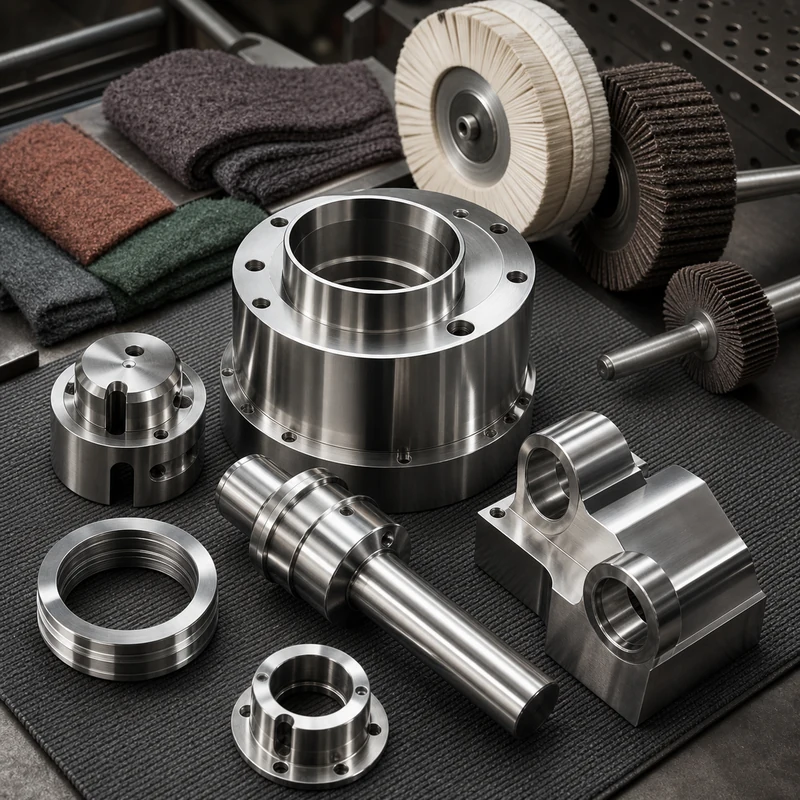
Stainless steel CNC parts are polished to remove tool marks, improve appearance, reduce roughness, prepare for cleaning, or support corrosion-resistant service. The best method depends on the stainless grade, starting surface, part geometry, cosmetic expectations, and whether the finish is decorative, functional, or both.
Polishing should be planned before production rather than treated as a last-minute cosmetic step. MTSPi can combine stainless steel CNC machining, surface finish planning, and quality checks so machined features and finished surfaces match the drawing intent.
Why Polish Stainless Steel Parts?
- Remove visible cutter marks, burr traces, scratches, or handling marks.
- Create a brushed, satin, bright, or mirror-like appearance.
- Reduce surface roughness where cleaning, sealing, or flow behavior matters.
- Improve corrosion performance when polishing is paired with proper cleaning or passivation.
- Prepare selected surfaces for assembly, inspection, or customer-facing use.
Common Polishing Methods
| Method | Typical Result | Best Use |
|---|---|---|
| Deburring and edge blending | Safer edges and cleaner transitions | General machined parts before cosmetic finishing |
| Abrasive grinding | Removes deeper tool marks and uneven areas | Pre-polish correction or weld/stock cleanup |
| Brushing | Uniform directional satin texture | Panels, covers, brackets, visible housings |
| Buffing | Bright reflective surface | Decorative components and customer-facing hardware |
| Mirror polishing | Very high reflectivity after staged abrasives | Optical, medical, food, and premium cosmetic surfaces |
| Electropolishing | Electrochemical smoothing and cleaning | Complex stainless parts, hygienic surfaces, and corrosion-sensitive applications |
A Practical Stainless Steel Polishing Workflow
1. Define the target finish
The finish should be described with a surface roughness value, visual standard, grain direction, sample photo, or approved reference part. Terms like “nice polish” or “shiny” are too vague for repeat production.
2. Machine with finishing allowance in mind
Polishing removes material. If a critical diameter, sealing surface, or flatness callout will be polished, the machining plan may need allowance and inspection after finishing. Tight features should not be polished aggressively unless the drawing accounts for it.
3. Remove defects gradually
Deep scratches, heavy cutter marks, and sharp edges should be reduced with controlled abrasives before fine polishing. Jumping directly to a fine compound can leave hidden waves, dull patches, or inconsistent reflections.
4. Clean and protect the part
After polishing, stainless steel parts should be cleaned to remove abrasive residue, compounds, oils, and loose particles. Depending on the application, passivation or electropolishing may be specified to improve surface cleanliness and corrosion behavior.
Stainless Steel Grades and Finish Behavior
| Grade Family | Polishing Notes | Typical CNC Use |
|---|---|---|
| 304 stainless steel | Polishes well and is widely used for general corrosion resistance | Housings, brackets, food equipment, covers |
| 316 stainless steel | Good corrosion resistance and common in harsher environments | Medical, marine, chemical, and hygienic components |
| 17-4 PH stainless steel | Can be heat treated; finish planning should account for hardness condition | High-strength shafts, fixtures, aerospace and industrial parts |
| 303 stainless steel | Machines well, but corrosion and finishing expectations should be checked | Turned parts, fittings, fasteners, bushings |
Design Notes Before Specifying a Polish
- Avoid deep narrow pockets if the inside surfaces must be cosmetically polished.
- Mark which faces are cosmetic and which are non-visible functional surfaces.
- Specify grain direction for brushed finishes on panels or covers.
- Confirm whether threaded holes, sharp edges, datums, and bores must be protected during finishing.
- Define inspection after finishing when surface removal could affect tolerances.
Polishing vs Passivation vs Electropolishing
Mechanical polishing changes texture and appearance by physically smoothing the surface. Passivation chemically removes free iron and supports corrosion resistance. Electropolishing removes a thin surface layer electrochemically, which can smooth micro-peaks and improve cleanliness on suitable stainless parts. These processes can be combined, but they are not interchangeable.
| Process | Main Purpose | Changes Dimensions? |
|---|---|---|
| Mechanical polishing | Appearance and roughness control | Yes, depending on abrasive stage and pressure |
| Passivation | Surface chemistry and corrosion support | Minimal dimensional change |
| Electropolishing | Micro-smoothing, cleaning, and corrosion support | Small controlled material removal |
How MTSPi Supports Stainless Finishing
For stainless components, MTSPi reviews machining, polishing access, tolerance risk, edge requirements, cleaning, and inspection before production. Send your 3D model, drawing, stainless grade, target finish, cosmetic faces, and quantity through our RFQ channel.
Related MTSPi Resources
FAQ
Can all stainless steel CNC parts be mirror polished?
Not always. Mirror polishing depends on grade, geometry, access, starting surface, tolerance limits, and cost. Some internal features are impractical to polish uniformly.
Does polishing improve corrosion resistance?
A smoother and cleaner surface can help, but corrosion performance also depends on stainless grade, contamination control, passivation, environment, and maintenance.