

Categories
Blog CNC Materials Guides Quality & Tolerances

Acetal vs Nylon: CNC Machining and Material Selection Guide

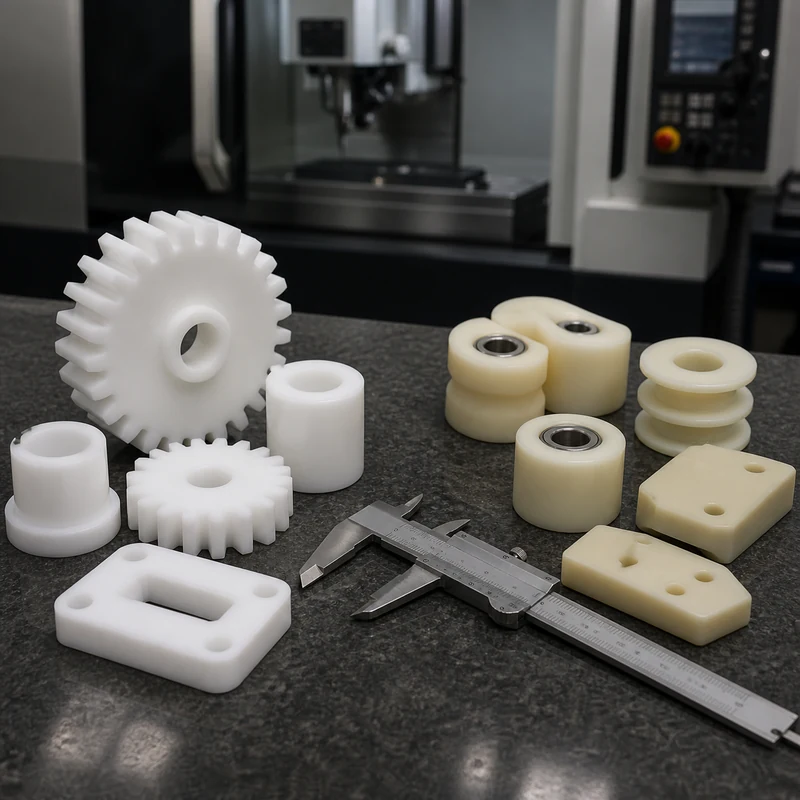
Acetal and nylon are two of the most useful engineering plastics for machined gears, rollers, bushings, guides, and structural components. They can look similar on a drawing, but they respond differently to humidity, impact, sustained load, friction, and tight tolerances. Acetal is usually the more predictable choice for dimensional stability and smooth precision motion. Nylon is often stronger when a component must absorb shock, tolerate abrasion, or flex without cracking.

This is not a simple good-versus-bad comparison. Both material families contain multiple grades, fillers, and stock forms. The right decision comes from the actual load case, environment, geometry, tolerance scheme, and inspection condition. This guide compares acetal (often specified as POM or by the Delrin trade name) with common machinable nylons from a design-for-manufacturing perspective.

Acetal vs Nylon: Quick Engineering Comparison

Decision factor Acetal / POM Nylon
Typical design priority Stable dimensions and low-friction precision motion Toughness, impact absorption, and abrasion resistance
Moisture response Low absorption; comparatively stable in humidity Absorbs moisture; dimensions and properties can change
Stiffness Generally high and consistent Grade- and moisture-dependent; often more compliant
Impact behavior Good, but less forgiving at notches Generally tougher under shock and repeated loading
Wear and sliding Excellent for controlled sliding and gears Excellent for wear pads, guides, and rugged contact
Machining behavior Clean chips and good tolerance control Can produce stringy chips and move after unclamping
Creep under load Must be checked Must be checked; reinforced grades may help
Best starting point Close fits, valve parts, precision gears, spacers Wear pads, pulleys, rollers, impact-loaded components

These are broad tendencies rather than certified values. Resin type, conditioning, reinforcement, stock-production method, temperature, test direction, and supplier all matter. Always approve the exact grade using its current technical data and any required compliance documentation.

What Is Acetal?

Acetal is the engineering-plastic family known chemically as polyoxymethylene, or POM. It is available as homopolymer and copolymer formulations. Delrin is a trade name associated with a particular acetal homopolymer, so a drawing that says only “Delrin” may not be equivalent to every generic acetal grade. Procurement documents should identify the exact resin or an approved-equivalent rule.

Machined acetal is valued for stiffness, low friction, fatigue performance, clean machinability, and low moisture absorption. These traits make it a practical choice for dimensional spacers, small gears, bearing cages, valve components, electrical insulators, and mechanisms that need repeatable motion. It also tends to produce a crisp machined surface when tools are sharp and heat is controlled.

Homopolymer vs Copolymer POM

Homopolymer POM often offers somewhat higher stiffness and strength, while copolymer grades may provide improved resistance to hot water, alkaline environments, and centerline porosity in larger cross-sections. The meaningful difference depends on grade and stock size. For a sealing bore, pressure component, or thick machined section, do not substitute between them without engineering review.

What Is Nylon?

Nylon refers to a broad polyamide family rather than one uniform material. Nylon 6, nylon 6/6, cast nylon, nylon 12, and reinforced or lubricant-filled grades can behave quite differently. Common nylons combine toughness, fatigue resistance, and excellent abrasion performance, making them useful for rollers, sprockets, wear strips, pulleys, guides, and mechanical components exposed to vibration or intermittent shock.

The defining design issue is moisture absorption. Nylon equilibrates with its surroundings, and absorbed water can change its size, stiffness, and toughness. That can be beneficial for impact behavior but problematic for a close sliding fit or a tightly located hole pattern. Engineering and inspection must agree on whether dimensions apply to dry-as-machined, conditioned, or service-equilibrated material.

The Differences That Matter in Real Parts

Dimensional Stability and Moisture

Acetal is normally easier to control when humidity changes or when the part has a close fit. Nylon can swell after machining as it absorbs moisture, and the amount is affected by grade, wall thickness, time, and exposure. A tolerance that is achievable at the machine may not represent the dimension after conditioning or field service.

For nylon, identify the conditioning state on the drawing or purchase specification. Allow clearance where function permits, avoid blanket tight tolerances, and inspect at a controlled temperature and moisture condition. For either plastic, thin walls and asymmetric stock removal can release internal stress and cause movement.

Stiffness, Toughness, and Impact

Acetal is often selected when rigidity preserves gear alignment, bearing clearance, or positional accuracy. Nylon is usually more forgiving under impact and repeated deflection. Yet geometry can outweigh the generic material trend: a sharp corner, thin snap arm, press fit, or molded-in stress raiser can fail even in a nominally tough resin.

Use generous transitions, remove sharp internal corners, distribute fastener loads, and verify short-term strength separately from long-term creep. Filled grades can increase stiffness but may reduce impact strength or create direction-dependent behavior.

Friction, Wear, and Counterface

Both families can work well in sliding mechanisms. Acetal commonly provides smooth low-friction motion and predictable gear or bearing geometry. Nylon is widely used where abrasive contact and shock occur together. Actual life depends on pressure, velocity, heat generation, lubrication, debris, shaft material, surface finish, alignment, and duty cycle—not the plastic name alone.

A wear pair should be tested as a system. A very rough metal shaft can rapidly abrade a polymer, while an excessively smooth or incompatible counterface may not retain lubricant. Filled or internally lubricated grades should be evaluated when dry running or high duty is expected.

Temperature, Creep, and Chemical Exposure

Neither material behaves like a metal under sustained heat and clamp load. Strength and modulus fall as temperature rises, and creep can relax a bolted joint or distort a bearing seat over time. Nylon grades may retain useful toughness at elevated temperature, while acetal may keep dimensions more predictably in ordinary humid service. Grade-specific curves are essential near any limit.

Both resist many oils, greases, and fuels, but neither is chemically universal. Check the exact fluid, concentration, temperature, stress level, and exposure duration. Cleaning agents, thread lockers, and assembly lubricants deserve the same review as the primary process chemical.

CNC Machining Acetal and Nylon

Machining issue Acetal planning Nylon planning
Cutting edge Sharp polished carbide; maintain a real chip Sharp positive geometry; prevent rubbing and stringy recutting
Heat control Evacuate chips and avoid dwell Control heat carefully because local softening encourages movement
Workholding Broad support without crushing Support flexible walls and avoid clamp distortion
Finishing pass Allow the part to stabilize before final sizing Rough, relax, then finish when tight geometry warrants it
Threads Good detail, but avoid excessive interference Use adequate engagement; inserts or through-bolts may be safer
Inspection Control temperature and fixturing Define moisture condition as well as temperature

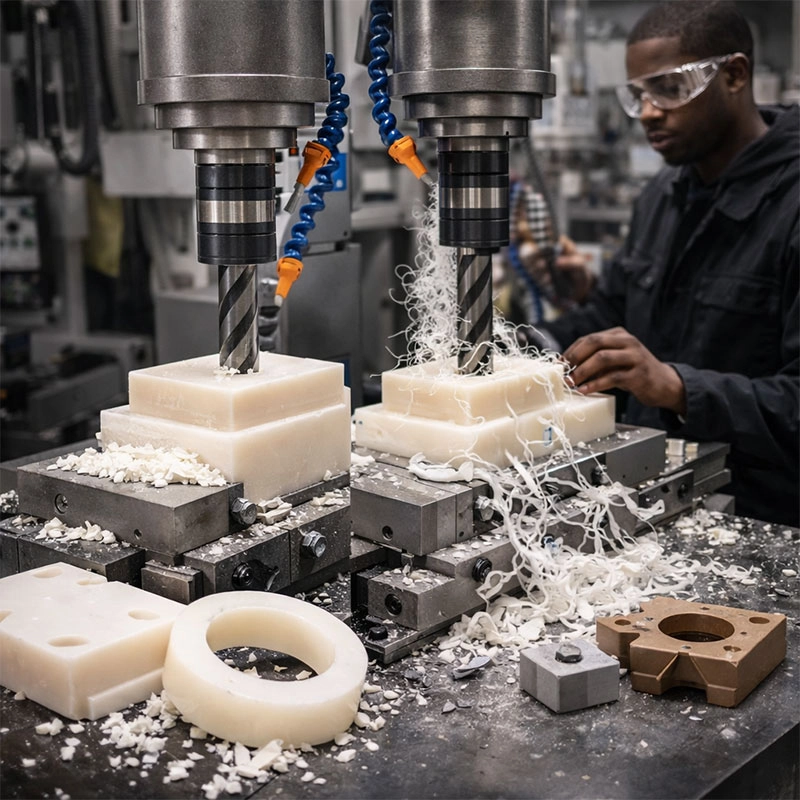
Successful CNC plastic machining removes heat with the chip. Rubbing, dull tools, excessive spindle speed, or repeated chip recutting can smear an edge and build residual stress. Air or a verified compatible coolant can help, but the fluid must not attack the polymer or contaminate a regulated part.

Practical Acetal Machining Guidance

  • Use stable, traceable stock and confirm homopolymer or copolymer before production.
  • Keep cutting tools sharp and avoid dwell marks at finished surfaces.
  • Support thin rings and long walls without creating ovality or clamp witness.
  • Use realistic press-fit allowances; excessive interference can split a hub over time.
  • Deburr by controlled cutting rather than melting or heavy edge rounding.

Practical Nylon Machining Guidance

  • State the material grade and conditioning state explicitly.
  • Use positive cutting geometry and evacuate continuous chips safely.
  • For tight features, consider rough machining followed by stress relaxation and finish machining.
  • Allow the part to stabilize before final measurement.
  • Protect long, flexible features from tool pressure and workholding distortion.

How to Choose by Application

Application condition Likely starting point What to verify
Precision gear or index component Acetal Tooth load, backlash, temperature, lubricant, and life
Close-fit bushing in changing humidity Acetal PV limit, shaft finish, clearance, and creep
Impact-loaded roller or pulley Nylon Shock load, moisture state, bearing retention, and wear
Wear pad or guide rail Nylon Counterface, debris, pressure, velocity, and lubrication
Valve or fluid-handling component Acetal grade selected for media Chemical compatibility, pressure, temperature, and porosity
Large structural plastic plate Cast nylon may be attractive Flatness, internal stress, conditioning, and creep
Food or medical contact part Certified grade only Applicable regulation, traceability, cleaning, and validation

Design Rules That Reduce Failure Risk

  1. Specify the family and exact grade. “Plastic,” “nylon,” or “acetal” alone leaves too much room for substitution.
  2. Define the service environment. Include humidity, immersion, temperature range, chemicals, UV exposure, and duty cycle.
  3. Tolerance only the interfaces that matter. Plastic dimensions respond to temperature, moisture, stress, and fixturing.
  4. Avoid sharp stress concentrators. Add corner radii and smooth section changes.
  5. Design fasteners for creep. Use washers, shoulders, metal inserts, or through-bolts where appropriate.
  6. Account for thermal expansion. Do not trap a long plastic component between rigid metal boundaries without clearance.
  7. Separate cosmetic and functional surfaces. Deburring, polishing, and protective handling can affect critical edges.

Cost: Compare the Finished System, Not Stock Price

Standard nylon stock may appear less expensive than a specified acetal grade, but material price is only one input. Add machining time, stabilization steps, scrap risk, inspection, assembly method, lubrication, maintenance, and expected service life. A stable acetal part may be cheaper if it avoids post-machining movement; a tougher nylon component may be cheaper if it survives shock and abrasive duty longer.

RFQ Checklist

  • Controlled 3D model and 2D drawing
  • Exact resin, grade, color, filler, and approved equivalents
  • Stock form and required material certification
  • Quantity and prototype-to-production plan
  • Critical datums, fits, tolerances, and inspection condition
  • Load, speed, temperature, humidity, chemicals, and expected life
  • Counterface material, finish, lubrication, and debris exposure
  • Threads, inserts, press fits, assembly torque, and cosmetic requirements

MTSPi can review these inputs through its CNC machining services, dedicated acetal machining and nylon machining capabilities, and quality assurance workflow.

Frequently Asked Questions

Is Delrin the same as acetal?

Delrin is a trade name for a specific POM homopolymer. Acetal is the wider POM family, which also includes copolymers. Use the exact grade on production documents.

Which material holds a tighter tolerance?

Acetal is usually the easier starting point because it absorbs less moisture. Geometry, stock stress, temperature, fixturing, and measurement method still control the achievable result.

Which is better for gears?

Acetal suits precise, low-friction gears; nylon can suit tougher or shock-loaded gears. Tooth load, heat, lubrication, backlash, and life testing should decide.

Can nylon be machined accurately?

Yes. Accurate nylon parts require suitable stock, sharp tools, controlled heat and workholding, stabilization, and a defined moisture condition.

Can both materials use threaded inserts?

Yes, but insert style, installation method, wall thickness, torque, temperature, and creep must be validated for the exact grade.

Conclusion

Choose acetal when stable dimensions, stiffness, clean machinability, and smooth low-friction motion lead the requirements. Choose nylon when toughness, abrasion resistance, and impact absorption matter more. Then verify the decision against the exact grade, conditioning state, environment, tolerance plan, counterface, and lifetime load—not a generic property chart.
Related MTSPi Resources

Categories
Blog CNC Materials Guides Quality & Tolerances

PVC vs Acrylic: CNC Machining and Material Selection Guide

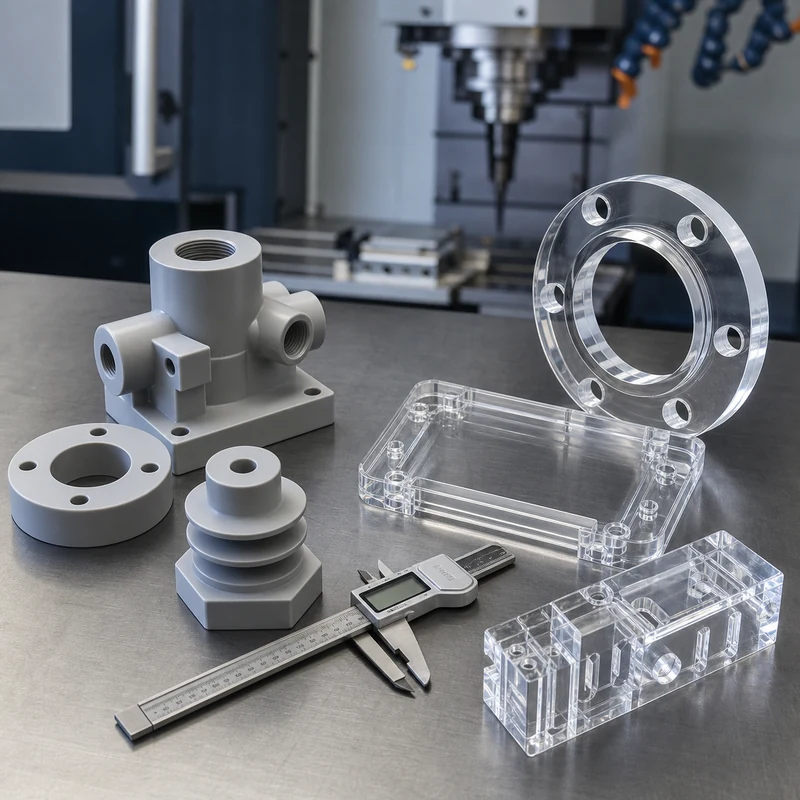
PVC and acrylic can both be machined into accurate plastic components, yet they solve different engineering problems. Rigid PVC is usually selected for chemical resistance, electrical insulation, toughness, and economical functional parts. Acrylic (PMMA) is selected when optical clarity, UV stability, a polished appearance, or visual inspection through the component matters.

The best choice cannot be made from appearance alone. Grade, service temperature, chemical exposure, impact risk, tolerances, edge finish, and fastening method all affect performance. This guide compares PVC vs acrylic from a design-for-machining perspective and explains what to include in a production RFQ.

PVC and Acrylic at a Glance

Selection factor Rigid PVC Acrylic (PMMA)
Primary advantage Chemical-resistant, economical functional performance Optical clarity and premium surface appearance
Transparency Opaque, translucent, and clear grades exist; optical quality varies Excellent clarity in optical-grade material
Impact behavior Generally tougher and less notch-sensitive Rigid but comparatively brittle
Chemical resistance Strong against many acids, alkalis, and salts Useful general resistance, but vulnerable to several solvents
Outdoor exposure Grade and stabilizer dependent Usually strong UV and weathering performance
Machining concern Heat, chip evacuation, dimensional recovery Chipping, cracking, heat, and residual stress
Typical use Manifolds, insulators, fixtures, corrosion-resistant parts Windows, guards, displays, light guides, clear housings

Property values vary by formulation, sheet or rod manufacturing method, colorant, and test standard. Designers should use the supplier’s current data for the purchased grade instead of treating a generic comparison as a material certificate.

What Is Rigid PVC?

Polyvinyl chloride is available in flexible and rigid forms. CNC components generally use rigid, unplasticized grades because they offer useful stiffness, low moisture absorption, electrical insulation, and resistance to many corrosive media. It is frequently considered for laboratory hardware, wet-process equipment, electrical components, and fluid-handling parts.

PVC is not a universal chemical solution. Temperature, concentration, exposure time, mechanical stress, and joining method can change compatibility. It also softens as temperature rises, so thin walls or clamped components require realistic thermal and creep expectations.

What Is Acrylic?

Acrylic is the common engineering name for polymethyl methacrylate (PMMA). Its defining advantage is clarity: properly selected and finished acrylic can create transparent covers, machine windows, instrument faces, lighting elements, and inspection components with a glass-like appearance at lower weight than glass.

Cast vs Extruded Acrylic

Cast acrylic is often favored for CNC machining because it typically handles cutting and polishing with lower sensitivity to localized heat and residual stress. Extruded sheet offers consistent thickness and economical availability, but its process history may make it more prone to gumming, stress, or dimensional movement. That is a practical tendency rather than an absolute rule; the actual grade and stock condition govern.

Key Engineering Differences

Optical Clarity and Finish

Acrylic is the natural choice for a view window or presentation surface. Machined edges can be brought to a clear finish through controlled sanding, polishing, or a qualified vapor/flame process. Every polishing method changes geometry and surface condition, so an appearance requirement should be separated from a critical sealing or dimensional surface.

Clear PVC exists, but it is generally specified for chemical or fabrication performance rather than maximum optical quality. A sample approval is useful whenever haze, tint, light transmission, or distortion is important.

Chemical Compatibility

Rigid PVC performs well in many aqueous chemical environments, which makes it attractive for manifolds, covers, and handling equipment. Acrylic can craze or crack after contact with incompatible solvents, cleaners, adhesives, or thread-locking compounds. Compatibility must be checked against the exact chemical, concentration, temperature, and duration. A brief wipe test does not predict long-term stressed exposure.

Impact, Notches, and Fasteners

Acrylic is stiff but notch-sensitive. Sharp internal corners, countersunk fasteners, press fits, and over-tightened screws can concentrate stress and initiate cracks. PVC usually tolerates routine handling better, although it can still deform under sustained clamp load. Add corner radii, provide clearance, distribute load with washers or inserts, and define assembly torque where necessary.

UV, Weather, and Temperature

Acrylic generally retains clarity well outdoors. PVC outdoor performance depends strongly on formulation, pigmentation, and stabilizers. Neither material is a high-temperature engineering plastic. For continuous heat, sterilization, or large thermal swings, evaluate alternatives through MTSPi’s machining materials system and account for thermal expansion in the tolerance plan.

PVC vs Acrylic for CNC Machining

Process issue PVC planning response Acrylic planning response
Tooling Sharp, polished carbide with geometry that cuts cleanly Very sharp polished tools and low-runout holders
Heat Maintain chip load and evacuate chips before they recut Avoid rubbing; control heat to prevent melting and stress
Workholding Support the part without long-term or local crushing Use broad, compliant support and avoid point loads
Edges Deburr cleanly without smearing Prevent breakout and specify whether edges remain machined or polished
Coolant/cleaner Confirm chemical compatibility Avoid stress-crazing fluids and solvents
Inspection Allow the part to reach stable temperature Protect optical faces and avoid probe or fixture damage

In CNC plastic machining, aggressive cutting is rarely the answer. The process should form a real chip instead of rubbing, while keeping heat out of the workpiece. Thin plastic parts may move after unclamping, so tolerances should reflect wall thickness, stock stress, temperature, and how the component will be supported during inspection.

Machining Rigid PVC

  • Use sharp tools and reliable extraction so stringy or warm chips do not recut.
  • Avoid excessive surface speed or dwell that can soften and smear the edge.
  • Support thin walls and large plates to limit vibration and clamping distortion.
  • Verify that coolant, adhesive, and cleaning chemistry are compatible with the selected grade.
  • Control deburring so edges are clean without being rounded beyond the drawing.

Machining Acrylic

  • Prefer stable stock and sharp, polished cutting edges.
  • Use toolpaths that reduce exit-edge breakout and sudden load changes.
  • Provide radii at internal corners rather than leaving sharp stress risers.
  • Protect cosmetic faces with appropriate film and handling controls.
  • If optical polishing is required, define the surfaces and acceptable distortion before quoting.

Design Guidance for Reliable Parts

  1. Name the exact grade and stock form. State rigid PVC or PMMA, cast or extruded acrylic where relevant, color, thickness, and any compliance needs.
  2. Prioritize tolerances. Apply tight limits only to functional interfaces; plastic movement makes blanket precision expensive and sometimes unstable.
  3. Use generous internal radii. Radii improve tool access and reduce stress concentration, especially in acrylic.
  4. Manage threads carefully. Large engagement, inserts, through-bolts, or coarse threads may be better than small deep tapped holes.
  5. Separate optical and dimensional requirements. Polishing can alter size, edge shape, and flatness.
  6. Allow for thermal expansion. A clear panel trapped in a rigid metal frame needs clearance across its full service range.

Application-Based Selection

Application Likely starting material Reason to verify
Chemical manifold or laboratory fixture Rigid PVC Exact chemical, pressure, temperature, and joining method
Electrical insulator or enclosure component Rigid PVC Voltage, flammability, heat, and certification requirements
Machine guard or inspection window Acrylic Impact standard, mounting clearance, thickness, and cleaning chemicals
Display or illuminated component Acrylic Optical grade, polish level, haze, and edge appearance
Outdoor transparent cover Acrylic UV exposure, impact, seal design, and thermal movement
Low-cost opaque spacer or bracket Rigid PVC Load, creep, temperature, and fire behavior

For a safety guard, pressure boundary, medical device, or regulated electrical assembly, generic material guidance is insufficient. The designer must verify the relevant standard and use certified material with traceability.

When Neither Material Is Ideal

Choose another engineering plastic when the application demands high impact strength, sustained high temperature, repeated steam sterilization, extreme wear, or solvent exposure that attacks both candidates. Polycarbonate may be considered for impact-critical transparent guards; PEEK, PEI, PTFE, POM, or nylon may better address other thermal, friction, or chemical requirements. The final choice should balance material behavior with machinability and inspection capability.

RFQ Checklist

  • 3D model and controlled 2D drawing
  • Exact resin grade, stock form, color, and certification
  • Quantity and prototype-to-production expectations
  • Critical dimensions, datums, flatness, and inspection method
  • Operating temperature, load, UV, moisture, and chemical exposure
  • Optical, cosmetic, edge-polish, and protective-film requirements
  • Thread inserts, adhesives, fasteners, and assembly torque
  • Required inspection report and material traceability

MTSPi can review these inputs through its CNC machining services and quality assurance workflow before production.

Frequently Asked Questions

Is PVC cheaper than acrylic?

Common rigid PVC stock is often less expensive, but finished-part cost also includes grade availability, machining time, inspection, polishing, and scrap risk.

Which is easier to CNC machine?

Rigid PVC is often more forgiving around edges, while acrylic needs closer control of heat, tool sharpness, and stress. Both can produce accurate parts with the right process.

Can acrylic hold tight tolerances?

Yes, within a realistic design. Stock stress, wall thickness, thermal expansion, clamping, polishing, and inspection temperature must be considered.

Can clear PVC replace acrylic?

Sometimes, when chemical or fabrication needs dominate. For high optical clarity, edge polish, and long-term outdoor appearance, acrylic is normally the stronger starting point.

Which is better outdoors?

Acrylic generally offers better inherent UV and clarity retention. Outdoor PVC must be selected by grade and formulation.

Conclusion

Select rigid PVC for economical functional components that need chemical resistance and electrical insulation. Select acrylic for transparent, UV-exposed, or appearance-critical parts. Then refine the decision using the exact grade, environment, geometry, fastening method, finish, and tolerance needs—not a generic material label.

Related MTSPi Resources

Categories
CNC Materials

Your Ultimate Guide to Plastic CNC Machining Success

Welcome to your go-to resource for plastic CNC machining! This guide breaks down everything from material selection to finishing techniques, helping you understand the process and achieve high-quality, precise plastic parts. Whether you’re new to CNC or looking to refine your skills, you’ll find practical advice here.

Why Choose CNC for Plastic Parts?

If you’re exploring plastic part fabrication or polymer machining, you might wonder why CNC is such a popular choice. Think of it like a highly skilled sculptor, but one that uses digital instructions to carve plastic with incredible accuracy. Unlike injection molding, which is great for huge volumes, CNC milling of plastics is perfect for prototypes, custom one-off pieces, or low to medium production runs. It gives you the freedom to make design changes quickly without expensive molds. The result? Parts with tight tolerances, excellent surface finishes, and complex geometries that are hard to achieve with other methods.

Picking the Right Plastic for Your Project

This is where your guide to machining plastics really starts. Not all plastics are created equal for machining! Picking the wrong one can lead to melted edges, poor finishes, or a part that just doesn’t hold up. Here’s a quick rundown of some common players:

ABS is a tough, all-rounder that machines nicely and is easy to glue and paint. Polycarbonate (PC) is incredibly strong and clear, but it can be a bit grabby on tools. Acrylic (PMMA) gives you that crystal-clear, glass-like finish but is brittle and can chip. For parts needing low friction and high wear resistance, Acetal (POM/Delrin) is a star performer. And for extreme chemical resistance or high temperatures, engineers often turn to PEEK or PTFE (Teflon). My advice? Always chat with your material supplier or machinist about your part’s function—they can point you to the perfect fit.

Key Considerations Before You Start Machining

Jumping straight into CNC plastic fabrication without a plan is like baking without a recipe. A few upfront thoughts make all the difference. First, consider your part’s design. Sharp internal corners? They might need a special tool. Very thin walls? They could vibrate or break during cutting. Sharing a detailed 3D model with your machinist helps them spot these issues early. Also, think about the final look and feel. Do you need a glossy finish, or will a matte texture work? Specifying this early guides the entire machining process for polymers.

Your Tooling and Cutting Strategy

The tools and how we use them are crucial in precision plastic machining. We generally use sharp, polished tools designed for plastics. Why sharp? Dull tools generate more heat through friction, and heat is the enemy—it can soften the plastic and ruin your cut. High spindle speeds with slow feed rates often work well, as they produce smaller chips that carry heat away. Using compressed air or mist coolant (never a flood of liquid that could swell the material) is key for temperature control. It’s a delicate balance, but getting it right means clean cuts and happy parts.

Workholding and Temperature Control

How you hold the plastic block still is just as important as the cutting. Since plastics are softer and more flexible than metal, we need gentle but secure fixturing. Vacuum tables are fantastic because they distribute holding force evenly without distorting the material. Sometimes, custom soft jaws or adhesive methods are used. The goal is always to prevent vibration and movement without crushing the part. And remember that temperature control we mentioned? Keeping everything cool prevents the plastic from expanding, which ensures your final dimensions are spot-on. For more on material properties, resources like Boedeker Plastics offer great technical data sheets.

A Step-by-Step Look at the CNC Process for Plastics

Let’s walk through a typical CNC machining plastic guide process. It starts with your CAD model, which gets translated into machine instructions (G-code) by CAM software. The machinist then secures a block of your chosen plastic to the machine bed. The first cuts are usually roughing passes—these quickly remove large amounts of material, leaving a little extra. Then, finishing passes come in with finer tools and precise movements to hit the exact dimensions and surface quality. Finally, the part is carefully detached, deburred (removing any sharp edges), and often goes through a secondary finishing process like sanding or polishing. It’s a methodical dance between machine, material, and machinist.

Common Pitfalls and How to Avoid Them

Even with a great plastic machining tutorial, things can go sideways. A common issue is melting or gumming. This usually points to excessive heat from dull tools, too slow spindle speed, or inadequate cooling. The fix? Sharpen or change your tools and optimize your speeds and feeds. Another headache is chipping, especially on brittle plastics like acrylic. Using climb milling techniques and very sharp, single-flute cutters can make a world of difference. Finally, dimensional inaccuracy often stems from the plastic expanding due to heat or from improper fixturing. Allowing the material to cool between passes and using the right workholding solve most of this. The key is to start with conservative settings and adjust as you learn how the specific material behaves.

Wrapping Up Your Plastic Machining Journey

I hope this comprehensive guide to CNC machining plastics has been helpful! Mastering plastic CNC machining is about understanding the unique personality of plastics—how they react to heat, force, and cutting tools. It blends science with a bit of practical artistry. Start with a suitable material, design for manufacturability, use sharp tools with a smart cutting strategy, and control your environment. Don’t be afraid to ask for advice from experienced machinists; their hands-on knowledge is invaluable. With these tips, you’re well on your way to turning your plastic part ideas into successful, high-quality realities. Happy machining!

Request A Quote

We'll Send You Back with Price Immediately!

DEC 1-31

XMAS SPECEIL

Up to

40% off

Your Ultimate Guide to Plastic CNC Machining Success

We'll Send You Back with Price Immediately!