Categories
Manufacturing Process Comparisons

CNC Machining vs Laser Cutting: Which Is Best for Your Project?

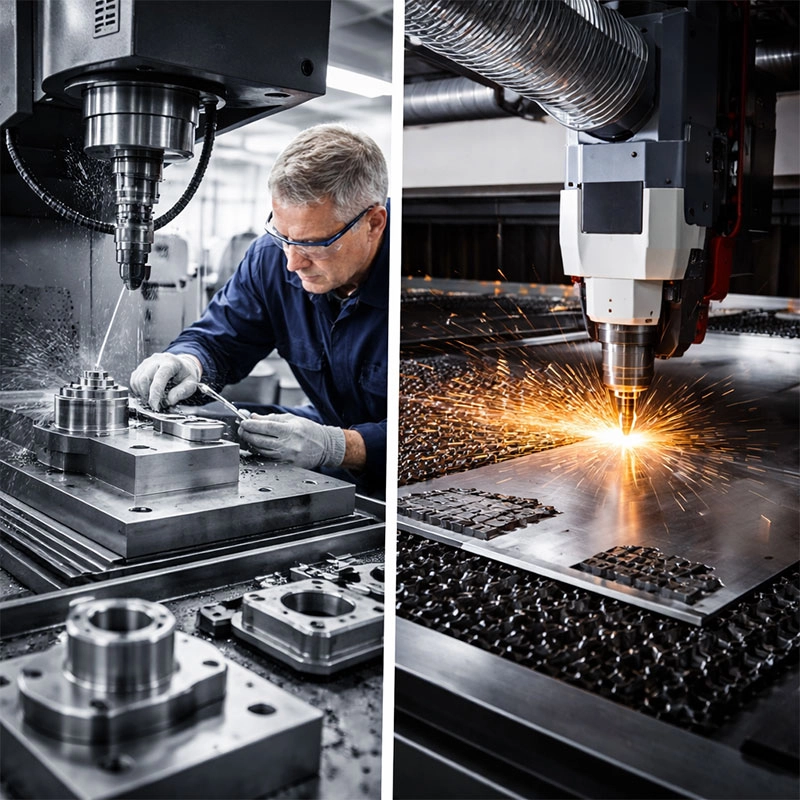
Choosing between CNC machining and laser cutting can be tricky. This guide breaks down their core differences, strengths, and ideal applications in a friendly, easy-to-understand way, helping you pick the perfect process for your next project.

Understanding the Basics

Let’s start by getting to know our two contenders. Think of it like choosing between a master sculptor and a master calligrapher—both are incredibly skilled, but they create in fundamentally different ways. Understanding these subtractive manufacturing methods is the first step to making a great choice.

What is CNC Machining?

CNC machining, short for Computer Numerical Control machining, is like a super-precise, automated carving tool. A computer program guides cutting tools (like drills and end mills) to selectively remove material from a solid block, known as a workpiece or blank. This CNC milling and turning process is fantastic for creating complex 3D shapes, threads, and parts with tight tolerances. It’s the go-to method for functional prototypes, engine components, and intricate enclosures.

What is Laser Cutting?

Laser cutting, on the other hand, is a form of sheet metal fabrication that uses a highly focused beam of light to melt, burn, or vaporize material along a defined path. It’s exceptionally good at cutting flat, 2D shapes from sheet materials with incredible speed and a clean edge. When people search for laser cutting services near me, they’re often looking to create precise panels, brackets, decorative art, or architectural models from materials like steel, acrylic, or wood.

Key Differences Explained

Now that we know what they are, let’s dive into the nitty-gritty. The core differences between these precision manufacturing techniques come down to how they interact with material, what shapes they can make, and what they can cut. This is where your project’s needs really start to point you in one direction.

Material Removal vs. Material Separation

This is the most fundamental difference. CNC machining is a subtractive process; it carves away material to reveal the final part, which can mean more waste (chips and shavings). Laser cutting is a thermal separation process; it slices through material with a thin kerf (the width of the cut), generally creating less waste from the sheet itself. It’s the difference between sculpting a statue from marble versus using a cookie cutter on dough.

Dimensional Capabilities

Here’s a big one: dimensionality. CNC milling services excel at true 3D fabrication. They can create pockets, holes, curved surfaces, and complex geometries on multiple axes. Laser cutters primarily work in 2D, creating flat parts. While some systems can etch or mark on a surface, they don’t typically create significant 3D relief like a CNC machine can. For a great visual comparison of capabilities, you can check out this resource from Engineering.com.

Material Compatibility

Both processes handle a wide range, but with caveats. CNC machines are incredibly versatile, working with metals (aluminum, steel, brass), plastics, and wood. Laser cutters are champions with metals, wood, acrylic, and fabric, but struggle with materials that melt or release toxic fumes, like PVC. Also, reflective materials like bare copper or aluminum can sometimes be tricky for standard CO2 lasers. The American Welding Society provides detailed guidelines on material interactions with thermal processes here.

Choosing the Right Process for Your Project

So, how do you decide? It often boils down to your part’s geometry, material, and required precision. Let’s walk through some common scenarios. I always tell my clients to sketch their part and ask: “Is this mostly a flat shape, or does it have depth and complex contours?

When to Choose CNC Machining

Opt for computer numerical control machining when your project needs:
– Complex 3D Geometry: Parts with curves, slopes, pockets, or undercuts (think a custom gear or a sculpted handle).
– Exceptional Strength & Precision: Parts requiring very tight tolerances (±0.001″ or better) and excellent structural integrity from a solid block.
– Threads and Detailed Features: Creating internal or external threads, precise holes for bearings, or intricate engravings on a curved surface.
In short, if you’re asking how to make a prototype for a mechanical part that needs to bear load or fit with other components, CNC is usually your best bet.

When to Choose Laser Cutting

A laser cutting service is likely your winner for projects that involve:
– Flat or 2D Parts: Signage, machine panels, brackets, intricate stencils, or architectural models.
– Speed for Thin Materials: Cutting through sheet metal or acrylic under 1/2″ thick is often significantly faster with a laser.
– Intricate, Clean Edges: Projects requiring very fine details and a smooth, sealed cut edge with minimal post-processing.
For example, if you need fifty identical flat brackets with complex cutouts by next week, laser cutting will get you there efficiently.

Practical Considerations and Common Questions

Beyond the technical specs, there are everyday factors to weigh. Let’s talk about setup, cost, and finish. A friend recently asked me about making custom aluminum nameplates. For a simple, flat plate with etched text, laser was cheaper and faster. But for a plate with a raised border and recessed text, CNC was the only way to go.

Setup and Cost: For one-off parts, laser cutting often has a simpler setup, making it more cost-effective for small batches. CNC machining might have a higher initial setup cost (programming, fixturing) but can become more economical for complex parts in larger quantities because the per-part time decreases.

Edge and Surface Finish: A laser-cut edge can have a characteristic slight taper and, on metals, a hardened layer. A machined edge is typically square and can have a variety of finishes (milled, turned, polished) directly from the machine. Sometimes, the best solution is a combination of both processes!

In the end, the “best” choice isn’t about which technology is superior, but which is superior *for your specific project*. By understanding the core strengths of CNC vs laser cutting, you can confidently choose the path that will bring your design to life most effectively. When in doubt, don’t hesitate to consult with a reputable machine shop—they can offer invaluable guidance based on your drawings and goals.
Categories
Manufacturing Process Comparisons

CNC Machining vs Stamping: Which Process Wins for Your Project?

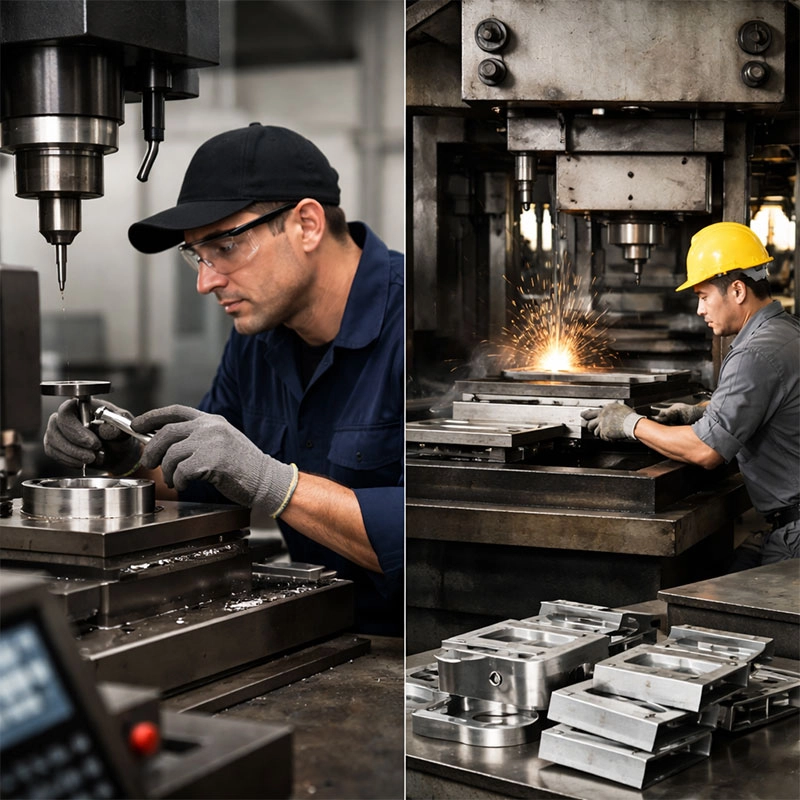
Choosing between CNC machining and stamping is a common manufacturing crossroads. This guide breaks down their core differences in cost, precision, and application to help you decide which fabrication process is the winner for your specific project needs.

Understanding the Basics: What Are We Comparing?

When you’re planning a new part, you’ll likely hear about CNC machining services and metal stamping processes. They’re both fantastic, but they work in completely different ways. Think of it like cooking: one is a meticulous chef carving a sculpture from a block of material (CNC), and the other is a high-speed cookie cutter pressing shapes out of sheet metal (stamping). Let’s get to know each one a bit better.

What is CNC Machining?

CNC, or Computer Numerical Control machining, is a subtractive manufacturing process. It starts with a solid block of material—like metal, plastic, or even wood—and uses computer-controlled cutting tools to remove material, carving out the final part. It’s incredibly precise and is perfect for creating complex, three-dimensional geometries. If you’re looking into precision machining for prototypes or low-volume custom parts, this is often the go-to method.

What is Metal Stamping?

Metal stamping, on the other hand, is a forming process. It uses a stamping press and a set of custom dies (like a specialized mold) to punch, bend, or shape sheet metal into a desired form. The key here is the die. Creating it is a significant upfront investment, but once it’s made, you can produce parts at lightning speed. This makes stamping ideal for high-volume sheet metal fabrication of components like brackets, enclosures, or automotive parts.

Head-to-Head Comparison: Where Each Process Shines

Now that we know the players, let’s put them side-by-side. This isn’t about which one is “better,” but about which one is better *for you*. I often tell my clients that the choice between CNC milling vs stamping comes down to a few key project factors.

Cost and Production Volume

This is the biggest deciding factor for most projects. CNC machining has low startup costs—you just need the digital file. But, the cost per part remains relatively high. Stamping has very high initial costs due to die creation, but the cost per part plummets as you make more. So, the rule of thumb is: low-volume production favors CNC, while high-volume manufacturing is where stamping wins on economics. For a deep dive on manufacturing economics, the Modern Machine Shop has a great resource on cost drivers.

Material and Design Flexibility

CNC is the clear champion here. It can handle a vast range of materials, from aluminum and stainless steel to engineering plastics. You can make incredibly complex parts with undercuts, deep cavities, and fine details. Stamping is primarily for ductile metals (like steel, aluminum, copper) and is best for parts with a relatively uniform thickness. Changing a design with CNC is as simple as tweaking the CAD file. With stamping, a design change often means a new, expensive die.

Precision and Surface Finish

Both can be precise, but in different ways. CNC machining typically offers tighter tolerances and superior surface finishes right off the machine. It’s the choice for parts that must fit together perfectly or have a cosmetic finish. Stamped parts can be very precise, but the precision is built into the die. The surface might have marks from the forming process and often requires secondary operations. For applications demanding the utmost accuracy, CNC turning and milling usually takes the lead.

Speed and Lead Time

For getting a first part in your hands quickly, CNC wins. There’s no tooling wait time. For mass production, however, nothing beats the sheer speed of a stamping press once it’s running. So, consider your timeline: need a prototype next week? CNC. Need a million parts over the next year? Stamping’s production rate is unbeatable.

Making the Right Choice for Your Project

So, which process wins? It depends entirely on your project’s recipe. Here’s a simple way to think about it:

Choose CNC Machining if your project involves: – Low to medium volumes (prototypes, custom parts, batches of 1-10,000). – Complex 3D geometries, tight tolerances, or excellent surface finish. – Frequent design changes or a wide variety of materials. – You need parts fast for testing or initial production.

Choose Metal Stamping (or progressive die stamping) if your project involves: – Very high volumes (tens of thousands to millions of parts). – Relatively simple, flat or bent parts made from sheet metal. – A finalized design where the cost of the die can be amortized. – The primary goal is the lowest possible cost per part at high speed.

Sometimes, the best solution uses both! A common approach is to use CNC to prototype and test a part, then transition to stamping for the full production run once the design is locked in. The team at ASM International’s handbook on metalworking discusses these hybrid manufacturing strategies. My advice? Start by clearly defining your volume, budget, timeline, and part complexity. With those in hand, the winning process for your custom part fabrication will become much clearer.

Categories
CNC Machining Basics

What Is Precision CNC Machining? Your Friendly Guide to the Basics

Precision CNC machining is a sophisticated manufacturing process where computer-controlled machines remove material from a solid block to create intricate, high-tolerance parts. It’s the backbone of modern industry, turning digital designs into physical reality with incredible accuracy. Let’s break down how it works and why it’s so vital.

Understanding the Fundamentals of Precision CNC Machining

So, you’re curious about precision CNC machining? Think of it as a super-skilled robotic sculptor. Instead of a chisel, it uses spinning cutting tools to carve a part out of metal, plastic, or other materials. The magic is in the “CNC” part – Computer Numerical Control. This means a computer program (often called G-code) tells the machine exactly where to move, how fast to spin, and how deep to cut, all with microscopic precision. This process is also widely known as subtractive manufacturing or CNC milling and turning.

CNC vs. Traditional Machining: What’s the Big Difference?

Imagine a master craftsperson making a part by hand on a manual lathe. It requires immense skill, is relatively slow, and each piece might have tiny variations. Now, imagine that craftsperson’s expertise translated into perfect digital instructions. That’s CNC machining. The computer control eliminates human error in the cutting process, allows for incredibly complex geometries that are impossible to make manually, and can produce the same perfect part over and over again. It’s the difference between handwriting a letter and printing it – both get the message across, but one is perfectly consistent and efficient for large volumes.

The Incredible Value and Real-World Applications

You might wonder, What is precision machining used for?” The answer is: almost everywhere! Its true value lies in creating reliable, high-performance components. If you’ve ever flown on a plane, received medical treatment, or used a smartphone, you’ve indirectly relied on precision machined components. In aerospace, it makes lightweight, strong engine parts. In medical device manufacturing, it creates life-saving implants like knee replacements with perfect biocompatible surfaces. For the automotive industry, it produces everything from complex engine blocks to custom performance parts. The key benefit is achieving tight tolerances – we’re talking about dimensions accurate to within the width of a human hair or even less. This level of high-precision manufacturing ensures parts fit together perfectly and perform flawlessly under stress. For a deeper dive into the technical standards behind this, you can explore resources from the American Society of Mechanical Engineers (ASME).

Getting Started: Your First Steps with a CNC Project

Let’s say you have a brilliant idea for a custom part. How do you make it a reality with CNC manufacturing? First, you need a digital 3D model, typically created in CAD (Computer-Aided Design) software. This is your part’s blueprint. Next, that CAD file is converted into machine instructions (CAM – Computer-Aided Manufacturing). Here’s a friendly tip: communicate clearly with your machine shop! Provide detailed drawings, specify the material (like aluminum, stainless steel, or PEEK plastic), and discuss the critical tolerances. Not every surface needs to be ultra-precise, which can save time and cost. A good shop will guide you on design for manufacturability (DFM) to optimize your design for the machining process. Asking how does CNC machining work for my specific design?” early on is the best way to ensure a smooth project.

Clearing Up Common Misconceptions

There are a few myths about precision CNC services we should clear up. One big one is that it’s only for giant companies doing mass production. While it’s excellent for production runs, it’s also perfect for prototyping and small batches thanks to its flexibility. Another misconception is that it’s prohibitively expensive. For simple designs and common materials, it can be quite cost-effective, especially when you consider the reduced labor and scrap waste compared to manual methods. Finally, some think the process is fully “hands-off.” While the cutting is automated, it relies on highly skilled programmers and machinists to set up the machines, choose the right tools, and oversee the entire operation. It’s a blend of advanced technology and human expertise.

Wrapping It All Up

In a nutshell, precision CNC machining is a transformative manufacturing method that combines digital design with automated, ultra-accurate cutting. It’s the reason we have advanced technology, safer vehicles, and innovative medical treatments. Whether you’re an engineer designing a new product or a hobbyist curious about how things are made, understanding this process opens up a world of possibility. It’s not just about making things; it’s about making things perfectly. So, the next time you see a complex metal component, you’ll know there’s a good chance a friendly CNC machine played a key role in its creation.

Categories
CNC Milling & Turning

What Is 5-Axis CNC Machining? Your Friendly Guide to How It Works

Welcome! If you’ve ever wondered how complex parts for airplanes or medical devices are made, you’re in the right place. This guide breaks down 5-axis CNC machining in simple terms, explaining how it works and why it’s such a game-changer for creating intricate, high-precision components.

Understanding the Fundamentals of 5-Axis Machining

Let’s start at the beginning. You might be familiar with a basic drill press that only moves up and down—that’s essentially one axis. 5-axis CNC milling is a massive leap from that. Think of it as giving a cutting tool the freedom to approach a workpiece from almost any angle. This capability is central to modern multi-axis machining and is what sets it apart from more common 3-axis methods.

What Are These “Axes” Anyway?

It’s simpler than it sounds! The three linear axes are straightforward: X (left to right), Y (front to back), and Z (up and down). A 5-axis CNC machine adds two rotational axes, typically called A and B or A and C. The A-axis rotates around the X-axis, and the B-axis rotates around the Y-axis. This rotation allows the cutting tool to tilt and swivel, making contact with the workpiece from directions that were previously impossible without manually repositioning it. This is the core of simultaneous 5-axis machining.

How It Works & The Value It Brings

So, what does this mean for making things? The benefits are huge and answer the common search for benefits of 5-axis CNC. Imagine you’re sculpting a detailed model out of clay. If you can only work from the top, you’ll have to constantly stop, turn the model, and try to match up your cuts. A 5-axis machine is like having a magical tool that lets you smoothly carve from the side, underneath, and at compound angles without ever letting go.

The Magic of a Single Setup

One of the biggest advantages is reduced setup time. In traditional machining, a complex part might need to be clamped down in five different positions to machine all its sides. Each setup introduces potential error and takes time. With a 5-axis system, the part is fixed once, and the machine’s head and table do all the moving. This not only speeds up production but also dramatically improves accuracy.

Tackling Complex Geometries with Ease

This technology shines when creating parts with complex contours and undercuts. Industries like aerospace rely on it for turbine blades and structural components with organic shapes. The medical field uses it for precise orthopedic implants and surgical tools. Even the automotive and mold-making industries benefit from the ability to create sleek, aerodynamic, or intricately detailed forms in one go. It’s the go-to solution for high precision machining of sophisticated parts.

Getting Started: Practical Advice for Your Projects

If you’re considering 5-axis machining services for a project, here’s some friendly advice. First, have a clear 3D CAD model—this is non-negotiable. The machine’s computer (the CNC) needs that digital blueprint. Second, communicate closely with your machining partner. Discuss the part’s function, tolerances, and material. Sometimes, a feature that looks tricky might be easy for a 5-axis machine, and vice-versa. A good partner can help optimize your design for manufacturability. You can learn more about the principles of CNC from resources like the Engineering.com platform.

Clearing Up Common Misconceptions

Let’s bust a few myths! A common one is that 5-axis CNC machining is always the best and fastest choice. Not necessarily. For a simple flat bracket with holes, a 3-axis machine is faster and more cost-effective. The 5-axis capability is for complexity. Another myth is that it’s impossibly expensive. While the machines are a significant investment, the total cost for your part might be lower due to reduced labor, setup time, and improved accuracy leading to less waste. It’s about the total value, not just the hourly rate.

Wrapping It All Up

In a nutshell, 5-axis CNC machining is a powerful manufacturing process that uses two extra rotational axes to machine complex parts from nearly any direction in a single setup. It’s the secret behind many of the advanced, high-performance components we rely on today. Whether you call it multi-axis milling or 5-axis CNC fabrication, the goal is the same: to create precise, intricate parts more efficiently. For the latest standards and technical insights, referring to authoritative sources like ASME (The American Society of Mechanical Engineers) is always a great idea. I hope this friendly guide has helped demystify how it all works!

Request A Quote

We'll Send You Back with Price Immediately!

DEC 1-31

XMAS SPECEIL

Up to

40% off

What Is 5-Axis CNC Machining? Your Friendly Guide to How It Works

We'll Send You Back with Price Immediately!