Categories
Manufacturing Process Comparisons

CNC Machining vs. Casting: Which Is Best for Your Project?

Choosing between CNC machining and casting is a common crossroads in manufacturing. This guide breaks down their core differences, strengths, and ideal applications in a friendly, straightforward way to help you decide which process fits your project’s budget, timeline, and quality needs.

Understanding the Core Processes

Let’s start by getting to know our two contenders. Think of it like meeting two different types of chefs—one is a master sculptor who carves a masterpiece from a solid block, and the other is a baker who pours batter into a mold. Both create amazing things, but their methods are worlds apart. This fundamental difference between subtractive manufacturing (CNC) and forming processes (casting) shapes everything about your final part.

What is CNC Machining?

CNC machining, or computer numerical control machining, is like high-precision carving. You start with a solid block of material—metal, plastic, or wood—and a computer-guided tool precisely cuts away material until the desired shape emerges. It’s incredibly accurate, producing parts with tight tolerances and excellent surface finishes right off the machine. Common searches like cnc milling vs casting or precision machining services often lead people here when they need strong, detailed components.

What is Casting?

Casting is a formative process. It involves pouring molten metal (or other materials) into a pre-made mold cavity. Once it cools and solidifies, you break the mold away to reveal the part. Processes like die casting, investment casting, and sand casting fall under this umbrella. It’s fantastic for creating complex, hollow, or oddly shaped parts that would be very difficult or wasteful to machine from solid. If you’re looking into metal casting vs machining for high-volume production, casting is usually a key player.

Key Differences: A Head-to-Head Look

Now, let’s put them side-by-side. I find it helpful to compare a few critical factors—imagine you’re deciding between buying a custom-made suit (CNC) versus a well-fitting, ready-made one (Casting). Both are great, but one might suit your specific event better.

Material and Waste

This is a big one. CNC is a subtractive process, meaning you remove material to create the part. For complex parts, you might end up with a significant pile of chips or shavings. Casting, as an additive manufacturing cousin in the forming family, typically uses only the material needed to fill the mold, resulting in much less waste for certain shapes. So, if material cost is a major concern and your part design is casting-friendly, that process can be more efficient.

Complexity and Design Freedom

Here’s where they truly diverge. CNC machining offers incredible precision and can handle very complex geometries, but it’s limited by the tool’s ability to reach certain areas. Undercuts and internal channels can be tricky. Casting processes, especially investment casting, excel at producing parts with intricate internal passages, hollow sections, and complex organic shapes in one go—things that would be impossible to machine as a single piece. It’s the go-to for questions like how to make complex metal parts.

Strength and Performance

Machined parts are generally stronger. Why? Because they’re made from a solid, homogeneous block of material with a continuous grain structure. Cast parts can sometimes have microscopic pores or inclusions from the solidification process, which might create weak points. For high-stress applications, a machined part is often the safer bet. However, modern casting techniques have come a long way in improving integrity and consistency.

Cost and Lead Time

This often decides the race. For one-off parts or small batches, CNC machining is usually faster and more cost-effective because you skip the expensive, time-consuming mold-making step. However, for high-volume production, the equation flips. The upfront cost of creating a mold (the “tooling”) for die casting or similar is high, but once it’s made, each subsequent part is produced quickly and cheaply. It’s the classic “pay more now, save later” scenario.

How to Choose the Right Process for You

So, how do you pick? Don’t worry, it’s not as hard as it seems. I usually tell folks to ask themselves four simple questions: How many parts do I need? How complex is my design? What’s my budget? And how fast do I need them? Your answers will point you in the right direction.

When to Choose CNC Machining

Choose CNC milling or turning when:

  • You need prototypes or low-volume production (1 to 100 parts).
  • Your design requires extremely tight tolerances and superior surface finish.
  • The part is made from a material that’s difficult to cast.
  • You need the superior strength of a wrought material structure.
  • You’re on a tight timeline and can’t wait for mold fabrication.

It’s the champion of flexibility and precision for smaller runs.

When to Choose Casting

Opt for a casting method like sand casting or investment casting when:

  • You plan for high-volume production (hundreds to thousands of parts).
  • Your part has a very complex, hollow, or organic geometry.
  • You want to minimize material waste for that specific shape.
  • You’re working with metals that are easily cast, like aluminum or zinc alloys.
  • The per-part cost needs to be as low as possible at high quantities.

It’s the efficiency expert for mass production of complex shapes.

Clearing Up Common Misconceptions

I hear a few myths all the time, so let’s clear the air. First, “casting is always cheaper.” Not true for low volumes—that mold cost is a big hurdle. Second, “machined parts are always better.” For a simple bracket made in the thousands, a cast part could be perfectly adequate and more economical. Third, “you can’t get good surface finish from casting.” While machining often gives a better finish straight away, many cast parts are finished with a quick CNC machining operation on critical surfaces, a combo often called casting with secondary machining operations. The best solution is sometimes a hybrid!

Final Thoughts and Next Steps

There’s no single “winner” between CNC machining and casting. The best process is the one that best serves your specific project’s needs. My friendly advice? Start by clearly defining your part’s requirements: quantity, complexity, material, budget, and deadline. For prototypes and complex, low-volume metal parts, CNC machining is often your best friend. For high-volume runs of intricate shapes, metal casting processes will likely save the day. When in doubt, consult with a reputable machine shop or foundry—they can offer invaluable guidance based on your drawings. You can learn more about material properties for these processes from authoritative sources like ASM International. Good luck with your project
Categories
Manufacturing Process Comparisons

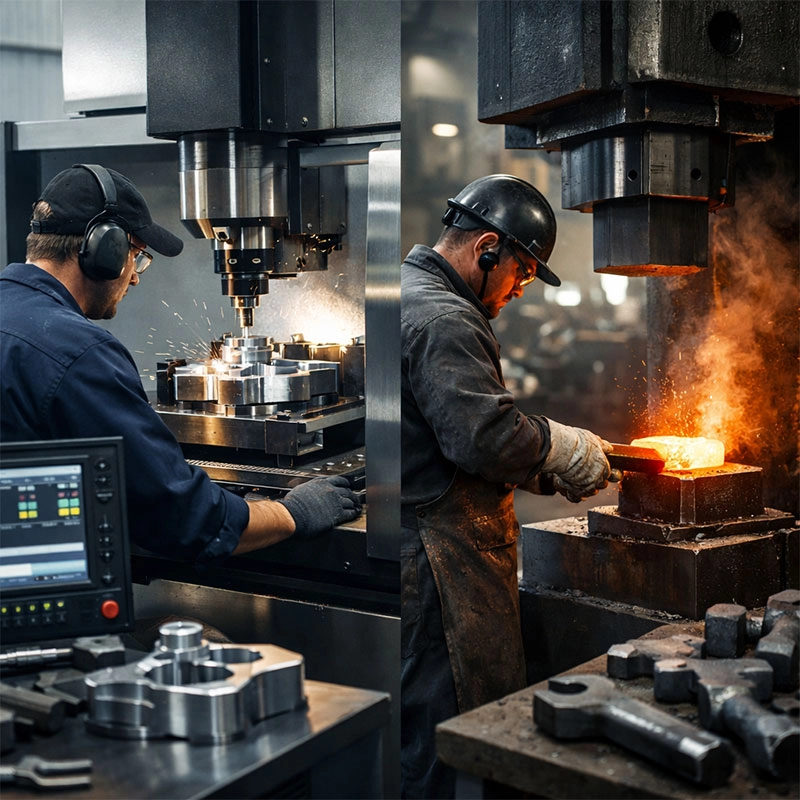
CNC Machining vs Forging: Which Process Wins for Your Project?

Choosing between CNC machining and forging can be a head-scratcher. Both are fantastic ways to make metal parts, but they work in completely different ways. This guide will walk you through the key differences, strengths, and ideal uses for each process, helping you decide which one is the winner for your specific project needs.

How They Work: A Tale of Two Methods

Let’s start with the basics. Imagine you’re a sculptor. CNC machining is like starting with a solid block of marble and carefully chiseling away everything that isn’t your statue. Forging, on the other hand, is like taking a lump of clay and using pressure to mold and shape it into the desired form. That fundamental difference—subtractive versus formative—shapes everything about these manufacturing processes.

The Subtractive Art of CNC Machining

CNC (Computer Numerical Control) machining is a form of precision machining. It uses computer-guided tools like mills, lathes, and routers to cut away material from a solid block (called a blank or billet). Think of it as a super-precise, automated carving process. You might also hear it called CNC milling or CNC turning, depending on the specific technique. The beauty of this method is its incredible flexibility and accuracy. Need a complex prototype with tight tolerances? CNC is often your go-to. For a deeper dive into the mechanics, resources like the American Society of Mechanical Engineers (ASME) offer great technical insights.

The Formative Power of Forging

Forging is one of the oldest metal forming techniques. It involves heating a metal workpiece and then applying compressive force—using a hammer or press—to deform it into a specific shape. This process aligns the metal’s grain structure, making it incredibly strong and durable. Common types include drop forging and press forging. It’s the preferred method for parts that must withstand immense stress, like forged crankshafts or forged connecting rods in engines. The Forging Industry Association provides excellent information on the benefits of this age-old craft.

Key Differences: Material, Strength, and More

Now that we know *how* they work, let’s look at *what* they deliver. The choice between cnc vs forging often boils down to a trade-off between three key factors: material integrity, design freedom, and cost-effectiveness for your production run.

Material Properties and Strength

This is where forging truly shines. The forging process compresses and refines the metal’s internal grain flow, following the contour of the part. This creates a continuous grain structure, dramatically increasing toughness and fatigue resistance. A forged component is typically stronger than a CNC machined part of the same material and size. Machining, however, can cut across the natural grain, which might create potential weak points in high-stress applications. So, if your main question is about forged vs machined strength, forging usually wins for dynamic, high-load parts.

Design Complexity and Precision

Here, CNC machining takes the lead. Because it’s controlled by a computer program, it can produce parts with extremely complex geometries, intricate details, and very tight tolerances that would be impossible with forging. Need internal channels, sharp corners, or a highly polished surface finish right off the machine? CNC is your friend. Forging is better suited for simpler, more solid shapes. While precision forging has advanced, it still can’t match the detail level of a 5-axis CNC machine.

Cost and Production Volume

This is a classic batch size consideration. CNC machining services have low upfront costs for tooling (often just the digital program), making them perfect for low volume production, one-off prototypes, and custom parts. However, the cost per part remains relatively steady. Forging requires expensive, custom-made dies. This makes the initial setup cost very high, but once the dies are made, the cost per part drops significantly for high-volume runs. So, for making 10 parts, CNC is cheaper. For making 10,000, forging becomes far more economical.

Choosing the Right Process for Your Project

So, how do you pick? Don’t worry, it’s not as hard as it seems once you break down your project’s requirements. Let’s match the process to the need.

When to Choose CNC Machining

You should lean towards CNC manufacturing when:
– You need prototype machining or a small batch of parts.
– Your design has complex features, tight tolerances, or excellent surface finish requirements.
– You are working with materials that are difficult to forge, like certain plastics or already-hardened metals.
– You need fast turnaround and design flexibility (making changes to a CAD file is easier than making a new forging die).
Essentially, if your priority is precision and complexity over ultimate tensile strength, CNC is the way to go.

When to Choose Forging

You should strongly consider metal forging when:
– The part will face high stress, impact, or fatigue (think automotive, aerospace, or tooling applications).
– You need superior structural integrity and reliability.
– Your production volume is high enough to justify the initial die cost.
– The part shape is relatively simple and solid.
In short, if you’re asking “is forged stronger than machined?” for a critical component, the answer is usually yes, and that’s your signal.

Clearing Up Common Misconceptions

I often hear a couple of myths that need busting. First, some folks think forging is a “low-tech” or imprecise process. Modern closed die forging is highly controlled and can produce near-net-shape parts with remarkable consistency. Second, there’s a belief that you can’t machine a forged part. Actually, it’s very common! Many forged parts undergo secondary machining (or “machining after forging”) to achieve final dimensions, drill holes, or create precision features. The processes are often partners, not just rivals.

Final Thoughts: Making Your Decision

So, which process wins? As you can see, there’s no single champion—it all depends on the goal of your project. Think of it this way: Forging is about creating supreme strength and durability from the inside out, ideal for high-volume, high-stress components. CNC machining is about achieving unparalleled precision and complexity from the outside in, perfect for prototypes, custom work, and intricate designs. My best advice? Clearly define your priorities for strength, complexity, quantity, and budget. Often, talking through these requirements with a knowledgeable CNC shop or forging supplier will quickly point you in the right direction. Good luck with your project!

Categories
Manufacturing Process Comparisons

CNC Machining vs Stamping: Which Process Wins for Your Project?

Choosing between CNC machining and stamping is a common manufacturing crossroads. This guide breaks down their core differences in cost, precision, and application to help you decide which fabrication process is the winner for your specific project needs.

Understanding the Basics: What Are We Comparing?

When you’re planning a new part, you’ll likely hear about CNC machining services and metal stamping processes. They’re both fantastic, but they work in completely different ways. Think of it like cooking: one is a meticulous chef carving a sculpture from a block of material (CNC), and the other is a high-speed cookie cutter pressing shapes out of sheet metal (stamping). Let’s get to know each one a bit better.

What is CNC Machining?

CNC, or Computer Numerical Control machining, is a subtractive manufacturing process. It starts with a solid block of material—like metal, plastic, or even wood—and uses computer-controlled cutting tools to remove material, carving out the final part. It’s incredibly precise and is perfect for creating complex, three-dimensional geometries. If you’re looking into precision machining for prototypes or low-volume custom parts, this is often the go-to method.

What is Metal Stamping?

Metal stamping, on the other hand, is a forming process. It uses a stamping press and a set of custom dies (like a specialized mold) to punch, bend, or shape sheet metal into a desired form. The key here is the die. Creating it is a significant upfront investment, but once it’s made, you can produce parts at lightning speed. This makes stamping ideal for high-volume sheet metal fabrication of components like brackets, enclosures, or automotive parts.

Head-to-Head Comparison: Where Each Process Shines

Now that we know the players, let’s put them side-by-side. This isn’t about which one is “better,” but about which one is better *for you*. I often tell my clients that the choice between CNC milling vs stamping comes down to a few key project factors.

Cost and Production Volume

This is the biggest deciding factor for most projects. CNC machining has low startup costs—you just need the digital file. But, the cost per part remains relatively high. Stamping has very high initial costs due to die creation, but the cost per part plummets as you make more. So, the rule of thumb is: low-volume production favors CNC, while high-volume manufacturing is where stamping wins on economics. For a deep dive on manufacturing economics, the Modern Machine Shop has a great resource on cost drivers.

Material and Design Flexibility

CNC is the clear champion here. It can handle a vast range of materials, from aluminum and stainless steel to engineering plastics. You can make incredibly complex parts with undercuts, deep cavities, and fine details. Stamping is primarily for ductile metals (like steel, aluminum, copper) and is best for parts with a relatively uniform thickness. Changing a design with CNC is as simple as tweaking the CAD file. With stamping, a design change often means a new, expensive die.

Precision and Surface Finish

Both can be precise, but in different ways. CNC machining typically offers tighter tolerances and superior surface finishes right off the machine. It’s the choice for parts that must fit together perfectly or have a cosmetic finish. Stamped parts can be very precise, but the precision is built into the die. The surface might have marks from the forming process and often requires secondary operations. For applications demanding the utmost accuracy, CNC turning and milling usually takes the lead.

Speed and Lead Time

For getting a first part in your hands quickly, CNC wins. There’s no tooling wait time. For mass production, however, nothing beats the sheer speed of a stamping press once it’s running. So, consider your timeline: need a prototype next week? CNC. Need a million parts over the next year? Stamping’s production rate is unbeatable.

Making the Right Choice for Your Project

So, which process wins? It depends entirely on your project’s recipe. Here’s a simple way to think about it:

Choose CNC Machining if your project involves: – Low to medium volumes (prototypes, custom parts, batches of 1-10,000). – Complex 3D geometries, tight tolerances, or excellent surface finish. – Frequent design changes or a wide variety of materials. – You need parts fast for testing or initial production.

Choose Metal Stamping (or progressive die stamping) if your project involves: – Very high volumes (tens of thousands to millions of parts). – Relatively simple, flat or bent parts made from sheet metal. – A finalized design where the cost of the die can be amortized. – The primary goal is the lowest possible cost per part at high speed.

Sometimes, the best solution uses both! A common approach is to use CNC to prototype and test a part, then transition to stamping for the full production run once the design is locked in. The team at ASM International’s handbook on metalworking discusses these hybrid manufacturing strategies. My advice? Start by clearly defining your volume, budget, timeline, and part complexity. With those in hand, the winning process for your custom part fabrication will become much clearer.

Categories
Manufacturing Process Comparisons

CNC Milling vs. Turning: Which Process Is Right for Your Project?

Choosing between CNC milling and CNC turning can be a pivotal decision for your manufacturing project. This guide breaks down the core differences, practical applications, and key factors to help you select the optimal subtractive manufacturing process for your specific part geometry and production goals.

Understanding the Core Differences Between CNC Milling and Turning

If you’re new to CNC machining, the terms “milling” and “turning” might sound similar. But in practice, they’re fundamentally different approaches to shaping material. Think of it like the difference between a sculptor and a potter. Both create shapes, but their tools and methods are distinct. Understanding this CNC milling vs CNC lathe distinction is the first step to making an informed decision for your prototype or production run.

How They Work: A Simple Analogy

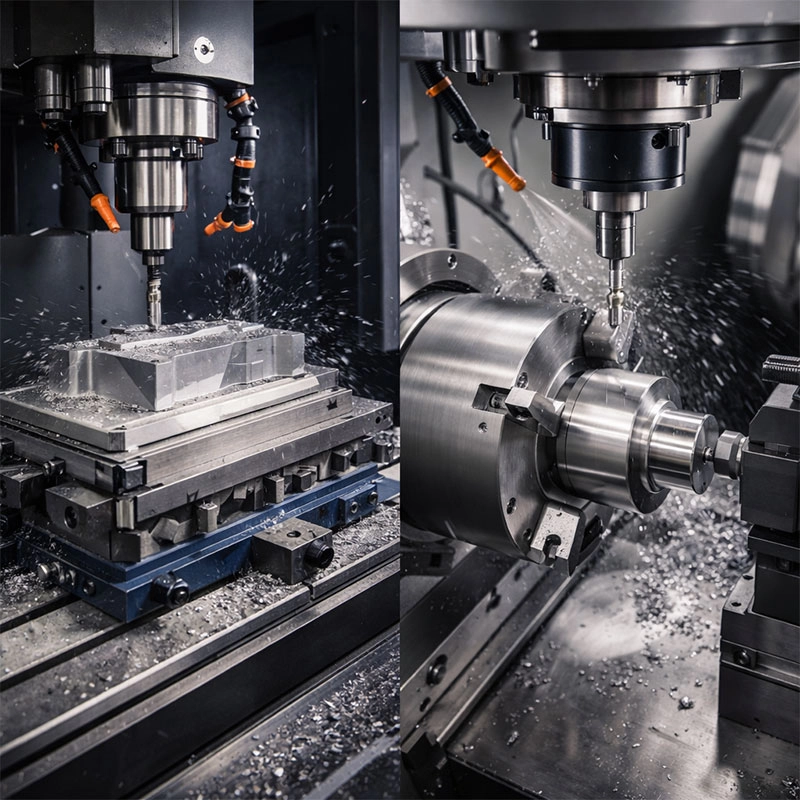
Let’s keep it simple. In CNC turning (often done on a CNC lathe), the workpiece is the one that spins. It’s clamped in a chuck and rotated at high speed. Then, a stationary cutting tool is brought into contact with it, peeling away material to create cylindrical shapes. Imagine a piece of clay spinning on a potter’s wheel as the potter’s hands shape it—that’s turning.

In CNC milling, the opposite happens. The workpiece is held stationary on a table, and a rotating cutting tool (the mill) moves across it along multiple axes (X, Y, and Z). This is like a sculptor using a rotating chisel to carve details into a stationary block of wood. This multi-axis movement allows milling to create incredibly complex and non-rotationally symmetric features, which is why comparing 3 axis vs 5 axis milling is also a common consideration for intricate parts.

When to Choose CNC Milling for Your Project

So, when does the “sculptor’s” method win? CNC milling services are your go-to for parts that aren’t primarily round. If your design has flat surfaces, pockets, slots, complex contours, or detailed 3D shapes, milling is almost certainly the answer. It excels at creating features like engine blocks, brackets, molds, and enclosures. The real power of milling lies in its versatility; you can machine a wide range of materials from aluminum and steel to plastics and composites. For operations like creating deep cavities or threading a hole that isn’t on the centerline, a milling machine with the right tools is indispensable.

When to Choose CNC Turning for Your Project

On the other hand, if your part is defined by its roundness, CNC turning is typically faster and more cost-effective. This process is ideal for producing shafts, pins, bolts, nuts, and any component where the critical shape is concentric around a central axis. The process is exceptionally efficient for high-volume production of such round parts. Furthermore, modern CNC lathes can perform secondary operations like drilling cross-holes or milling flats—often called “turn-mill” machines—which blurs the line a bit. But at its heart, turning is the master of cylindrical machined parts.

Making the Right Choice for Your Part

You might find that some projects clearly lean one way, while others could potentially use either process. Don’t worry, this is common! The best approach is to start with your part’s design and work backwards. I always tell my clients that the geometry is the ultimate guide.

Key Questions to Ask

Here’s a quick mental checklist we can run through:
1. Is the primary shape cylindrical or rotational? If yes, lean towards turning.
2. Does it have complex 3D surfaces, slots, or pockets? If yes, milling is likely needed.
3. What is the required tolerance and surface finish? Both processes can achieve high precision, but the optimal method depends on the feature.
4. What’s the production volume? Turning often has a speed advantage for simple round parts in bulk.

Sometimes, the most cost-effective solution involves both processes. A part might be roughed out on a lathe and then have detailed features added by a mill. This is where working with an experienced machine shop is invaluable.

What About Hybrid Machining?

It’s worth mentioning that the line between milling and turning continues to blur with advanced multi-axis machining centers. A Swiss-type lathe or a mill-turn center can perform both rotating workpiece operations and rotating tool operations in a single setup. This is fantastic for reducing handling time and improving accuracy for complex components. If you’re curious about the capabilities of these advanced systems, resources like the Basics of Mill-Turn Technology on Modern Machine Shop offer a great technical deep dive.

Conclusion: Partnering for Precision

The debate of CNC milling vs turning isn’t about which is better overall, but which is better for *your specific part*. By understanding the core principle—rotating tool vs. rotating workpiece—you’re already ahead. My friendly advice? Start with a clear CAD model and have a conversation with your machining partner. Share your goals for function, budget, and timeline. A good shop will help you navigate the choice between subtractive manufacturing processes, and might even suggest design tweaks (DFM – Design for Manufacturability) to make your part stronger, cheaper, and faster to produce. For further reading on material properties and machining guidelines, the Machine Design learning resources library is a trustworthy place to continue your research.

Categories
Manufacturing Process Comparisons

CNC vs. Traditional Machining: Which Is Right for Your Project?

Choosing between CNC and traditional machining can be a pivotal decision for your manufacturing project. This guide breaks down their core differences in automation, precision, and cost to help you make an informed choice that aligns with your specific needs and budget.

The Core Differences: Automation vs. Craftsmanship

At its heart, the debate between CNC machining vs manual machining is about how control is exerted over the cutting tools. Think of it like driving: one is a pre-programmed, hands-off cruise control, and the other is a fully manual stick shift requiring constant input. This fundamental shift changes everything about the machining process.

How CNC Machining Works

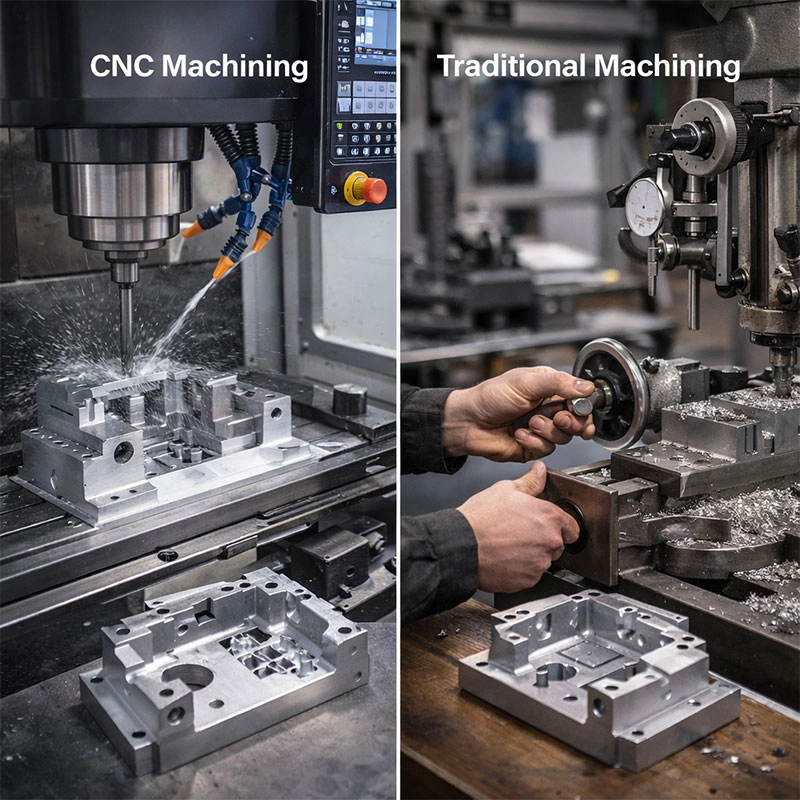
CNC, or Computer Numerical Control machining, is all about automation. A machinist writes a program (using G-code) that tells the machine—be it a mill, lathe, or router—exactly what to do. Once set up, the machine runs the program with minimal human intervention, producing part after identical part. This method is fantastic for precision machining of complex geometries that would be incredibly time-consuming or impossible to do by hand. It’s the go-to for high-volume production or parts with tight tolerances.

How Traditional Machining Works

Traditional machining, often called conventional machining or manual machining, relies on the skill of a machinist operating machines like engine lathes, milling machines, or drill presses. The machinist directly controls the movement of the cutting tool using hand wheels, levers, and their expert judgment. This method offers incredible flexibility for one-off parts, quick prototypes, or repairs. The comparison of manual vs automated machining really shines here—it’s the difference between a custom-tailored suit and one bought off the rack.

Which Machining Process Fits Your Project?

So, how do you decide? There’s no single “best” option—only the best one for *your* job. Let’s walk through some common scenarios to see where each method excels. I often tell my clients that understanding the advantages of CNC over manual machining (and vice versa) is the key to a successful and cost-effective project.

When to Choose CNC Machining

You’ll likely want to lean towards CNC milling and turning services if your project has these characteristics:

Volume & Repeatability: Need 50, 500, or 5,000 identical parts? CNC is your friend. The initial setup and programming take time, but once done, reproducing parts is fast and consistent.

Complex Designs: Does your part have intricate contours, complex 3D shapes, or precise holes at odd angles? Computer-controlled machining handles these with ease, following the digital blueprint to the letter.

Extreme Precision: For parts where tolerances are measured in thousandths of an inch (or less), the automated precision of CNC is hard to beat. It minimizes human error.

Material Considerations: While both methods work with many materials, CNC is often more efficient for machining tough alloys or materials that benefit from highly consistent cutting parameters.

When to Choose Conventional Machining

Don’t count out traditional milling and lathe work just yet! It’s often the perfect choice for:

Prototypes & One-Offs: Need a single part made quickly to test a concept? A skilled manual machinist can often have it in your hands faster and for less money than programming a CNC machine.

Simplicity & Speed for Simple Parts: If you have a basic bracket with a few holes, the setup time on a manual mill or drill press can be almost instantaneous.

Modifications & Repairs: This is where traditional machining shines. Fixing a worn shaft, adding a new keyway to an existing gear, or modifying a casting on the fly is often easier and more intuitive on a manual machine.

Lower Budget for Simple Jobs: For very low-volume, simple parts, the lower overhead of a manual shop can mean significant cost savings. You’re paying primarily for skilled labor, not machine programming and amortization.

Making Your Final Decision: A Practical Guide

Feeling stuck? Let’s make it practical. Grab your project notes and ask yourself these questions, which get to the heart of the difference between CNC and manual machining:

What’s my quantity? (Low volume = lean traditional. High volume = lean CNC).

How complex is the geometry? (Simple shapes = either works. Complex curves = likely CNC).

What are my tolerance requirements? (Very tight = CNC. More forgiving = traditional can work).

What’s my timeline and budget? (Fast/cheap for one part = traditional. Consistent cost per part for many = CNC).

My best advice? Have a conversation with your machine shop. A good shop, like many reputable ones you can find through industry resources such as Thomasnet for supplier discovery or by reviewing standards on ASME’s website, will discuss these factors with you. They can tell you if your part is a better candidate for a CNC machine tool or a manual one, often saving you time and money. Remember, the goal isn’t to use the “most advanced” technology, but the *most appropriate* one to get your project from idea to finished part successfully.

Categories
Manufacturing Process Comparisons

CNC Milling vs. Turning: Which is Best for Your Precision Parts?

Choosing between CNC milling and CNC turning can be confusing when you need high-accuracy components. This guide breaks down the fundamental differences in how these two subtractive manufacturing processes work, their unique strengths, and how to decide which one is the optimal choice for your specific precision part project.

Understanding the Core Distinctions: CNC Milling and Turning Processes

Let’s start with the basics. The main difference between CNC milling and CNC turning boils down to what moves and what stays still. Imagine you’re sculpting a piece of wood. In one method, you move the chisel around a stationary block (that’s like milling). In the other, you spin the block against a stationary chisel (that’s like turning). This simple analogy is at the heart of precision machining.

How CNC Milling Works

In the CNC milling process, your raw material (called the workpiece) is held stationary in a vise or fixture. A rotating cutting tool, which can have multiple cutting edges, then moves along various axes (X, Y, and Z) to remove material. Think of it like a highly sophisticated, programmable drill that can also slide sideways to carve out slots, pockets, and complex 3D contours. This method is fantastic for creating parts with intricate features that aren’t symmetrical, like engine blocks, brackets, or molds. You might also hear this referred to as CNC machining in a broader sense, though that term can encompass both milling and turning.

How CNC Turning Works

Now, let’s look at CNC turning. Here, the workpiece is the star of the show—it rotates at high speed on a spindle. A single-point cutting tool is then fed into the spinning material, shaving it away to create cylindrical shapes. This is the go-to process for making anything that is fundamentally round: shafts, bolts, pins, and bushings. The machines that perform this operation are often called CNC lathes or turning centers. If you’re wondering about the difference between a lathe and a milling machine, remember: the lathe spins the part, the mill spins the tool.

Strengths and Typical Applications

Each process shines in different scenarios. Knowing their strengths helps you match the right manufacturing technique to your part’s design, which is key for cost-effectiveness and quality in precision part manufacturing.

When to Choose CNC Milling

You’ll want to lean towards CNC milling services when your component has complex geometries. This includes parts with flat surfaces, pockets, slots, threaded holes, or detailed 3D surfaces. For example, a mounting plate with an array of precisely located holes and a recessed cavity is a perfect job for a milling machine. It’s also ideal for working with block-like raw materials. The versatility of multi-axis milling machines allows for incredible complexity in a single setup. You can learn more about the capabilities of modern machine tools from resources like the Engineering.com platform.

When to Choose CNC Turning

Opt for CNC turning when your part design is primarily rotational or axisymmetric. Need a smooth, perfectly round diameter? Turning is your friend. It excels at producing parts like connectors, nozzles, and rollers with excellent concentricity and surface finish on the outer diameter. It’s generally faster and more cost-effective for high-volume production of simple cylindrical shapes. For creating internal features on a cylindrical part, like a drilled hole or an internal thread, turning machines use stationary tools brought into the rotating workpiece, a operation sometimes specifically called out in requests for precision turned components.

Making the Choice: Which Process is Best for Your Part?

So, how do you decide? I often advise clients to start by looking at the basic shape of their part. Ask yourself: “Is the core shape of my part round?” If the answer is a clear yes, turning is likely the most efficient starting point. If the part is more of a block, plate, or has a complex, non-round shape, milling is the probable candidate. Remember, many finished parts actually use both processes—this is where CNC milling and turning combined comes in. A part might be turned to create its basic cylindrical form and then moved to a mill to add cross-holes or flat features. A great resource for understanding material properties and how they interact with these processes is the ASM International knowledge base.

Clearing Up Common Misconceptions

Let’s tackle a couple of common mix-ups. First, one isn’t universally “better” than the other; they are different tools for different jobs. Second, while turning is often faster for simple rounds, modern 5-axis milling can be incredibly efficient for complex parts, reducing or eliminating the need for multiple setups. Lastly, both processes achieve extremely high precision; the choice isn’t about accuracy but about the most effective *path* to that accuracy based on the part geometry. Understanding these key differences in CNC machining helps you have a more productive conversation with your manufacturing partner.

In the end, the best choice for your precision parts depends entirely on their design. By understanding the fundamental motion of milling versus turning, you’re well-equipped to make an informed decision that leads to a better-made, more cost-effective component. When in doubt, a quick sketch or 3D model shared with a trusted machine shop can provide the perfect guidance.

Request A Quote

We'll Send You Back with Price Immediately!

DEC 1-31

XMAS SPECEIL

Up to

40% off

CNC Milling vs. Turning: Which is Best for Your Precision Parts?

We'll Send You Back with Price Immediately!